

Bilkul. Neeche main aapke Ortox Industry ke liye SEO-focused long-form blog de raha hoon. Main primary keyword “streetwear vs sportswear fabric” rakhoonga, aur naturally sportswear, streetwear, sportswear manufacturer, streetwear manufacturer, custom sportswear, custom streetwear, private label clothing manufacturer jaise related keywords bhi use kar raha hoon.
Aapke backlink ke liye Ortox Industry ko article ke andar naturally place kiya gaya hai, taa-ke link forced na lage. Google ranking ke liye sirf keyword repetition nahi, balki useful content, search intent, internal linking aur quality backlinks bhi important hain.
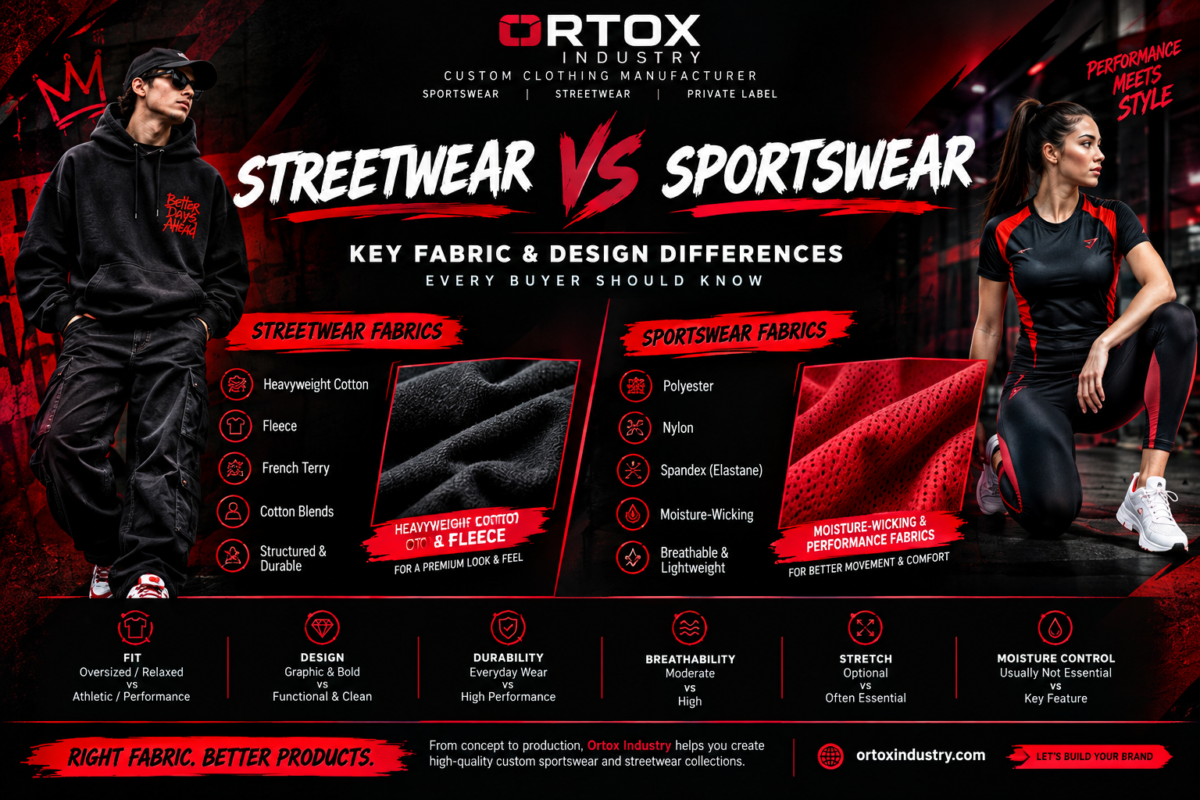
Streetwear vs Sportswear: Key Fabric & Design Differences Every Buyer Should Know
When you are planning a clothing collection, choosing between streetwear and sportswear is not simply a matter of selecting a different style. The two categories are built around different customer expectations, different fabric requirements, different construction techniques, and different performance goals.
A streetwear customer may care more about heavyweight fabric, oversized silhouettes, graphic artwork, premium finishing and a distinctive visual identity. A sportswear customer, on the other hand, may expect lightweight materials, moisture management, stretch, breathability, durability and freedom of movement.
Understanding the difference between streetwear vs sportswear fabric is therefore essential for clothing brands, fashion startups, retailers, teamwear buyers and anyone working with a custom clothing manufacturer.
The wrong fabric can make a good design feel uncomfortable. A beautiful oversized hoodie made from a lightweight performance fabric may not deliver the premium streetwear feel customers expect. Likewise, a heavy cotton sweatshirt may look excellent but perform poorly during intense training.
This guide explains the major differences between streetwear and sportswear fabrics, designs, construction, fit, printing, branding, durability and manufacturing considerations. It also explains how buyers can choose the right materials for their next collection.
For brands looking for a manufacturing partner, Ortox Industry provides custom clothing manufacturing solutions for sportswear and streetwear collections, helping brands turn designs into finished garments.
Table of Contents
What Is Streetwear?
What Is Sportswear?
Streetwear vs Sportswear: The Main Difference
Streetwear vs Sportswear Fabric
Why Sportswear Uses Performance Fabrics
Why Streetwear Often Uses Heavyweight Cotton
Cotton vs Polyester for Clothing Brands
Fleece in Streetwear
Moisture-Wicking Fabric in Sportswear
Fabric Weight and GSM Explained
Breathability and Airflow
Stretch and Freedom of Movement
Durability and Abrasion Resistance
Streetwear Fit and Silhouette
Sportswear Fit and Performance
Design Differences Between Streetwear and Sportswear
Printing and Embroidery
Branding Differences
Color and Visual Identity
Construction and Stitching
Zippers, Pockets and Functional Details
Choosing Fabric for Hoodies
Choosing Fabric for T-Shirts
Choosing Fabric for Shorts
Choosing Fabric for Joggers
Choosing Fabric for Jackets
Streetwear Manufacturing Considerations
Sportswear Manufacturing Considerations
Common Fabric Mistakes Buyers Make
How to Choose the Right Manufacturer
Custom Sportswear Manufacturing
Custom Streetwear Manufacturing
Private Label Clothing
OEM Clothing Manufacturing
How Ortox Industry Can Help
Streetwear vs Sportswear Comparison Table
Frequently Asked Questions
Final Conclusion
- What Is Streetwear?
Streetwear is a fashion category strongly associated with casual clothing, youth culture, music, art, skateboarding, sneakers and modern urban fashion.
Typical streetwear products include:
Oversized T-shirts
Graphic T-shirts
Heavyweight hoodies
Crewneck sweatshirts
Cargo pants
Baggy trousers
Oversized jackets
Varsity jackets
Sweatpants
Track-inspired pieces
Caps and accessories
Unlike performance sportswear, streetwear does not necessarily need to be designed for intense physical activity. Instead, its primary objectives are usually appearance, comfort, identity and lifestyle.
Fabric plays an important role in achieving the desired streetwear appearance.
For example, a heavyweight cotton T-shirt can create a structured oversized silhouette. A thick fleece hoodie can provide the substantial, premium feeling that many contemporary streetwear buyers look for.
This does not mean every streetwear product must be heavyweight cotton. Modern brands increasingly combine cotton, polyester, nylon, fleece, French terry and blended fabrics depending on the design.
The key is matching the fabric to the product’s purpose.
- What Is Sportswear?
Sportswear is clothing designed for physical activity, exercise, training, competition or an active lifestyle.
Examples include:
Football jerseys
Basketball uniforms
Training shirts
Running tops
Gym shorts
Compression garments
Performance leggings
Tracksuits
Training jackets
Sports polos
Cycling garments
Team uniforms
Sportswear is generally more focused on function than traditional streetwear.
The garment needs to allow movement while managing sweat and body heat.
Performance fabrics commonly include polyester, nylon and elastane blends. Polyester is widely used because it is durable and quick drying, while nylon is commonly used in activewear and technical garments.
For buyers, the important question is not simply:
“Which fabric is better?”
The better question is:
“Which fabric is better for the purpose of my garment?”
- Streetwear vs Sportswear: The Main Difference
The simplest way to understand the difference is to look at the primary objective.
Streetwear is usually designed around lifestyle and visual identity.
Sportswear is usually designed around movement and performance.
A streetwear hoodie may prioritize:
Heavyweight construction
Oversized fit
Soft hand feel
Structured shape
Premium appearance
Graphic artwork
Embroidery
Washed finishes
A sportswear training top may prioritize:
Moisture management
Quick drying
Lightweight construction
Breathability
Stretch
Freedom of movement
Durability
Functional panels
This distinction affects almost every manufacturing decision.
The fabric influences the fit. The fit influences the pattern. The pattern influences the stitching. The fabric surface influences printing. The intended activity influences the construction.
That is why understanding streetwear vs sportswear fabric is so important before beginning production.
- Streetwear vs Sportswear Fabric
Fabric is one of the biggest differences between these two clothing categories.
For sportswear, moisture management is often one of the most important considerations. Moisture-wicking materials are designed to move sweat away from the skin and help the fabric dry quickly. Polyester and nylon are commonly used for this purpose.
Streetwear fabrics are usually selected based more heavily on:
Weight
Texture
Drape
Structure
Softness
Appearance
Durability
Premium feel
Heavyweight cotton, French terry and fleece are popular choices for streetwear sweatshirts and hoodies.
A useful comparison looks like this:
Feature Streetwear Sportswear
Main purpose Lifestyle/fashion Performance/activity
Common fabrics Cotton, fleece, French terry Polyester, nylon, elastane
Fabric weight Often medium/heavy Often light/medium
Moisture wicking Usually secondary Often important
Stretch Product dependent Often important
Fit Relaxed/oversized Athletic/performance
Graphic design Very important Important but functional
Breathability Product dependent High priority
Durability Important Very important
Structure Often substantial Often lightweight
However, these are general guidelines rather than strict rules.
Modern fashion frequently combines both categories.
- Why Sportswear Uses Performance Fabrics
During exercise, the human body generates heat and sweat.
If a garment absorbs a large amount of sweat and stays wet, it can become heavy and uncomfortable.
Moisture-wicking fabrics work differently. They help move perspiration away from the skin toward the outer surface of the garment, where it can evaporate more efficiently.
This is one reason polyester and nylon are common in performance clothing.
According to REI, polyester and nylon are widely used in activewear because they can wick moisture and dry quickly.
For a sportswear buyer, fabric selection should therefore consider:
Moisture management
Does the material move sweat away from the skin?
Drying speed
Does the garment dry quickly after exercise?
Breathability
Can heat and moisture escape?
Stretch
Can the wearer move naturally?
Durability
Can the garment survive repeated training and washing?
Weight
Will the garment remain comfortable during activity?
These characteristics are especially important for football, basketball, running, gym training and other high-movement activities.
- Why Streetwear Often Uses Heavyweight Cotton
Heavyweight cotton has become an important fabric choice in contemporary streetwear.
The reason is simple: weight changes the appearance and behavior of the garment.
A heavyweight T-shirt can hang differently from a lightweight T-shirt. It can create a more structured shoulder, thicker sleeve and stronger oversized silhouette.
Similarly, heavyweight fleece can give a hoodie a substantial and premium feel.
Streetwear buyers often associate heavier fabrics with:
Premium quality
Durability
Structure
Oversized silhouettes
Luxury casualwear
High-end construction
Cotton is also comfortable and breathable, although it absorbs moisture rather than efficiently wicking it away. This makes standard cotton more suitable for casual use than intense athletic activity.
This is why a heavyweight cotton hoodie can be an excellent streetwear product but a poor choice for high-intensity training.
- Cotton vs Polyester for Clothing Brands
The cotton-versus-polyester debate is often presented as though one fabric must be better.
That is not the right approach.
They solve different problems.
Cotton
Cotton is widely appreciated for:
Softness
Natural hand feel
Comfort
Casual appearance
Breathability
Versatility
Premium fashion applications
It works particularly well for:
T-shirts
Hoodies
Sweatshirts
Streetwear
Casual trousers
Lifestyle collections
However, cotton absorbs moisture and generally dries more slowly than synthetic performance fabrics.
Polyester
Polyester is popular for:
Sportswear
Training shirts
Football jerseys
Performance tops
Lightweight jackets
Activewear
It is strong, durable and quick drying.
This makes polyester especially useful when performance is more important than the traditional feel of cotton.
Blended Fabrics
Brands can also combine fibers.
A cotton-polyester blend can balance:
Comfort
Durability
Cost
Appearance
Performance
For some products, a blend may provide a better overall solution than choosing 100% cotton or 100% polyester.
- Fleece in Streetwear
Fleece is one of the most important materials for hoodies, sweatshirts and winter streetwear.
Interestingly, fleece itself can be made from polyester. Textile construction and fiber type are not exactly the same thing.
Fleece is a fabric construction that creates a soft, insulating surface. REI notes that common fleece jackets are made from polyester and that their warmth comes significantly from the soft, thick fibers.
For streetwear, fleece can be used to create:
Heavy hoodies
Oversized sweatshirts
Joggers
Matching sets
Zip-up hoodies
Winter tracksuits
The buyer should consider:
GSM
Surface texture
Brushing
Softness
Shrinkage
Pilling resistance
Color fastness
A manufacturer should also understand how the fleece behaves during cutting, sewing, washing and finishing.
- Moisture-Wicking Fabric in Sportswear
Moisture-wicking fabric is one of the defining performance characteristics of many sports garments.
The concept is straightforward.
Instead of allowing sweat to remain against the skin, the fabric helps transport moisture toward the outer surface, where it can dry.
REI describes moisture wicking as having two key functions: moving sweat to the fabric’s outer surface and drying quickly.
Common sportswear choices include:
Polyester
Nylon
Polyester-spandex
Nylon-spandex
Performance mesh
Technical knits
The exact construction depends on the sport.
A football jersey may require lightweight polyester mesh.
A running garment may use lightweight moisture-wicking polyester.
A compression garment may use a stretch polyester-spandex blend.
The design and fabric need to work together.
- Fabric Weight and GSM Explained
GSM means grams per square meter.
It is commonly used to describe fabric weight.
In general, a higher GSM means a heavier fabric, although GSM alone does not tell you everything about quality or performance.
For example:
Lightweight performance fabric may have relatively low GSM.
Standard T-shirt fabric may sit in a medium range.
Heavyweight streetwear cotton may have significantly higher GSM.
Heavy fleece can be even more substantial.
However, brands should not choose fabric simply because a number is high.
A 400 GSM hoodie may feel premium, but it may be too warm for certain climates.
A lightweight 140 GSM performance shirt may be excellent for training but unsuitable for an oversized winter streetwear design.
The correct GSM depends on:
Climate
Product category
Target customer
Season
Fit
Intended use
Retail price
Brand positioning
- Breathability and Airflow
Breathability is important for both categories, but for different reasons.
A streetwear hoodie may need enough breathability for everyday comfort.
A sportswear shirt may need much greater moisture and heat management because the wearer is physically active.
Fabric construction can have a major impact.
Mesh panels, ventilation zones and lightweight knits can improve airflow in performance garments.
Sportswear manufacturers often place breathable panels in areas where heat and sweat accumulate.
For example, a training shirt might use mesh under the arms or along the sides.
This is a good example of how design and fabric work together.
- Stretch and Freedom of Movement
Stretch is another major difference.
A streetwear garment can be loose enough to provide movement through its silhouette.
Sportswear often needs mechanical or fiber-based stretch because the garment must move with the body.
Elastane, also known as spandex in some markets, can be blended with polyester or nylon to create stretch.
This is useful for:
Training shorts
Compression wear
Leggings
Cycling garments
Performance tops
Sports uniforms
The amount of stretch required depends on the activity.
A football jersey does not require the same stretch characteristics as compression leggings.
This is why product development should begin with the end use rather than simply choosing a fashionable fabric.
- Durability and Abrasion Resistance
Both streetwear and sportswear need durability, but the stress points are different.
Streetwear may experience:
Daily wear
Repeated washing
Friction from bags
Graphic cracking
Seam stress
Sportswear may experience:
High movement
Sweating
Stretching
Repeated washing
Contact with surfaces
Abrasion
Outdoor exposure
Synthetic fabrics such as polyester and nylon are commonly valued for durability and abrasion resistance.
For streetwear, heavyweight cotton can provide excellent durability and structure.
For sportswear, a technical synthetic fabric may offer better performance-to-weight characteristics.
The manufacturer’s responsibility is to match construction with the intended use.
- Streetwear Fit and Silhouette
Streetwear has developed a strong association with oversized and relaxed silhouettes.
Common streetwear fits include:
Oversized
Boxy
Relaxed
Dropped shoulder
Wide leg
Baggy
Cropped oversized
Layered
A heavyweight fabric can enhance these silhouettes.
For example, an oversized T-shirt made from a very thin fabric may collapse against the body.
A heavier fabric can help maintain the shape.
This is why pattern and fabric selection should happen together.
- Sportswear Fit and Performance
Sportswear typically focuses on movement.
Depending on the product, the fit may be:
Athletic
Regular
Relaxed
Compression
Tapered
A football jersey may have enough room for movement while remaining relatively streamlined.
A running shirt may use a performance fit.
A gym hoodie may have a more relaxed silhouette.
The correct fit depends on the sport.
A manufacturer should consider:
Arm movement
Shoulder rotation
Leg movement
Stretch
Seam placement
Body heat
Layering
A garment that looks good on a mannequin may not perform well when someone is actually moving.
- Design Differences Between Streetwear and Sportswear
Streetwear design often starts with visual identity.
A brand might build an entire collection around:
A logo
Graphic artwork
Typography
Embroidery
Cultural references
Distinctive colors
Unique silhouettes
Sportswear design often begins with performance requirements and team or brand identity.
It may include:
Team colors
Player numbers
Names
Sponsor logos
Performance panels
Reflective details
Functional pockets
Ventilation zones
Modern brands can combine both approaches.
This has created a growing overlap between sportswear and streetwear.
- Printing and Embroidery
Printing and embroidery can both be used across streetwear and sportswear.
However, the best method depends on the garment.
Screen Printing
Popular for:
Graphic T-shirts
Hoodies
Streetwear artwork
Large logos
It can produce bold graphics and strong visual impact.
DTG Printing
Useful for detailed artwork on suitable cotton garments.
DTF Printing
Can be useful for smaller production runs and detailed graphics.
Sublimation
Especially relevant to polyester sportswear because the design can become part of the fabric surface rather than sitting like a conventional print.
This is widely used for custom sports jerseys.
Embroidery
Often used for:
Premium streetwear
Caps
Hoodies
Jackets
Brand logos
However, embroidery adds weight and structure to the fabric, so placement and garment construction matter.
- Branding Differences
Streetwear branding is often highly visible.
A logo may be:
Large on the chest
Centered
Back printed
Sleeve printed
Embroidered
Woven as a label
Integrated into the artwork
Sportswear branding can be more functional.
For example:
Team badge on chest
Player number
Player name
Sponsor logo
Manufacturer logo
A sportswear collection may therefore require multiple branding locations.
This affects production planning.
- Color and Visual Identity
Streetwear brands often use color as part of their identity.
Some brands may prefer:
Black
White
Grey
Earth tones
Washed colors
Vintage shades
Bold seasonal colors
Sportswear frequently uses strong team colors and high-contrast combinations.
For example, a football club may have a fixed color identity that must be reproduced consistently.
Color matching therefore becomes an important manufacturing requirement.
Brands should approve production samples before bulk manufacturing whenever color accuracy is important.
- Construction and Stitching
Good fabric cannot compensate for poor construction.
A premium streetwear hoodie requires appropriate:
Seam construction
Rib quality
Cuff construction
Hood construction
Drawcord finishing
Stitch density
Sportswear requires construction that can survive movement and repeated use.
Important considerations include:
Reinforced seams
Flat seams where appropriate
Stretch-compatible stitching
Strong hems
Durable neck construction
Proper seam allowance
The construction method should match the fabric.
- Zippers, Pockets and Functional Details
Streetwear often uses functional details as visual design elements.
Examples include:
Cargo pockets
Utility pockets
Metal zippers
Heavy drawcords
D-rings
Adjustable hems
Oversized hoods
Sportswear uses functional details primarily to improve performance.
Examples include:
Zipper pockets
Hidden pockets
Ventilation zips
Reflective elements
Elastic waistbands
Adjustable cuffs
A buyer should always communicate the purpose of every detail to the manufacturer.
- Choosing Fabric for Hoodies
Hoodies are one of the areas where streetwear and sportswear overlap heavily.
For a streetwear hoodie, consider:
Heavyweight fleece
French terry
Cotton-rich blends
Oversized pattern
Heavy rib
Premium drawcord
Embroidery or screen printing
For a sports hoodie, consider:
Lightweight fleece
Polyester blends
Breathability
Stretch
Quick drying
Functional pockets
A gym warm-up hoodie does not necessarily need the same fabric as a premium streetwear hoodie.
- Choosing Fabric for T-Shirts
T-shirts are another product where the differences become obvious.
Streetwear T-Shirt
Usually focuses on:
Heavyweight cotton
Oversized fit
Boxy cut
Dropped shoulder
Graphic printing
Premium neck rib
Sportswear T-Shirt
Usually focuses on:
Polyester
Lightweight construction
Moisture management
Breathability
Stretch
Athletic fit
If a customer wants a T-shirt for running, choose performance characteristics.
If the customer wants an oversized graphic T-shirt for a streetwear collection, heavyweight cotton may be more appropriate.
- Choosing Fabric for Shorts
Sports shorts need freedom of movement.
Popular choices include:
Polyester
Nylon
Polyester-spandex
Lightweight woven fabric
Features can include:
Elastic waist
Drawcord
Side pockets
Zip pockets
Inner lining
Breathable panels
Streetwear shorts may use:
Cotton
French terry
Heavy jersey
Nylon
Cargo fabrics
The styling can be looser and more fashion-oriented.
- Choosing Fabric for Joggers
Joggers can belong to either category.
Streetwear joggers often use:
Heavy fleece
French terry
Cotton blends
Sports joggers may use:
Polyester
Stretch woven fabric
Performance blends
Lightweight fleece
A streetwear jogger may prioritize a relaxed leg and heavy fabric.
A training jogger may prioritize mobility and moisture management.
- Choosing Fabric for Jackets
Jackets can become particularly technical.
Streetwear jackets may focus on:
Nylon
Denim
Cotton canvas
Heavy twill
Varsity materials
Synthetic blends
Sports jackets may require:
Lightweight polyester
Nylon
Water-resistant fabrics
Wind-resistant materials
Stretch fabrics
Breathable constructions
The intended environment should determine the fabric.
- Streetwear Manufacturing Considerations
If you are developing a streetwear collection, provide your manufacturer with a detailed specification.
Your tech pack should ideally include:
Product sketches
Measurements
Fabric composition
Fabric GSM
Color references
Stitching requirements
Print artwork
Embroidery files
Labels
Packaging instructions
For oversized streetwear, measurements are especially important.
Do not simply tell a manufacturer:
“Make it oversized.”
Instead, specify:
Chest width
Body length
Shoulder width
Sleeve length
Armhole
Neck opening
Hem width
This creates a repeatable product.
- Sportswear Manufacturing Considerations
Sportswear requires an even more detailed understanding of function.
A technical sportswear specification may include:
Fabric composition
GSM
Stretch percentage
Moisture management requirements
Color references
Mesh locations
Seam construction
Player numbering
Sponsor placement
Logo dimensions
Size grading
Washing instructions
For teamwear, consistency is critical.
A club may order different sizes and player names while expecting all garments to look identical.
- Common Fabric Mistakes Buyers Make
One of the biggest mistakes is selecting fabric based only on appearance.
A fabric can look excellent in a sample but fail in actual use.
Mistake 1: Using cotton for high-intensity sports
Standard cotton absorbs sweat and dries slowly, making it less suitable for intense activity.
Mistake 2: Choosing extremely heavy fabric for hot climates
Heavy fabric can feel uncomfortable when temperatures are high.
Mistake 3: Ignoring stretch
A design that requires movement may become uncomfortable without enough stretch.
Mistake 4: Ignoring shrinkage
Cotton garments can change dimensions after washing if shrinkage is not controlled.
Mistake 5: Choosing fabric without considering printing
Some printing techniques work better with particular fiber types and surfaces.
Mistake 6: Focusing only on GSM
GSM is useful but does not completely define fabric quality.
Mistake 7: Skipping samples
Bulk production should ideally begin only after the buyer approves a development sample or pre-production sample.
- How to Choose the Right Manufacturer
Choosing the right manufacturer is one of the most important decisions for a clothing brand.
Look for a manufacturer that understands your product category.
If you are producing sportswear, ask about:
Performance fabrics
Sublimation
Teamwear
Moisture-wicking materials
Stretch fabrics
Performance construction
If you are producing streetwear, ask about:
Heavyweight cotton
Fleece
French terry
Oversized patterns
Screen printing
Embroidery
Garment washing
Custom labels
A manufacturer experienced in both categories can also help brands create hybrid products.
- Custom Sportswear Manufacturing
Custom sportswear gives brands and organizations the opportunity to create garments around their own identity.
Products can include:
Football jerseys
Basketball uniforms
Training kits
Gymwear
Running apparel
Tracksuits
Sports shorts
Performance T-shirts
Team jackets
For sportswear buyers, customization can include:
Fabric
Colors
Logos
Player names
Numbers
Sponsor branding
Labels
Packaging
The most important consideration is ensuring that customization does not compromise performance.
- Custom Streetwear Manufacturing
Custom streetwear allows brands to develop garments that look different from mass-market products.
A brand can customize:
Fabric
GSM
Fit
Colors
Prints
Embroidery
Labels
Washes
Packaging
Hardware
This is especially useful for emerging fashion brands that want to establish a recognizable identity.
Instead of simply buying generic blanks and adding a logo, a brand can develop its own pattern and specifications.
- Private Label Clothing
Private label clothing is another option for brands that want customized products under their own brand name.
A private label manufacturer can help with:
Product development
Fabric sourcing
Pattern development
Sampling
Manufacturing
Branding
Labels
Packaging
For new brands, private label manufacturing can simplify the transition from concept to finished product.
The brand can focus on marketing, sales and customer relationships while the manufacturing partner handles production.
- OEM Clothing Manufacturing
OEM manufacturing can be suitable for brands that already have specific product designs and specifications.
The buyer may provide:
Tech packs
Measurements
Artwork
Fabric requirements
Color references
Branding requirements
The manufacturer then produces the garments according to the specifications.
This can be particularly useful for established brands that already have a defined product development process.
- How Ortox Industry Can Help
For brands looking for a manufacturer capable of working across both streetwear and sportswear, Ortox Industry can be positioned as a custom clothing manufacturing partner.
The manufacturing process can begin with understanding the buyer’s product requirements.
For example:
Step 1: Product Concept
The buyer provides the design, reference images or product idea.
Step 2: Fabric Selection
The appropriate material is selected according to product purpose.
Step 3: Sampling
A sample is developed to evaluate fit, construction and appearance.
Step 4: Approval
The buyer reviews and approves the sample.
Step 5: Bulk Manufacturing
Production begins according to the approved specifications.
Step 6: Quality Control
Finished garments are checked for construction, measurements, branding and overall quality.
Step 7: Packing and Shipment
The finished order is prepared for delivery.
This process helps reduce mistakes because fabric, fit and design decisions are addressed before bulk production.
- Streetwear vs Sportswear Comparison Table
Category Streetwear Sportswear
Main purpose Fashion and lifestyle Athletic performance
Typical fabric Cotton/fleece/French terry Polyester/nylon/stretch blends
Fabric weight Often medium to heavyweight Often lightweight to medium
Moisture wicking Usually not essential Often essential
Breathability Important Very important
Stretch Depends on design Often important
Fit Oversized/relaxed Athletic/performance
Graphics Major design element Branding/team identity
Embroidery Common Common
Sublimation Less common Very common in polyester teamwear
Heavy fleece Common Used for selected products
Lightweight mesh Less common Common
Functional details Fashion + utility Performance focused
Main customer Fashion/lifestyle buyer Athlete/team/active consumer
The comparison shows why there is no universal “best fabric.”
The right fabric depends on what the garment is expected to do.
- Frequently Asked Questions
What is the main difference between streetwear and sportswear?
Streetwear is primarily designed around lifestyle, fashion, comfort and visual identity, while sportswear is designed around movement, performance, moisture management and functionality.
What fabric is best for sportswear?
Polyester and nylon are common choices because they can provide moisture-wicking, quick-drying and durable characteristics. Stretch blends containing elastane can be useful when additional movement is required.
What fabric is best for streetwear?
There is no single best fabric, but heavyweight cotton, fleece and French terry are popular for streetwear hoodies, sweatshirts, joggers and T-shirts.
Is cotton good for sportswear?
Cotton can be comfortable for casual or low-intensity use, but standard cotton absorbs moisture and dries more slowly than many synthetic performance fabrics.
Is polyester good for streetwear?
Yes. Polyester can be used in streetwear, especially for jackets, track-inspired products, technical garments and fashion pieces where durability or lightweight performance is desired.
What is heavyweight streetwear?
Heavyweight streetwear generally refers to garments made from heavier fabrics and often featuring substantial construction and relaxed or oversized silhouettes.
What does moisture-wicking mean?
Moisture-wicking refers to a fabric’s ability to move perspiration away from the skin toward the outer surface and help it dry quickly.
Is fleece suitable for sportswear?
It can be. Fleece is useful for warm layers, training hoodies and cold-weather products. However, a heavy fleece garment may not be suitable for high-intensity activity.
What is GSM in clothing?
GSM means grams per square meter and is commonly used to describe fabric weight.
Is higher GSM always better?
No. Higher GSM generally means heavier fabric, but the ideal weight depends on the product, climate, use case, fit and customer expectations.
Can one manufacturer produce both sportswear and streetwear?
Yes. A capable custom clothing manufacturer can produce both categories if it has suitable fabric sourcing, pattern development, printing, embroidery and garment construction capabilities.
What is better for a new clothing brand: sportswear or streetwear?
It depends on the target customer and business model. A brand focused on fitness, teams or athletic performance may be better suited to sportswear. A brand focused on fashion, culture and lifestyle may prefer streetwear.
Can streetwear and sportswear be combined?
Absolutely.
Modern fashion frequently combines athletic functionality with streetwear styling. A collection might use performance polyester with oversized silhouettes, or technical nylon with streetwear-inspired graphics.
This hybrid category can give brands an opportunity to differentiate their products.
- Final Conclusion
The debate around streetwear vs sportswear fabric is not really about which category has better fabric.
It is about choosing the right material for the right purpose.
Streetwear generally emphasizes:
Style
Comfort
Fabric weight
Structure
Graphics
Oversized silhouettes
Brand identity
Sportswear generally emphasizes:
Moisture management
Breathability
Quick drying
Stretch
Mobility
Durability
Performance
Heavyweight cotton and fleece can be excellent choices for premium streetwear because they create structure, substance and a distinctive feel.
Polyester, nylon and stretch performance fabrics can be excellent for sportswear because they can support moisture management, quick drying and freedom of movement.
But modern clothing brands do not always have to choose one category.
The strongest collections can combine the visual language of streetwear with the technical advantages of sportswear.
For example, a brand could create an oversized performance T-shirt, a technical streetwear jacket, a heavyweight sports-inspired hoodie or a relaxed tracksuit made from performance materials.
The key is understanding the customer first.
Ask:
Where will the garment be worn?
What does the customer expect from the fabric?
Does the garment need to manage sweat?
Does it need stretch?
Should it feel heavyweight and premium?
Is the product designed for fashion, training or both?
Once these questions are answered, fabric selection becomes much easier.
For clothing brands, retailers, sports teams and fashion startups, working with a manufacturer that understands both categories can make the product-development process significantly easier.
Ortox Industry can be a manufacturing partner for brands developing custom clothing, including sportswear, streetwear, custom apparel and private label clothing. Visit ortoxindustry.com to learn more about custom clothing manufacturing and discuss your next collection.
The most successful clothing products are not created by choosing the most expensive fabric.
They are created by choosing the right fabric, right construction, right fit and right manufacturing process for the customer.
And that is the real difference between streetwear and sportswear.
Suggested SEO Setup
Primary Keyword:
streetwear vs sportswear fabric
Secondary Keywords:
sportswear fabric
streetwear fabric
streetwear vs sportswear
sportswear manufacturer
streetwear manufacturer
custom sportswear manufacturer
custom streetwear manufacturer
custom clothing manufacturer
private label clothing manufacturer
sportswear clothing manufacturer
streetwear clothing manufacturer
performance fabric for sportswear
heavyweight cotton streetwear
moisture wicking sportswear
sportswear manufacturing
streetwear manufacturing
Suggested SEO Title:
Streetwear vs Sportswear Fabric: Key Differences Buyers Should Know
Suggested Meta Description:
Discover the key differences between streetwear vs sportswear fabric, including heavyweight cotton, fleece, polyester, moisture-wicking performance fabrics, fit and design.
Suggested URL Slug:
/streetwear-vs-sportswear-fabric/
Recommended internal-link anchor:
Custom Sportswear & Streetwear Manufacturer
Recommended backlink:
Use Ortox Industry or custom clothing manufacturer as the natural anchor linking to ortoxindustry.com.
Important SEO note: Don’t stuff the exact keyword into every paragraph. Keep the primary keyword in the title, introduction, one or two H2s, meta title/description, URL, and naturally throughout the article. This gives Google clearer topical relevance without making the article look artificially optimized.