
Bilkul. Maine Ortox Industry ki current website content ko base banaya hai. Website par Ortox OEM/private-label clothing, streetwear, fitness apparel aur sportswear manufacture karta hai, aur current manufacturing process exactly Design & Development → Material Selection → Stitching & Assembly → Printing → Quality Check & Packing diya gaya hai. (Ortox Industry)
Neeche SEO-focused long-form blog diya hai, jisme primary keyword “apparel manufacturing process” hai aur sportswear/streetwear ke keywords naturally target kiye gaye hain.
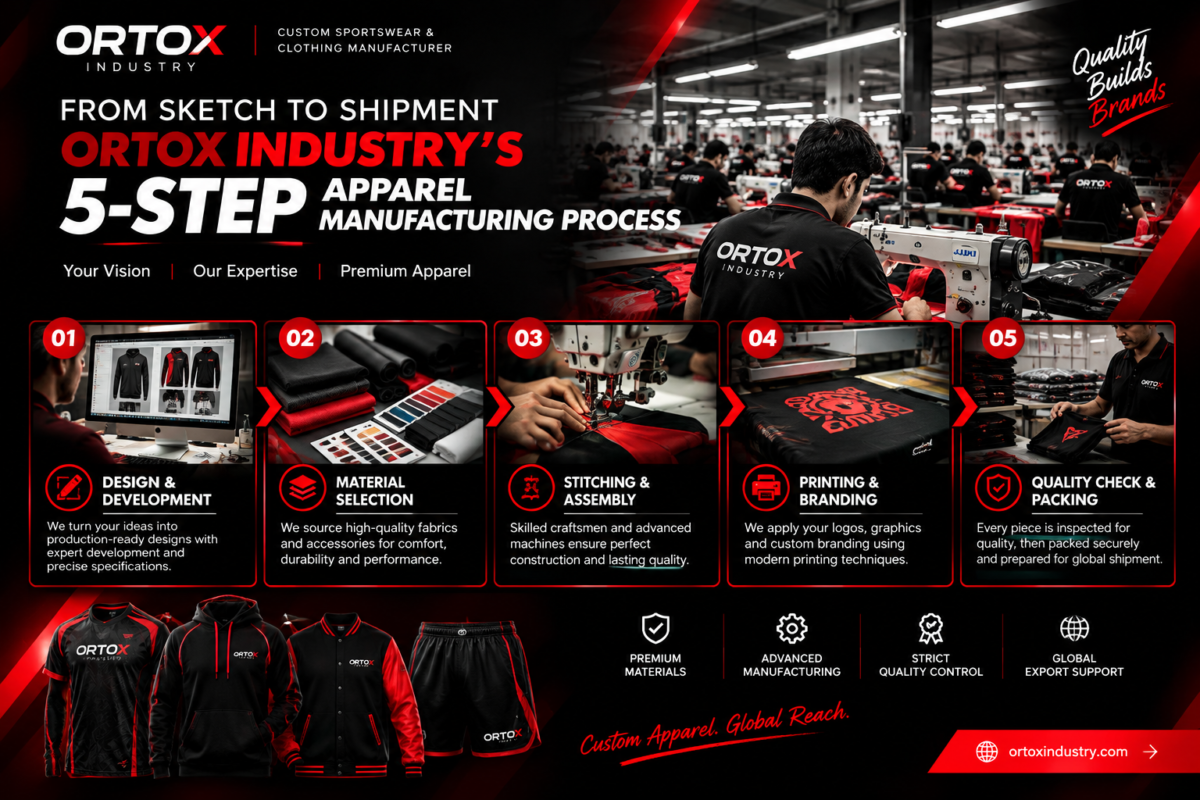
From Sketch to Shipment: Ortox Industry’s 5-Step Apparel Manufacturing Process
Primary Keyword: apparel manufacturing process
Secondary Keywords:
sportswear manufacturer, sportswear manufacturing, sportswear manufacturer Pakistan, custom sportswear manufacturer, streetwear manufacturer, custom streetwear manufacturer, private label clothing manufacturer, OEM clothing manufacturer, custom apparel manufacturer, clothing manufacturer Pakistan, sportswear supplier, custom sportswear, private label sportswear, private label streetwear, custom clothing manufacturer, athletic apparel manufacturer, sportswear production, clothing manufacturing process, apparel production, custom apparel manufacturing
Suggested SEO Title:
From Sketch to Shipment: Ortox Industry’s 5-Step Apparel Manufacturing Process
Suggested Meta Description:
Discover the complete apparel manufacturing process at Ortox Industry, from design and material selection to stitching, printing, quality control, packing, and worldwide shipment.
Suggested URL Slug:/apparel-manufacturing-process/
Recommended Article Length: 5,500–6,000 words
From Sketch to Shipment: Ortox Industry’s 5-Step Apparel Manufacturing Process
When a clothing brand has a great idea, the journey from a simple sketch to a finished garment involves much more than sewing fabric together.
A successful apparel product requires careful planning, the right materials, accurate construction, professional branding, detailed quality control, and reliable packing before it is ready to reach customers.
For sportswear brands, streetwear labels, private-label businesses, wholesalers, retailers, gyms, clubs, academies, and fashion companies, choosing the right manufacturing partner can make a major difference.
At Ortox Industry, the apparel manufacturing process is designed around precision, consistency, customization, and quality. From the first design concept to the final packed order, each stage is managed with attention to detail.
Ortox Industry currently specializes in fashion wear, streetwear, fitness apparel, athletic clothing, custom OEM manufacturing, and private-label apparel for international customers. Its website highlights custom product development, quality material sourcing, advanced manufacturing, strict quality control, and global export support. (Ortox Industry)
This guide explains the five major stages of the apparel manufacturing process at Ortox Industry:
- Design & Development
- Material Selection
- Stitching & Assembly
- Printing & Branding
- Quality Check & Packing
The goal is simple: turn your concept into a finished product that is ready for your customers.
What Is the Apparel Manufacturing Process?
The apparel manufacturing process is the complete sequence of activities involved in turning a clothing concept into a finished garment.
Depending on the product, it can include design development, fabric selection, pattern development, cutting, stitching, printing, embroidery, labeling, finishing, quality inspection, packing, and shipment.
For a basic T-shirt, the process may appear simple. However, manufacturing a professional custom T-shirt for a clothing brand involves multiple decisions.
The manufacturer must understand:
- The design
- Garment measurements
- Fabric requirements
- Fit
- Color
- Branding
- Printing
- Labels
- Packaging
- Quantity
- Quality requirements
- Delivery requirements
The same applies to sportswear and streetwear.
A custom sports jersey may require breathable performance fabric, player names, numbers, logos, sponsor branding, and specialized finishing.
A streetwear hoodie may require heavyweight fabric, oversized fitting, custom labels, screen printing, embroidery, patches, or other branding details.
This is why choosing an experienced custom apparel manufacturer is important.
Why the Manufacturing Process Matters for Clothing Brands
Your product quality is directly connected to your manufacturing process.
A strong design can lose its value if:
- The fabric is poor
- The sizing is inconsistent
- Stitching is weak
- Printing cracks
- Colors are incorrect
- Labels are misplaced
- Finishing is rushed
- Packing is careless
For an emerging clothing brand, manufacturing mistakes can be expensive.
A poor production run can result in customer complaints, returns, negative reviews, wasted inventory, and damage to brand reputation.
A professional apparel manufacturing process helps reduce these risks by organizing production into clearly managed stages.
At Ortox Industry, the manufacturing philosophy focuses on quality materials, precision manufacturing, strict quality control, OEM/private-label solutions, and dependable support. (Ortox Industry)
Step 1: Design & Development
Every successful garment starts with an idea.
The first stage of the apparel manufacturing process is Design & Development.
This is where a brand’s concept is transformed into a practical product that can be manufactured.
At Ortox Industry, the design and development stage focuses on understanding the client’s requirements and refining the concept for style, function, and performance. (Ortox Industry)
Turning a Sketch Into a Product
A clothing brand may approach a manufacturer with:
- A hand-drawn sketch
- A digital design
- A reference garment
- A tech pack
- Product photographs
- A logo
- A mood board
- A basic product concept
The manufacturer then works toward converting that idea into a production-ready garment.
For example, imagine a brand wants to create a custom oversized streetwear hoodie.
The concept might specify:
- Oversized fit
- Heavyweight fabric
- Drop shoulders
- Kangaroo pocket
- Ribbed cuffs
- Custom chest logo
- Large back graphic
- Woven neck label
- Custom packaging
Every one of these elements needs to be considered before production.
Design Is More Than Appearance
A professional apparel design considers both appearance and functionality.
For sportswear, functionality is especially important.
A sportswear product may need:
- Lightweight construction
- Breathability
- Flexibility
- Moisture management
- Comfortable fit
- Freedom of movement
- Durable construction
Ortox Industry’s current product range includes performance shirts, sports jerseys, soccer uniforms, volleyball uniforms, baseball uniforms, hockey uniforms, athletic tank tops, sports shorts, and other athletic products. (Ortox Industry)
For streetwear, the priorities can be different.
Streetwear brands may focus more heavily on:
- Oversized silhouettes
- Heavyweight fabrics
- Unique graphics
- Premium finishing
- Embroidery
- Patches
- Custom labels
- Distinctive branding
- Fashion-forward construction
This is why a good streetwear manufacturer needs to understand both fashion and production.
Understanding Your Brand Before Production
A professional manufacturer should understand what the customer is trying to achieve.
For a private-label clothing brand, manufacturing isn’t simply about producing garments.
The product needs to represent the identity of the brand.
For example, a premium streetwear brand may want:
- Minimal branding
- Premium fabric
- Clean stitching
- Oversized fit
- High-quality labels
- Premium packaging
Meanwhile, a sportswear brand may prioritize:
- Performance fabrics
- Breathability
- Lightweight construction
- Athletic fitting
- Team colors
- Player names
- Numbers
- Logos
The manufacturing process must adapt to the product.
Product Development for Sportswear
Sportswear requires careful consideration because garments are often used during physical activity.
At Ortox Industry, custom performance products are described as using lightweight, breathable, moisture-wicking and quick-dry performance fabric options, depending on the product. (Ortox Industry)
For a sportswear brand, the development stage can include decisions about:
- Fabric weight
- Stretch
- Breathability
- Fit
- Construction
- Sleeve style
- Collar
- Hem
- Team colors
- Logos
- Names
- Numbers
- Sponsor branding
A professional sportswear manufacturer should be able to understand these requirements before production begins.
Product Development for Streetwear
Streetwear has become an important category for modern clothing brands.
The product may look simple, but the details often determine its perceived quality.
A streetwear manufacturer may work with products such as:
- T-shirts
- Hoodies
- Sweatshirts
- Sweatpants
- Varsity jackets
- Bomber jackets
- Tracksuits
- Shorts
- Tank tops
- Polo shirts
- Jackets
Ortox Industry’s website currently lists several of these categories under its streetwear offering, including T-shirts, polo shirts, shorts, sweatshirts, performance shirts, tank tops, sweatpants, varsity jackets, tracksuits, pullover hoodies and zip-up hoodies. (Ortox Industry)
The design stage determines how these products will eventually look and feel.
Why Development Accuracy Matters
Small mistakes during development can become large problems during bulk production.
For example:
If the sleeve measurement is incorrect during development, every garment produced from that specification may have the same problem.
If the logo placement is wrong, the entire production batch may need correction.
If the fabric weight is unsuitable, the final product may not meet the brand’s expectations.
That is why development is one of the most important stages in the clothing manufacturing process.
Step 2: Material Selection
Once the design is understood, the next major stage is Material Selection.
The materials used in a garment directly affect its:
- Comfort
- Appearance
- Durability
- Weight
- Performance
- Fit
- Price
- Overall quality
Ortox Industry describes its material-selection stage as choosing fabrics, leather, and accessories with consideration for durability, comfort, performance, strength, and long-lasting use. (Ortox Industry)
Choosing the Right Fabric
There is no single fabric that is perfect for every clothing product.
A sportswear garment may require a completely different material from a premium streetwear hoodie.
For example:
Sportswear
Sportswear commonly requires fabrics selected for:
- Lightweight performance
- Breathability
- Flexibility
- Comfort
- Moisture management
- Quick drying
Streetwear
Streetwear may require:
- Cotton
- Heavyweight jersey
- Fleece
- Blended fabrics
- Structured materials
- Premium fashion fabrics
The right choice depends on the product and brand requirements.
Fabric Quality and Brand Reputation
Fabric is one of the first things customers notice when they wear a garment.
A product can have excellent graphics, but if the fabric feels uncomfortable, the customer may not purchase from the brand again.
For a clothing brand, fabric quality is therefore not just a manufacturing issue.
It is a branding issue.
Premium materials can contribute to:
- Better customer experience
- Better product perception
- Improved durability
- Stronger brand reputation
- Higher perceived value
This is especially important for private-label brands competing in international markets.
Material Selection for Sportswear
Sportswear needs materials appropriate for movement and physical activity.
For example, a performance shirt may require:
- Breathable construction
- Lightweight fabric
- Moisture-wicking properties
- Quick-dry performance
- Flexible construction
Ortox Industry’s product descriptions specifically highlight these characteristics across its custom performance and sports products. (Ortox Industry)
For teams, academies, gyms, clubs and sports brands, the material must support the intended use of the garment.
Material Selection for Streetwear
Streetwear materials are often selected based on:
- Hand feel
- Weight
- Structure
- Comfort
- Appearance
- Durability
- Seasonal use
For example, a heavyweight hoodie requires different material characteristics than a lightweight summer T-shirt.
A premium streetwear manufacturer should understand these differences.
Accessories and Components
Material selection is not limited to the main fabric.
A garment can also include:
- Zippers
- Buttons
- Drawcords
- Elastic
- Labels
- Patches
- Thread
- Tags
- Packaging
- Other accessories
Every component contributes to the final product.
For private-label clothing brands, even small details such as neck labels and packaging can help create a consistent brand experience.
Step 3: Stitching & Assembly
Once materials are selected, production moves into Stitching & Assembly.
This is where separate fabric components begin becoming a finished garment.
Ortox Industry describes this stage as using skilled teams and advanced stitching technology to assemble garments with strength, precision and attention to detail. (Ortox Industry)
Why Stitching Quality Matters
Stitching affects both the appearance and durability of apparel.
Poor stitching can cause:
- Loose seams
- Uneven construction
- Weak garment areas
- Poor finishing
- Customer complaints
- Reduced product life
Professional stitching helps create garments that are consistent and durable.
For sportswear, stitching is particularly important because garments may experience repeated movement, stretching, washing and physical activity.
For streetwear, clean stitching contributes to the premium appearance of the garment.
Stitching Sportswear
Sportswear needs construction that supports movement.
Depending on the product, the manufacturing process may involve:
- Body panels
- Sleeves
- Collars
- Cuffs
- Side panels
- Shorts panels
- Waistbands
- Team-specific components
The goal is to produce a garment that combines comfort, function and appearance.
Ortox Industry manufactures a wide range of sports products, including soccer uniforms, volleyball uniforms, baseball uniforms, hockey uniforms, performance shirts and athletic products. (Ortox Industry)
Stitching Streetwear
Streetwear construction often focuses heavily on silhouette and finishing.
For example, an oversized hoodie may require accurate:
- Shoulder measurements
- Sleeve length
- Body width
- Hood construction
- Ribbing
- Pocket placement
- Seam finishing
If these measurements are inconsistent, the entire look of the product can change.
This is why experienced production teams are important for a custom streetwear manufacturer.
Consistency in Bulk Production
One of the biggest challenges in apparel manufacturing is maintaining consistency across a large order.
A brand does not want:
- One hoodie to fit differently from another
- One T-shirt to have a different shade
- One jersey to have a logo placed differently
- One pair of shorts to have weaker stitching
Consistency is especially important for wholesale and private-label businesses.
At Ortox Industry, quality and consistency are positioned as key parts of its manufacturing service for brands, wholesalers, distributors and retailers. (Ortox Industry)
Step 4: Printing & Branding
After the garment has been assembled, the next stage is Printing & Branding.
For modern apparel brands, branding is often one of the most important parts of the final product.
A garment can be manufactured from quality fabric and have excellent stitching, but the wrong branding application can negatively affect the final appearance.
Ortox Industry states that its printing stage uses printing techniques selected according to the product and artwork, with attention to sharp designs, vibrant appearance, durability and finishing. (Ortox Industry)
Custom Printing for Clothing Brands
Printing allows brands to turn basic garments into branded products.
Common requirements can include:
- Front logos
- Back graphics
- Sleeve graphics
- Team logos
- Player numbers
- Player names
- Sponsor logos
- Brand artwork
- Promotional designs
For streetwear, large graphic artwork may be a major part of the product identity.
For sportswear, logos, names, numbers and sponsor branding are often essential.
Branding Sportswear
A sports team uniform may include:
- Team logo
- Player name
- Player number
- Sponsor logo
- Team colors
- Competition branding
The positioning and appearance of these elements need to be consistent.
If ten jerseys are ordered for a team, customers expect all ten to follow the same design specifications.
This makes professional production control important.
Branding Streetwear
Streetwear branding can be more creative.
Brands may use:
- Front graphics
- Back prints
- Sleeve graphics
- Minimal logos
- Oversized artwork
- Text graphics
- Patches
- Embroidery
- Woven labels
The objective is to create a product that matches the brand’s visual identity.
A good private label clothing manufacturer should be able to work with brand-specific artwork and specifications.
Branding and Private Label Manufacturing
Private-label manufacturing allows brands to develop apparel under their own identity.
Instead of selling generic clothing, a brand can create products featuring its:
- Logo
- Labels
- Colors
- Designs
- Packaging
- Specifications
Ortox Industry specifically offers OEM and private-label manufacturing and describes its service as supporting custom branding, labels, packaging, designs and specifications. (Ortox Industry)
This makes the manufacturing process particularly useful for startups, established fashion brands, sports businesses and retailers looking to develop their own collections.
Step 5: Quality Check & Packing
The final major stage is Quality Check & Packing.
This stage is critical because a garment should not simply be manufactured.
It should be inspected before it reaches the customer.
Ortox Industry states that products undergo quality inspection for durability, finishing, stitching and overall appearance before being securely packed for shipment. (Ortox Industry)
What Is Checked During Quality Control?
Quality control can focus on different aspects of the finished product, including:
Fabric
The material should match the required specifications.
Stitching
Seams and construction should be inspected.
Measurements
Garments should follow the required size specifications.
Printing
Graphics should have the expected appearance and placement.
Finishing
The garment should have a clean and professional appearance.
Branding
Labels and branding should be correctly applied.
Overall Appearance
The finished product should meet the agreed specifications.
Why Quality Control Is Essential
Imagine a brand ordering 1,000 garments.
If quality problems are not detected before shipment, the brand could receive a large quantity of products with defects.
That can create:
- Returns
- Complaints
- Financial losses
- Delays
- Negative reviews
- Brand reputation problems
A strong quality-control stage helps identify issues before products leave the manufacturing process.
Packing the Finished Apparel
After products pass quality inspection, they are prepared for packing.
Good packing helps protect garments during:
- Handling
- Transportation
- Storage
- International shipping
For private-label brands, packaging can also be part of the brand experience.
Custom packaging may help create a more professional presentation when products reach retailers or end customers.
From Factory to International Customer
After production and packing, the order is ready for shipment.
Ortox Industry states that it supports worldwide export and works with wholesalers, retailers, brands and private-label businesses across global markets. Its website currently lists customers/markets including the USA, Canada, UK, Germany, France, Italy, Australia, UAE and Saudi Arabia, and states that it serves 30+ countries worldwide. (Ortox Industry)
This international focus is important for brands searching for a sportswear manufacturer Pakistan or clothing manufacturer Pakistan.
Why Choose a Professional Apparel Manufacturer?
The apparel manufacturing process involves many individual details.
A professional manufacturer can help bring these details together.
For a clothing brand, the ideal manufacturing partner should understand:
- Product development
- Materials
- Construction
- Branding
- Quality control
- Packaging
- Export requirements
- Communication
- Consistency
Ortox Industry positions itself as a manufacturer and exporter for fashion wear, streetwear, fitness apparel and athletic clothing, serving wholesalers, distributors, retailers and private-label brands worldwide. (Ortox Industry)
Ortox Industry’s Approach to OEM Manufacturing
OEM manufacturing allows brands to work with a manufacturer to produce products according to their specifications.
This can be useful for brands that already have a product concept but need manufacturing support.
The process can begin with:
Your Idea → Product Development → Materials → Manufacturing → Branding → Quality Control → Packing → Shipment
This approach allows brands to focus on their business while the manufacturing partner manages production.
Custom Apparel Manufacturing for Startups
Starting a clothing brand can be challenging.
One of the biggest decisions is finding a manufacturer that understands smaller or developing brands.
A startup may need:
- Custom designs
- Private labels
- Custom packaging
- Sportswear
- Streetwear
- Sampling
- Flexible production support
The manufacturer becomes an important part of the brand’s supply chain.
A strong relationship can help a startup move from its first collection toward larger production orders.
Custom Sportswear Manufacturing
Sportswear brands require specialized manufacturing because their products are designed for active use.
A custom sportswear manufacturer can produce products such as:
- Soccer jerseys
- Basketball uniforms
- Baseball uniforms
- Volleyball uniforms
- Hockey uniforms
- Rugby uniforms
- Performance shirts
- Training apparel
- Sports shorts
- Athletic tank tops
- Team warm-up products
Ortox Industry currently lists many of these categories within its sportswear offering. (Ortox Industry)
Custom Streetwear Manufacturing
Streetwear brands require a different approach.
The emphasis can be on:
- Fashion
- Fit
- Fabric weight
- Graphics
- Branding
- Finishing
- Product identity
A custom streetwear manufacturer can help brands transform creative concepts into production-ready garments.
Ortox Industry’s current site specifically presents streetwear as one of its main categories, alongside casual wear and sportswear uniforms. (Ortox Industry)
Why Sialkot Is Relevant to Apparel Manufacturing
Ortox Industry is located in Sialkot, Punjab, Pakistan.
The company states that its facility is located on Roras Road, Mini Industrial Area, Sialkot. (Ortox Industry)
Sialkot has a long-established manufacturing ecosystem, particularly around sports-related products.
For international buyers looking for a sportswear manufacturer in Pakistan, Sialkot can therefore be an attractive manufacturing location.
The combination of manufacturing experience, skilled production workers, supporting suppliers and export-oriented businesses creates an established industrial environment.
What Makes Ortox Different?
The manufacturing process is only valuable when every stage is handled consistently.
Ortox Industry highlights several capabilities:
Custom Product Development
Helping transform product ideas into finished apparel.
Quality Material Sourcing
Selecting materials according to product requirements.
Advanced Manufacturing
Using production techniques to manufacture different apparel categories.
Strict Quality Control
Inspecting products for quality, construction, finishing and consistency.
Global Export Support
Supporting international customers and worldwide apparel supply. (Ortox Industry)
These capabilities form the foundation of a complete apparel manufacturing process.
The Complete Ortox Manufacturing Process at a Glance
The complete process can be summarized as:
1. Design & Development
Your concept is reviewed and developed into a production-ready product.
↓
2. Material Selection
Fabrics and accessories are selected according to quality, comfort, durability and product requirements.
↓
3. Stitching & Assembly
Components are assembled using precision stitching and careful construction.
↓
4. Printing & Branding
Logos, graphics, names, numbers and branding elements are applied according to the product specifications.
↓
5. Quality Check & Packing
Finished products are inspected, approved and securely packed for shipment.
↓
Shipment
The completed order is prepared for international delivery.
That is the journey from sketch to shipment.
Apparel Manufacturing Process for Sportswear Brands
For sportswear brands, each stage has a specific purpose.
Design
The design needs to support the intended sport and brand identity.
Materials
Performance-focused materials may be selected according to breathability, comfort, flexibility and use.
Stitching
Construction needs to support movement and durability.
Branding
Team logos, names, numbers and sponsor graphics are applied.
Quality Control
The finished garments are inspected for consistency.
This creates a complete sportswear manufacturing workflow.
Apparel Manufacturing Process for Streetwear Brands
For streetwear brands, the same five stages can be adapted to fashion requirements.
Design
Create the desired silhouette and visual identity.
Material
Select the appropriate fabric weight, feel and construction.
Stitching
Build the garment according to the desired fit and structure.
Branding
Apply graphics, embroidery, labels and other branding.
Quality Control
Check the final garment for appearance, construction and consistency.
This process helps transform an idea into a market-ready streetwear product.
The Importance of Communication Between Brand and Manufacturer
Manufacturing quality depends not only on machines and workers.
Communication matters too.
A manufacturer needs to understand the client’s requirements.
Brands should communicate:
- Product type
- Quantity
- Measurements
- Fabric preferences
- Colors
- Artwork
- Branding
- Labels
- Packaging
- Delivery requirements
The clearer the information, the easier it becomes to produce the desired result.
Ortox Industry emphasizes dependable communication and support as part of its approach to long-term partnerships with international customers. (Ortox Industry)
Building a Long-Term Manufacturing Partnership
The best apparel manufacturer relationship is not always a one-time transaction.
A clothing brand may need a manufacturing partner for:
- New collections
- Seasonal products
- Team uniforms
- Reorders
- Product development
- Private-label collections
- Wholesale orders
- Sportswear programs
As the relationship develops, both sides can better understand the product specifications and quality expectations.
This can improve consistency across future orders.
Quality Should Be Built Into Every Stage
Quality control should not only happen at the end.
Quality starts from the first stage.
Design Quality
The product needs clear specifications.
Material Quality
The fabric and accessories need to meet requirements.
Construction Quality
Stitching and assembly need to be consistent.
Branding Quality
Printing and branding should meet the design requirements.
Final Quality
Finished products need to be inspected before packing.
This is why the apparel manufacturing process should be viewed as one connected system rather than five isolated steps.
Why Brands Should Think Beyond Price
Price is obviously important when selecting an apparel manufacturer.
However, the lowest manufacturing price does not always result in the lowest total cost.
A cheap product can become expensive if it causes:
- High defect rates
- Returns
- Customer complaints
- Delayed launches
- Poor reviews
- Reproduction costs
- Brand damage
For a serious clothing business, the better approach is to evaluate:
Quality + Communication + Consistency + Production Capability + Price + Delivery
This provides a more complete picture of manufacturing value.
Apparel Manufacturing for Wholesale Buyers
Wholesale buyers need consistency.
A wholesale customer may order hundreds or thousands of garments and expect every unit to meet the same specifications.
The manufacturing process must therefore maintain consistency across:
- Sizes
- Colors
- Materials
- Stitching
- Branding
- Packaging
This is why professional production and quality control are so important for wholesale apparel.
Ortox Industry specifically states that it works with wholesalers, distributors, retailers and private-label brands worldwide. (Ortox Industry)
Apparel Manufacturing for Private-Label Brands
Private-label apparel gives businesses the opportunity to sell products under their own brand.
The manufacturer can produce the garments while the brand controls:
- Product identity
- Branding
- Labels
- Packaging
- Marketing
- Distribution
This model is particularly useful for fashion and streetwear businesses.
A brand can create a collection without needing to build its own manufacturing facility.
What Products Can Be Manufactured?
A modern custom apparel manufacturer may work across many product categories.
Ortox Industry’s current product range includes:
- T-shirts
- Performance shirts
- Polo shirts
- Hoodies
- Zip-up hoodies
- Sweatpants
- Shorts
- Tank tops
- Varsity jackets
- Bomber jackets
- Tracksuits
- Soccer jerseys
- Volleyball uniforms
- Baseball uniforms
- Hockey uniforms
- Rugby uniforms
- Fitness wear
- Gym apparel
- Other customized garments. (Ortox Industry)
This broad product range allows brands to develop multiple product categories with one manufacturing partner.
From One Product to a Full Collection
A clothing brand rarely stops at one product.
A brand might begin with:
T-Shirt
Then expand into:
Hoodie → Sweatpants → Shorts → Jacket → Tracksuit → Accessories
Similarly, a sportswear business might begin with:
Soccer Jersey
Then develop:
Shorts → Training Shirt → Tracksuit → Warm-Up Jacket → Teamwear Collection
A reliable manufacturer can support this product expansion.
The Future of Custom Apparel Manufacturing
The apparel industry continues to become more customized.
Consumers increasingly want products that feel unique.
Brands therefore need manufacturing partners capable of producing:
- Custom designs
- Custom colors
- Custom graphics
- Custom labels
- Custom packaging
- Private-label products
- Performance apparel
- Fashion apparel
This makes flexible OEM and private-label manufacturing increasingly valuable.
Why Work With Ortox Industry?
Ortox Industry is positioned as a manufacturer and exporter focused on fashion wear, streetwear, fitness apparel and athletic clothing.
The company’s current website highlights:
Premium Materials
High-quality fabrics selected for comfort, durability, performance and finished appearance.
Precision Manufacturing
Precision cutting, stitching and finishing handled by experienced manufacturing specialists.
Worldwide Export
Supply to wholesalers, retailers, brands and private-label businesses across global markets.
Strict Quality Control
Inspection of fabric quality, stitching, sizing, finishing and consistency.
OEM & Private Label
Custom manufacturing with branding, labels, packaging, designs and specifications.
Trusted Partnership
Consistent production, communication and support. (Ortox Industry)
From Your Idea to Your Finished Product
A successful apparel product starts with an idea.
Maybe you have a sketch.
Maybe you have an existing sample.
Maybe you have a logo and want to build an entire collection around it.
Maybe you are launching a new sportswear brand.
Maybe you are creating a streetwear label.
Maybe you need custom uniforms for a sports academy.
Whatever the starting point, the manufacturing process turns that concept into a physical product.
At Ortox Industry, the process is structured around five core stages:
Design → Material → Stitching → Printing → Quality & Packing
The result is a finished garment prepared for the next step: reaching your market.
Frequently Asked Questions About the Apparel Manufacturing Process
What is the apparel manufacturing process?
The apparel manufacturing process is the sequence used to transform a clothing concept into a finished garment. It can include design, material selection, construction, printing, branding, quality control, finishing, packing and shipment.
At Ortox Industry, the core manufacturing process is presented as Design & Development, Material Selection, Stitching & Assembly, Printing & Assembly, and Quality Check & Packing. (Ortox Industry)
What is the first step in apparel manufacturing?
The first step is generally design and product development.
The manufacturer needs to understand the product concept, specifications, measurements, materials, branding and intended use before production begins.
What materials are used in sportswear?
Sportswear can use different performance-focused fabrics depending on the product and requirements.
Ortox Industry describes its performance products using lightweight, breathable, moisture-wicking and quick-dry fabric options. (Ortox Industry)
What is a private-label clothing manufacturer?
A private-label clothing manufacturer produces garments for a brand that sells those products under its own brand identity.
The products can include custom designs, labels, branding and packaging.
What is an OEM clothing manufacturer?
An OEM clothing manufacturer produces apparel according to a customer’s specifications.
The customer may provide designs, product requirements, branding or other specifications, while the manufacturer manages production.
Can Ortox manufacture sportswear?
Yes. Ortox Industry’s website currently lists sports products including soccer jerseys, volleyball uniforms, baseball uniforms, hockey uniforms, rugby uniforms, performance shirts, athletic tank tops and other sportswear products. (Ortox Industry)
Can Ortox manufacture streetwear?
Yes. Streetwear is one of Ortox Industry’s stated product categories, with products including T-shirts, hoodies, sweatshirts, sweatpants, varsity jackets, tracksuits, tank tops, shorts and other apparel. (Ortox Industry)
Can clothing brands create custom designs?
Yes. Custom product development and OEM/private-label manufacturing allow brands to develop apparel according to their designs and specifications.
Why is quality control important in apparel manufacturing?
Quality control helps identify problems with materials, measurements, stitching, printing, finishing and overall appearance before products reach customers.
What is the difference between sportswear and streetwear manufacturing?
Sportswear manufacturing generally emphasizes performance, movement, comfort and functionality.
Streetwear manufacturing often focuses more heavily on fashion, fit, graphics, fabric weight, branding and visual identity.
However, both require accurate design, quality materials, professional construction and reliable quality control.
How can I start a custom apparel project?
A clothing brand can begin by preparing its product concept, designs, artwork, measurements, quantity requirements and branding information.
The manufacturer can then review the requirements and move the project through development and production.
Conclusion: From Sketch to Shipment
The journey of a garment does not begin at the sewing machine.
It begins with an idea.
That idea is developed into a design.
The design determines the materials.
The materials become a garment through stitching and assembly.
Branding gives the garment its identity.
Quality control ensures that the finished product meets expectations.
Finally, the garments are packed and prepared for shipment.
That is the complete journey from sketch to shipment.
For brands looking for a reliable apparel manufacturing process, choosing the right manufacturing partner is an important business decision.
Whether you are developing sportswear, streetwear, private-label clothing, custom uniforms, fitness apparel, or fashion collections, a structured production process can help turn your concept into a finished product.
Ortox Industry combines custom product development, material sourcing, manufacturing, quality control and global export support for brands, wholesalers, distributors and retailers. (Ortox Industry)
If you are ready to turn your next apparel concept into a finished product, you can explore Ortox Industry’s manufacturing capabilities here:
Ortox Industry — OEM, Private Label & Custom Apparel Manufacturer
SEO Keyword Strategy for This Blog
Primary keyword:
- apparel manufacturing process
High-priority secondary keywords:
- sportswear manufacturer
- sportswear manufacturing
- sportswear manufacturer Pakistan
- custom sportswear manufacturer
- streetwear manufacturer
- custom streetwear manufacturer
- private label clothing manufacturer
- OEM clothing manufacturer
- custom apparel manufacturer
- clothing manufacturer Pakistan
Long-tail keywords:
- apparel manufacturing process step by step
- sportswear manufacturing process
- custom sportswear manufacturing
- private label sportswear manufacturer
- private label streetwear manufacturer
- custom clothing manufacturer Pakistan
- sportswear manufacturer in Pakistan
- streetwear clothing manufacturer
- OEM sportswear manufacturer
- custom apparel manufacturing company
- athletic apparel manufacturer
- custom sportswear supplier
- clothing manufacturing process
- how apparel is manufactured
- how sportswear is manufactured
- how streetwear is manufactured
Important SEO note
Keyword stuffing mat karna. Google ke liye same keyword ko har paragraph mein repeat karna useful nahi hota. Is article mein primary keyword ko naturally use karna better hai, aur sportswear + streetwear + OEM + private label + custom apparel ke semantic keywords ko different headings aur paragraphs mein distribute karna hai.
Recommended internal-link structure
Article ke andar relevant phrases ko apni website ke relevant product/category pages se link karo — for example Sports Wear, Streetwear, Performance Shirts, Soccer Jerseys, T-Shirts, Hoodies, aur Custom Collection Request. Ortox ki current site par ye categories/pages available hain. (Ortox Industry)
Blog background: aapke blog ke hero/background mein Ortox factory ki existing website image use karna strong rahega. Maine site par jo factory image verify ki hai, woh Ortox facility ki image hai.
Recommended visual style: black + red overlay, factory image in background, white heading, red highlights, aur foreground mein sportswear/streetwear garments. Isse article ka look aapki existing Ortox branding ke saath consistent rahega.