

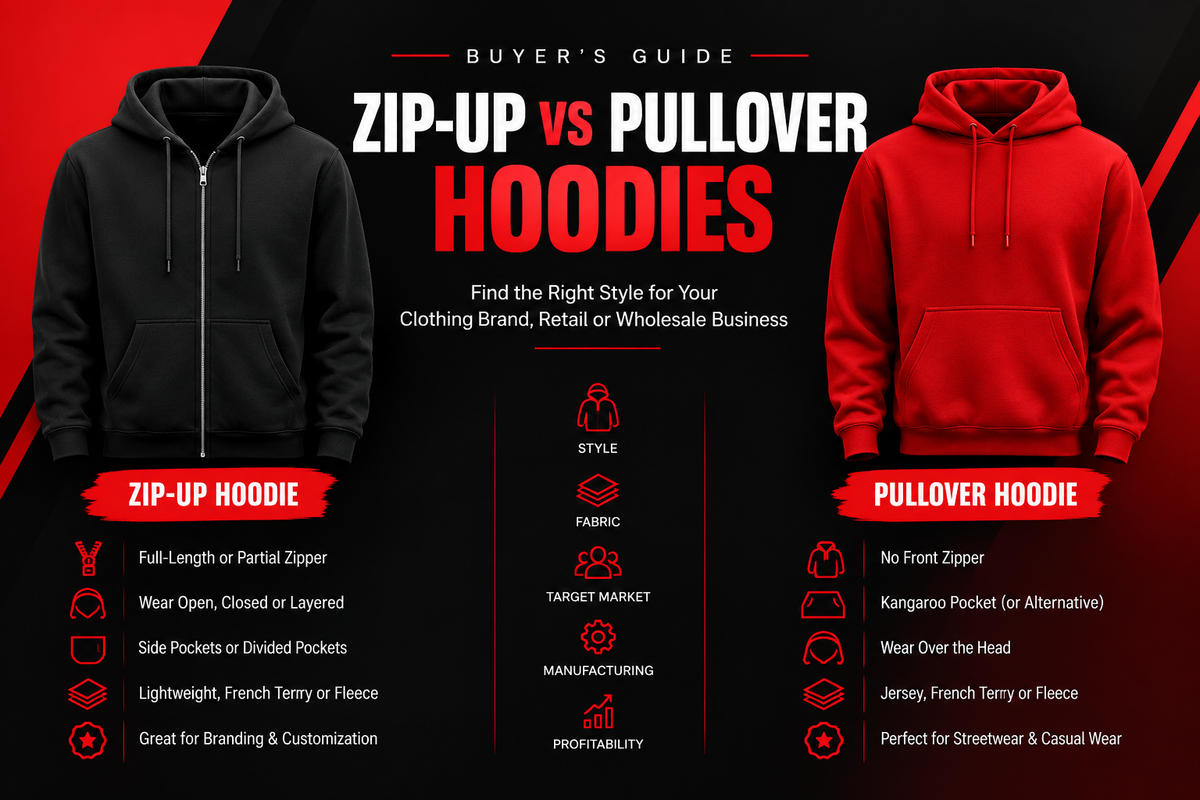
Zip-Up vs Pullover Hoodies: A Complete Buyer’s Comparison Guide for Clothing Brands and Retailers
How to Choose the Best Hoodie Style for Your Streetwear, Sportswear and Private Label Clothing Collection
Primary Keyword: zip up hoodie vs pullover hoodie
Secondary Keywords: custom hoodie manufacturer, pullover hoodie manufacturer, zip up hoodie manufacturer, wholesale hoodies, private label hoodies, custom streetwear hoodies, custom sportswear manufacturer, oversized pullover hoodie, heavyweight zip up hoodie, hoodie manufacturing, wholesale hoodie supplier, custom clothing manufacturer, streetwear manufacturer, sportswear manufacturer.
Target Audience: Clothing brand owners, fashion retailers, apparel wholesalers, sports clubs, distributors, e-commerce businesses and private-label clothing entrepreneurs.
Recommended URL Slug: /zip-up-hoodie-vs-pullover-hoodie/
Introduction: Why Hoodie Style Matters for Your Clothing Business
Choosing the right hoodie style is an important decision for every clothing brand, retailer and apparel distributor. Hoodies are versatile garments that can be sold as everyday essentials, premium streetwear, athletic apparel, team merchandise and seasonal fashion products. However, not every hoodie serves the same purpose, and understanding the difference between zip-up and pullover hoodies can help businesses develop a more profitable product collection.
When comparing zip up hoodie vs pullover hoodie, buyers should consider more than appearance. Fabric quality, garment construction, customer preferences, branding options, manufacturing costs, retail pricing and seasonal demand can all influence which style makes the most sense for a particular collection.
A zip-up hoodie features a front zipper that allows the wearer to open or close the garment easily. A pullover hoodie has no full-length front zipper and is worn over the head. Both styles offer opportunities for customization, but their construction creates different advantages for fashion brands and sportswear businesses.
For example, a streetwear brand planning a heavyweight oversized collection might prefer pullover hoodies with bold front graphics, dropped shoulders and premium fleece. An activewear brand might choose lightweight zip-up hoodies that customers can wear over training shirts before and after exercise.
Retailers who understand these differences can select products that fit their target market, maintain consistent quality and support their brand identity.
At Ortox Industry, the focus is on custom apparel manufacturing for businesses developing sportswear, streetwear and private-label clothing collections. Whether you are planning custom hoodies, tracksuits, T-shirts or coordinated apparel sets, selecting the right garment construction is an important first step.
Explore Ortox Industry to learn more about custom clothing manufacturing and apparel development.
1. What Is a Zip-Up Hoodie?
A zip-up hoodie is a hooded sweatshirt featuring a zipper running down the front. Depending on the design, the zipper may extend from the bottom hem to the neckline or stop at a shorter length in a partial-zip construction.
Full-zip hoodies are particularly popular because they can be worn open, partially closed or fully zipped. This makes them useful for layering, everyday casual outfits, travel and sportswear collections.
Main Features of Zip-Up Hoodies
Typical features include:
- A full-length or partial front zipper.
- An attached hood, sometimes with adjustable drawstrings.
- Ribbed cuffs and hem on many traditional designs.
- Side pockets or divided front pockets.
- Lightweight jersey, French terry or fleece fabric options.
- Opportunities for embroidered logos, sleeve graphics and back prints.
Modern zip-up hoodies are available in several silhouettes, including slim-fit athletic designs, relaxed casual styles, oversized streetwear fits and heavyweight fashion constructions.
Why Retailers Stock Zip-Up Hoodies
Retailers often consider zip-up hoodies when they want garments that can be worn across different temperatures and settings.
Customers can wear a zip-up hoodie over a T-shirt during mild weather or underneath a jacket when temperatures fall. In athletic collections, the ability to remove a layer without pulling it over the head can be particularly convenient.
Zip-up hoodies can also complement matching joggers, tracksuits, gym clothing and team warm-up apparel.
For private-label clothing brands, a zip-up hoodie provides an opportunity to create a distinctive product through zipper selection, custom drawcords, contrast panels, sleeve branding, woven labels and customized packaging.
However, buyers should evaluate the quality of the zipper carefully. A poorly aligned or difficult-to-operate zipper can affect the customer experience even when the fabric and overall design are attractive.
2. What Is a Pullover Hoodie?
A pullover hoodie is a hooded sweatshirt without a full-length front opening. The wearer puts it on over the head, and the garment usually features a continuous front panel.
Many traditional pullover hoodies include a kangaroo pocket across the front, although some modern designs use side pockets, concealed pockets or minimalist pocket-free construction.
Pullover hoodies are widely used in streetwear, casual clothing, university merchandise, sports team apparel and premium fashion collections.
Main Features of Pullover Hoodies
Common features include:
- A continuous front panel without a full-length zipper.
- An attached hood with optional drawstrings.
- A kangaroo pocket or alternative pocket design.
- Ribbed cuffs and hem on many styles.
- Cotton, cotton-polyester blends, French terry or fleece.
- A large front surface suitable for graphics and branding.
Pullover hoodies can be developed in lightweight, midweight or heavyweight fabrics. Their overall warmth depends on the fabric, lining, construction and fit rather than the style name alone.
Why Retailers Stock Pullover Hoodies
Pullover hoodies are useful for brands that want a classic sweatshirt silhouette, a clean front surface and a wide range of graphic possibilities.
They are particularly suitable for oversized streetwear, college-inspired apparel, minimalist fashion, graphic merchandise and heavyweight winter collections.
A pullover can feature a large screen-printed graphic, embroidered artwork, a prominent brand name or a small chest logo. Since there is no central zipper dividing the front panel, designers have more freedom to position artwork across the chest.
For businesses developing private-label hoodies, pullovers can also simplify certain aspects of construction because they do not require zipper hardware and its installation.
Nevertheless, the final production cost depends on the selected fabric, design complexity, garment weight, trims, decoration and order quantity.
3. Zip-Up Hoodie vs Pullover Hoodie: Side-by-Side Comparison
Before deciding which hoodie style to stock, retailers should compare the practical and commercial differences.
| Feature | Zip-Up Hoodie | Pullover Hoodie |
|---|---|---|
| Front construction | Full or partial zipper | Continuous front panel |
| Wearing method | Opens at the front | Pulled over the head |
| Layering | Very convenient | Less convenient to remove |
| Temperature adjustment | Easy to open or close | Less adjustable |
| Front branding | Must work around the zipper | Broad, uninterrupted surface |
| Pocket options | Often divided pockets | Often a kangaroo pocket |
| Construction | Requires zipper installation | No full-length zipper required |
| Cost considerations | Zipper and additional sewing may increase cost | Can be simpler to manufacture |
| Streetwear applications | Relaxed layers and statement zip-ups | Oversized and graphic-heavy designs |
| Sportswear applications | Warm-ups and versatile outer layers | Training, casual wear and team merchandise |
| Styling options | Open, partially zipped or closed | Usually worn as a complete top |
| Quality checks | Include zipper operation and alignment | Focus on neckline, seams and overall construction |
The key takeaway: A zip-up hoodie generally offers greater flexibility for layering, while a pullover hoodie offers a more continuous front design. Neither is automatically better for every clothing brand.
Retailers should choose according to their customers, price positioning, artwork requirements and intended use.
4. Which Hoodie Is Warmer: Zip-Up or Pullover?
Warmth is an important consideration when selecting hoodies for autumn and winter collections. However, buyers should avoid assuming that every pullover hoodie is warmer than every zip-up hoodie.
If both garments use similar fabric, thickness, lining and fit, a pullover can feel warmer because its front panel has no zipper opening. A zip-up may allow more air to enter through the front when the zipper is open or when the construction does not provide adequate protection.
However, a heavyweight fleece zip-up can be warmer than a thin pullover made from lightweight French terry.
Understanding Hoodie Fabric Weight
Fabric weight is commonly measured in grams per square metre (GSM). GSM helps buyers compare material density, although it does not determine warmth by itself.
The following ranges are useful starting points for product development, not universal industry standards.
Lightweight hoodies: approximately 200–280 GSM
These are suitable for lighter layering, transitional weather and selected activewear applications. Lightweight French terry and jersey-based constructions can work well when flexibility and breathability are priorities.
Midweight hoodies: approximately 280–350 GSM
Midweight fabrics offer a balance between comfort, structure and versatility. They are useful for everyday casual collections, branded merchandise and many all-season clothing lines.
Heavyweight hoodies: approximately 350–450 GSM
Heavyweight materials are popular for premium streetwear, oversized silhouettes and colder-weather collections. Brushed fleece can create a soft interior, while dense French terry provides a different texture and drape.
Ultra-heavyweight hoodies: approximately 450 GSM and above
These fabrics may appeal to premium streetwear brands seeking substantial garments, structured silhouettes and a distinctive hand feel. Buyers should evaluate comfort, shrinkage, drape and production requirements before committing to bulk quantities.
Which Fabric Should Your Brand Choose?
For a lightweight athletic zip-up hoodie, consider a suitable French terry or cotton-polyester blend.
For a premium oversized pullover, consider heavyweight cotton-rich fleece or dense French terry.
For winter merchandise, evaluate brushed interiors, fabric density, hood construction and cuff quality.
For travel and everyday layering, consider a fabric that provides enough warmth without excessive bulk.
The best approach is to request samples and compare the actual materials rather than selecting a hoodie solely by its GSM.
5. Zip-Up vs Pullover Hoodies for Streetwear Brands
Streetwear brands often use hoodies as statement products rather than simply functional garments. Fit, fabric texture, colour, artwork and construction all contribute to how a hoodie communicates a brand’s identity.
Both zip-up and pullover hoodies can work well in streetwear, but they support different design directions.
Pullover Hoodies for Streetwear
Pullover hoodies are a strong option for brands that want bold graphics and a substantial silhouette.
Popular design possibilities include:
- Oversized and boxy fits.
- Dropped shoulders.
- Heavyweight fleece.
- Large front and back screen prints.
- Embroidered chest logos.
- Puff-print graphics.
- Washed or garment-dyed effects.
- Minimalist branding and tonal embroidery.
- Custom woven labels and branded drawcords.
A continuous front panel makes a pullover especially useful for large central graphics. Designers can also combine a small chest logo with a larger back illustration.
For premium collections, brands can develop distinctive proportions through body length, sleeve volume, hood size, ribbing and pocket construction.
Zip-Up Hoodies for Streetwear
Zip-up hoodies offer a different design opportunity. The front zipper introduces a vertical line that can become part of the overall aesthetic.
Popular options include:
- Oversized full-zip hoodies.
- Cropped zip-up silhouettes.
- Double-zip designs.
- Contrast-colour zippers.
- Distressed or washed finishes.
- Minimal chest embroidery.
- Large back graphics.
- Sleeve prints and custom patches.
- Coordinated hoodie-and-jogger sets.
A double-zip hoodie, for example, can offer additional styling options, although its hardware and construction require careful development.
Zip-up hoodies can also be styled open over graphic T-shirts, creating an additional way for customers to display other pieces in a collection.
How to Choose for a Streetwear Collection
If your brand focuses on bold artwork, heavyweight fabric and a clean front silhouette, start by developing a pullover hoodie.
If your collection focuses on layering, alternative silhouettes and versatile styling, consider a zip-up hoodie.
If your budget and product range allow it, develop both styles in coordinated colours and materials. This creates variety without requiring an entirely unrelated design direction.
Explore Ortox Industry’s custom apparel manufacturing when planning a streetwear collection with customized fits, materials and branding details.
6. Zip-Up vs Pullover Hoodies for Sportswear Brands
Sportswear buyers have different priorities from fashion retailers. Comfort, movement, layering, moisture management and the intended sporting activity should influence product selection.
The best hoodie style depends on whether the garment is intended for warm-ups, recovery, travel, casual teamwear or everyday athletic clothing.
Zip-Up Hoodies for Sportswear
Zip-up hoodies are particularly useful for athletes who need to adjust their clothing before and after training.
Potential applications include:
- Football and soccer warm-up apparel.
- Basketball team travel clothing.
- Gym and fitness collections.
- Running-club casual apparel.
- Coaching and staff clothing.
- Team tracksuits.
- Training layers for outdoor activities.
A zip-up hoodie can be worn over a training shirt and removed quickly when exercise intensity increases.
For sportswear manufacturing, buyers should assess the garment’s weight, stretch, seam construction and intended level of activity. A heavy cotton fleece hoodie may be appropriate for travel or warm-ups but less suitable for high-intensity exercise.
For more active applications, lightweight technical materials may be worth considering.
Pullover Hoodies for Sportswear
Pullover hoodies are also widely used in teamwear and athletic clothing.
They can work well for:
- School and university sports merchandise.
- Club supporter apparel.
- Post-training clothing.
- Casual gym wear.
- Team travel collections.
- Outdoor recreational clothing.
- Coordinated athlete merchandise.
A pullover hoodie can carry a club crest, team name, player-inspired artwork or sponsor branding.
For team orders, consider whether all garments need identical designs or whether different versions are required for players, coaches, staff and supporters.
Fabric Selection for Sportswear Hoodies
For sportswear products, material selection should reflect the intended function.
Cotton-rich fleece can provide a soft, comfortable feel for casual wear.
French terry can offer a lighter alternative for layering and everyday use.
Polyester-rich technical fabrics may be appropriate when quick drying, lower moisture absorption or specific performance properties are required.
A fabric’s actual performance depends on its construction, finishing, fibre composition and garment design. Buyers should request technical specifications and test samples before making performance claims.
7. Which Hoodie Is More Cost-Effective for Retailers?
Cost is a major consideration for clothing brands, wholesalers and distributors. However, the cheapest garment is not necessarily the most profitable product.
Retailers need to consider the complete cost of developing, manufacturing, shipping and selling a hoodie.
Pullover Hoodie Production Costs
A pullover hoodie generally avoids the cost of a full-length zipper and the associated installation process.
This can make it a practical option for brands that need a straightforward design or want to allocate more of their budget to fabric, embroidery or printed graphics.
However, a premium heavyweight pullover with complex panels, specialized washing, elaborate embroidery or custom trims can still have a substantial manufacturing cost.
Zip-Up Hoodie Production Costs
A zip-up hoodie includes zipper hardware, additional construction requirements and more detailed quality checks.
The final cost may be influenced by:
- Zipper type and quality.
- Zipper length and finish.
- Fabric weight and composition.
- Pocket construction.
- Custom hardware.
- Embroidery and printing.
- Pattern complexity.
- Order quantity.
- Packaging requirements.
A well-designed zip-up hoodie may also support a higher retail price if it offers distinctive styling, premium materials and reliable construction.
Calculate the Total Landed Cost
Retailers should consider more than the factory price when comparing products.
A useful calculation is:
Landed cost per unit = garment cost + decoration + packaging + allocated freight + duties and applicable import charges.
Actual costs depend on the supplier, destination, shipping method and order terms.
Next, compare the landed cost with your intended selling price.
For example, if a hoodie costs $20 in total to bring into stock and you sell it for $50, your gross profit before other operating expenses is $30.
That represents a 60% gross margin on the selling price.
The formula is:
Gross margin = (selling price − landed cost) ÷ selling price × 100.
This is an illustrative example, not a quote or guarantee of profit. Retail discounts, payment fees, returns, advertising and other business expenses can reduce the final result.
How Retailers Can Improve Hoodie Profitability
Consider these strategies:
- Choose a fabric that matches your retail price point.
- Avoid unnecessary design details that do not improve customer value.
- Request samples before approving bulk production.
- Compare the complete cost of both hoodie styles.
- Plan quantities around realistic demand.
- Select branding methods that suit the garment and target audience.
- Confirm shipping, packaging and quality requirements before placing an order.
The goal is to find the right balance between manufacturing cost, product quality, customer satisfaction and retail positioning.
8. Which Hoodie Offers Better Branding Opportunities?
Branding can influence whether a hoodie feels like a basic sweatshirt or a distinctive private-label product.
Both styles support customization, but the front construction affects how certain designs can be applied.
Branding a Pullover Hoodie
The uninterrupted front panel makes pullover hoodies suitable for large graphics and centred branding.
Options include:
Screen printing: Useful for suitable designs and production quantities, particularly when the artwork uses repeatable colours and shapes.
Embroidery: Suitable for logos and selected decorative elements. Stitch density, fabric stability and design size should be assessed.
Puff printing: Creates a raised visual effect that can suit selected streetwear designs.
DTF printing: Can support detailed, multicolour artwork, depending on the garment, transfer quality and application requirements.
Woven labels: Useful for adding brand identity to the hem, side seam or other suitable positions.
Custom packaging: Branded bags, hang tags and product inserts can support a consistent retail presentation.
Branding a Zip-Up Hoodie
A zipper divides the front panel, so designers need to plan artwork placement carefully.
Suitable options include:
- Left-chest embroidery.
- Small chest logos.
- Sleeve prints.
- Back graphics.
- Custom zipper pulls.
- Branded drawcords.
- Woven hem labels.
- Interior neck labels.
- Coordinated packaging.
Large centred graphics can be more difficult to execute on a full-zip hoodie because the zipper interrupts the artwork.
Designers can work around this by placing graphics on one side, using separate panels or creating artwork specifically designed around the zipper.
Branding Recommendation for Retail Buyers
Choose a pullover hoodie if your main design requires a large, uninterrupted front graphic.
Choose a zip-up hoodie if your branding relies on small chest logos, sleeve details, back graphics or distinctive hardware.
In both cases, approve a physical sample or production-ready decoration sample before authorizing bulk production.
9. Fabric and Material Selection for Custom Hoodies
The right fabric influences comfort, durability, appearance, shrinkage and customer satisfaction.
When working with a custom hoodie manufacturer, buyers should specify both the fibre composition and the desired fabric construction.
Cotton Hoodies
Cotton-rich fabrics are popular for everyday wear because they can offer a soft hand feel and a familiar natural-fibre appearance.
They can work well for casual pullovers, oversized streetwear and selected zip-up styles.
However, cotton fabrics can shrink or change shape depending on the yarn, construction, finishing and washing process. Pre-production testing is important.
Cotton-Polyester Blends
Blended fabrics can combine characteristics of cotton and polyester.
Depending on the blend and construction, they may offer useful dimensional stability, durability and ease of care.
They are common options for everyday hoodies, team merchandise and selected sportswear products.
Buyers should not assume all blends perform identically. Request the exact fibre percentages and care instructions.
French Terry
French terry generally features looped yarns on the inner surface and a smoother exterior.
It can be suitable for lightweight or midweight hoodies, casual clothing and layering products.
The final weight and composition determine whether a particular French terry fabric is suitable for your collection.
Brushed Fleece
Brushed fleece has a soft, raised interior that can provide additional warmth and a comfortable feel.
It is frequently considered for cold-weather hoodies, heavyweight pullovers and relaxed streetwear designs.
For premium products, evaluate the fabric’s pilling resistance, shrinkage, colourfastness and surface appearance.
Technical Fabrics
Selected polyester-rich or stretch fabrics can be useful for athletic zip-up hoodies and performance-oriented products.
Depending on the specification, these materials may offer lighter weight, stretch, moisture-management characteristics or faster drying.
Performance claims should be based on verified material properties and appropriate testing rather than marketing language alone.
What to Ask Your Manufacturer
Before selecting a fabric, ask your supplier:
- What is the exact fibre composition?
- What is the fabric weight in GSM?
- Is the interior brushed or loopback?
- What shrinkage should be expected?
- How does the fabric perform after washing?
- Is the material suitable for embroidery or printing?
- What colour options are available?
- Can the supplier provide fabric swatches or garment samples?
These questions help brands make more informed decisions before bulk production.
10. Choosing the Right Fit: Oversized, Regular or Athletic
Fit is one of the most important factors in hoodie product development. A good fabric cannot compensate for a silhouette that does not match the intended customer.
Oversized Hoodies
Oversized hoodies are often associated with contemporary streetwear and relaxed casual clothing.
Typical features include a wider body, dropped shoulders and fuller sleeves.
When developing oversized pullovers, buyers should review body width, garment length, sleeve volume, hood proportions and ribbing.
Oversized zip-up hoodies require additional attention to zipper length, panel balance and how the garment hangs when worn open.
Regular-Fit Hoodies
Regular-fit hoodies offer a more traditional silhouette and can work across different customer groups.
They are suitable for casual retail, team merchandise, branded uniforms and everyday clothing collections.
For retailers serving broad audiences, a regular fit can be a useful starting point, although customer preferences should guide the final decision.
Athletic-Fit Hoodies
Athletic-fit hoodies may use a more shaped body, narrower sleeves or stretch-friendly materials.
They can suit selected sportswear and fitness collections where the garment is intended to sit closer to the body.
Buyers should ensure that the design still allows comfortable movement and layering.
Sizing and Grading
A private-label hoodie should have a clearly defined size chart.
Important measurements include:
- Chest width.
- Body length.
- Shoulder width.
- Sleeve length.
- Cuff width.
- Bottom opening.
- Hood dimensions.
Ask the manufacturer how measurements are taken and what tolerances apply.
Review samples across multiple sizes where possible, particularly if your brand plans to sell a broad size range.
A well-developed size chart can help reduce avoidable fit-related returns and improve consistency across repeat orders.
11. Quality Control Checklist for Zip-Up and Pullover Hoodies
Quality control is essential when ordering custom apparel. A garment may look attractive in a photograph but still have issues that become obvious after washing or repeated use.
A reliable inspection process should cover fabric, construction, measurements, branding and finishing.
Zip-Up Hoodie Quality Checks
Inspect the following:
Zipper operation: Open and close the zipper repeatedly to check for catching, separation, rough movement or alignment problems.
Zipper attachment: Examine the stitching and ensure that the zipper tape sits evenly.
Front-panel alignment: Check whether both sides align properly when the hoodie is closed.
Pockets: Inspect pocket placement, stitching strength and usability.
Seams: Check for skipped stitches, loose threads and uneven seam allowances.
Cuffs and hem: Confirm that ribbing is attached securely and has suitable recovery.
Branding: Check that logos and prints are positioned correctly and do not interfere with zipper operation.
Pullover Hoodie Quality Checks
Inspect the following:
Neck opening: Ensure that the opening is comfortable and suitable for the intended fit.
Kangaroo pocket: Check its symmetry, attachment and stitching.
Hood construction: Review the shape, lining, drawcord and seam finishing.
Front and back panels: Look for visible defects, twisting or uneven construction.
Cuffs and hem: Check ribbing quality, attachment and recovery.
Prints and embroidery: Verify artwork placement, colour consistency and finishing.
Quality Checks for Both Styles
Regardless of style, assess:
- Fabric weight and composition.
- Colour consistency.
- Garment measurements.
- Stitch quality.
- Shrinkage after washing.
- Pilling and surface appearance.
- Print durability.
- Embroidery quality.
- Label accuracy.
- Packaging and size identification.
For larger orders, establish written quality requirements before production and agree on an inspection process with the supplier.
12. How to Choose the Best Hoodie Style for Your Target Market
The right product depends on the people you want to sell to and the role the hoodie plays in your collection.
For Premium Streetwear Brands
Consider heavyweight pullovers with oversized proportions, distinctive fabrics and carefully developed graphics.
You can complement them with zip-up hoodies featuring minimal branding, contrast details or alternative silhouettes.
For Sportswear Brands
Consider zip-up hoodies for warm-up clothing, team travel and layering.
Pullover hoodies can complement the range with casual teamwear, supporter merchandise and post-training clothing.
For Fashion Boutiques
A combination of styles may provide a wider selection.
For example, offer a classic pullover as an everyday staple and a premium zip-up as a more versatile layering product.
For Online Clothing Stores
Online retailers should consider how each style will be presented in product photography.
For zip-up hoodies, show the garment both open and closed. For pullovers, show the front graphic, hood, pocket and fit clearly.
Provide accurate size charts, fabric descriptions and care instructions.
For Wholesale Distributors
Distributors should evaluate the requirements of their customers before committing to large quantities.
A retailer serving a premium streetwear market may need different fabric weights and decoration options from a distributor supplying sports clubs or promotional merchandise.
Requesting samples and confirming specifications before placing a bulk order can help reduce purchasing risk.
For New Clothing Brands
New brands should avoid developing too many variations before understanding customer demand.
Consider launching one carefully developed hoodie style in a limited selection of colours. Gather feedback, review sales and use that information to decide whether to expand into the alternative style.
This approach can make initial product development easier to manage.
13. Should You Stock Zip-Up Hoodies, Pullover Hoodies or Both?
There is no universal answer. The best product mix depends on your brand identity, available budget, customers and sales channels.
A retailer focused on oversized graphic streetwear might prioritize pullovers.
A sportswear business focused on warm-up clothing and easy layering might prioritize zip-ups.
A broader clothing brand may benefit from offering both.
A Practical Product-Mix Strategy
If you are developing your first hoodie collection, consider three stages.
Stage 1: Define the main product.
Select the style that best represents your brand. Specify its fabric, fit, colour, branding and intended retail price.
Stage 2: Test the market.
Use samples, customer feedback, pre-orders or a controlled initial launch to assess demand.
Stage 3: Expand based on evidence.
If customers respond well to the first product, introduce complementary colours, additional sizes or a second hoodie construction.
For example, a brand may begin with a heavyweight pullover and later introduce a matching zip-up in the same colour family.
Alternatively, an athletic apparel business may begin with a lightweight zip-up and later develop a heavier pullover for casual wear.
The objective is to create a cohesive collection rather than simply increasing the number of products.
14. Working With a Custom Hoodie Manufacturer
Choosing a suitable manufacturing partner is an important part of developing a reliable hoodie collection.
A manufacturer should be able to understand your design requirements, explain material options, clarify production specifications and communicate about sampling and quality control.
For brands developing private-label apparel, the process often includes design confirmation, fabric selection, sample development, sample approval, bulk production, inspection and shipping.
Step 1: Define Your Hoodie Design
Prepare a reference image, sketch or technical specification.
Include the desired silhouette, fabric, colour, pocket design, hood construction, zipper details and branding positions.
The more clearly the product is specified, the easier it is to evaluate whether a sample matches your expectations.
Step 2: Select the Fabric
Decide whether the product requires lightweight French terry, midweight cotton-rich fabric, heavyweight fleece or another suitable material.
Confirm the fibre composition, GSM, colour availability and finishing requirements.
Step 3: Confirm Branding Details
Specify the logo, artwork, printing or embroidery method, labels and packaging.
For zip-up hoodies, clearly indicate how the front design should work around the zipper.
For pullovers, confirm the size and location of any large front graphics.
Step 4: Request a Sample
Evaluate the sample for fit, fabric quality, stitching, comfort and overall appearance.
Wash the garment according to the intended care instructions and review any changes in measurements or surface quality.
Request revisions when necessary before approving bulk production.
Step 5: Confirm the Bulk Order
Before production begins, confirm the final specifications, size breakdown, colours, quantities, agreed costs, timeline and quality requirements.
Ask which items are included in the quotation and clarify any additional charges.
Step 6: Inspect and Prepare the Order for Shipping
Check the finished garments against the approved specifications.
Confirm that labels, sizes, quantities and packaging are correct before dispatch.
International buyers should also clarify shipping arrangements, customs documentation, applicable import charges and delivery expectations.
Why Choose Ortox Industry for Custom Apparel?
Ortox Industry focuses on custom sportswear, streetwear and private-label apparel manufacturing for businesses that want to develop products under their own brand identity.
When discussing a potential hoodie order, buyers can share their designs and requirements to establish whether the requested fabric, fit, branding and order quantities are suitable for production.
If you are planning a new collection, prepare your reference images, estimated quantity, target market and desired delivery schedule before requesting a quotation.
Your Brand. Your Designs. Our Manufacturing.
Website: https://ortoxindustry.com/
15. Common Mistakes Buyers Should Avoid
Even experienced retailers can encounter problems when hoodie specifications are not clearly defined.
Mistake 1: Choosing by Appearance Alone
A hoodie may look attractive but still be unsuitable for your customers if the fabric, fit or construction does not meet their needs.
Evaluate the product as a complete garment rather than judging it only by photographs.
Mistake 2: Ignoring Zipper Quality
For zip-up hoodies, a zipper is both a functional component and a visible design feature.
Specify the required quality and finish, then test the sample before bulk approval.
Mistake 3: Selecting Fabric Without Testing
GSM alone does not determine softness, durability, warmth or shrinkage.
Review fabric samples and, where appropriate, wash-test the finished garment.
Mistake 4: Overcomplicating the First Collection
Too many colours, fits and decoration variations can make inventory planning difficult.
Start with a focused collection and expand when you have evidence of demand.
Mistake 5: Failing to Approve Branding Placement
A large front graphic that works on a pullover may not translate directly to a zip-up hoodie.
Approve artwork placement on the actual garment construction.
Mistake 6: Ignoring the Full Cost
Factory price is only one part of the financial calculation.
Account for decoration, packaging, freight, import charges and other relevant expenses.
Mistake 7: Ordering Without Clear Specifications
Written requirements help both the buyer and manufacturer understand what has been agreed.
Confirm measurements, materials, colours, labels, artwork, quantities and inspection requirements before production.
16. Frequently Asked Questions About Zip-Up vs Pullover Hoodies
Q1. What is the main difference between a zip-up hoodie and a pullover hoodie?
A zip-up hoodie has a front zipper that allows the garment to open, while a pullover hoodie has no full-length front opening and is worn over the head. This difference affects layering, front-panel design, pocket construction and manufacturing requirements.
Q2. Is a pullover hoodie warmer than a zip-up hoodie?
A pullover may retain warmth more effectively when both garments use comparable fabrics and construction because it has no front zipper opening. However, fabric weight, lining, fit and overall construction have a major influence on warmth.
Q3. Which hoodie is better for streetwear brands?
Pullover hoodies are often suitable for graphic-heavy streetwear because they provide an uninterrupted front panel. Zip-up hoodies are useful for layering-focused collections, minimalist branding and alternative silhouettes. The best choice depends on the brand’s design direction.
Q4. Which hoodie is better for sportswear?
Zip-up hoodies can be particularly useful for warm-ups and layering because they are easy to open or remove. Pullovers are also suitable for casual athletic clothing, team merchandise and post-training apparel.
Q5. Are zip-up hoodies more expensive to manufacture?
They can be more expensive because they require zipper hardware and additional construction. However, actual costs depend on fabric, trims, decoration, order quantity and design complexity. Buyers should compare quotations for equivalent specifications.
Q6. Which hoodie is better for printing?
Pullover hoodies are generally easier to use for large centred front graphics because their front panel is uninterrupted. Zip-up hoodies can support chest, sleeve and back graphics, but designs must account for the zipper.
Q7. Can both hoodie styles be customized with private labels?
Yes. Both can be developed with suitable woven labels, printed labels, custom embroidery, graphics, drawcords and packaging. Available options depend on the design and manufacturing requirements.
Q8. What fabric is best for heavyweight streetwear hoodies?
Cotton-rich fleece and dense French terry are common options for heavyweight streetwear. The best material depends on the desired structure, softness, warmth, drape and care requirements.
Q9. What GSM should I choose for a custom hoodie?
The appropriate GSM depends on the intended use. Lightweight designs may use approximately 200–280 GSM, midweight designs around 280–350 GSM, and heavyweight styles around 350–450 GSM or more. These are general starting points, and fabric construction matters as well.
Q10. Can I order matching zip-up hoodies and joggers?
Matching sets are a common option for streetwear, sportswear and casual apparel collections. Buyers should confirm colour consistency, fabric compatibility, fit and branding placement across both garments.
Q11. What should I send a manufacturer when requesting a hoodie quotation?
Share your design references, desired fabric, approximate GSM, colour options, size range, branding requirements, estimated quantity and destination country. Include your target delivery date if you have one.
Q12. Should a new clothing brand launch both hoodie styles?
Not necessarily. A new brand can begin with the style that best represents its collection, evaluate customer demand and introduce the second style later. Offering both from the beginning can work when the budget, product strategy and audience justify it.
Q13. How can I check hoodie quality before bulk production?
Request a sample and inspect the measurements, fabric, stitching, pocket construction, cuffs, hood, zipper if applicable, labels and decoration. Wash the garment according to the care instructions and review any changes before approving production.
Q14. Where can I find a custom sportswear and streetwear manufacturer?
You can explore Ortox Industry for information about custom sportswear, streetwear and private-label apparel manufacturing. Share your requirements to discuss whether your intended product is suitable for development.
Conclusion: Make the Right Hoodie Choice for Your Brand
The decision between a zip-up hoodie and a pullover hoodie should be based on the needs of your customers, your product design and your overall business strategy.
Zip-up hoodies provide convenient layering, flexible styling and opportunities for distinctive zipper details. They are useful for athletic warm-ups, everyday outer layers and streetwear collections built around versatility.
Pullover hoodies provide a continuous front panel, a classic silhouette and broad possibilities for graphic branding. They can be particularly effective for heavyweight streetwear, casual apparel, team merchandise and collections built around bold artwork.
Both styles can be developed in a wide range of fabrics, fits, colours and finishes. The most important factors are selecting suitable materials, confirming accurate specifications, testing samples and establishing clear quality requirements before bulk production.
For retailers, the right choice is not simply the hoodie that looks best. It is the product that fits the target audience, supports the intended retail price and delivers the expected quality.
If you are planning your next streetwear, sportswear or private-label hoodie collection, start with a clear product concept and a reliable manufacturing process.
Ready to develop custom hoodies for your brand?
Visit Ortox Industry — Custom Sportswear, Streetwear and Private Label Apparel to explore your manufacturing options.
Ortox Industry — Your Brand. Your Designs. Our Manufacturing.
SEO Metadata for Your Website
SEO Title: Zip-Up Hoodie vs Pullover Hoodie: Complete Buyer’s Guide
Meta Description: Compare zip-up vs pullover hoodies for streetwear, sportswear and retail. Explore fabrics, costs, branding, quality control and custom hoodie manufacturing with Ortox Industry.
Focus Keyword: zip up hoodie vs pullover hoodie
Suggested Secondary Keywords:
- zip up hoodie manufacturer
- pullover hoodie manufacturer
- custom hoodie manufacturer
- wholesale hoodies
- private label hoodies
- custom streetwear hoodies
- heavyweight pullover hoodie
- oversized zip up hoodie
- sportswear manufacturer
- streetwear manufacturer
- custom apparel manufacturer
- hoodie fabric guide
- custom hoodie supplier
- wholesale clothing manufacturer
Suggested Image Alt Text: Zip-up hoodie vs pullover hoodie comparison for custom streetwear and sportswear manufacturing by Ortox Industry.
Suggested Featured Image Filename: zip-up-hoodie-vs-pullover-hoodie-buyers-guide.webp
Recommended Internal Links
Add these links naturally if the corresponding pages exist on your website:
- Custom Hoodie Manufacturer — link to your custom hoodie product or manufacturing page.
- Custom Tracksuit Manufacturer — link to your tracksuit page.
- Custom T-Shirt Manufacturer — link to your T-shirt page.
- Sportswear Manufacturer — link to your sportswear category.
- Streetwear Manufacturer — link to your streetwear category.
- Private Label Clothing Manufacturer — link to your private-label manufacturing page.
- Contact Ortox Industry — link to your contact or quotation page.
Use the exact, live page URLs from your website rather than creating unverified links.
SEO Publishing Recommendations
- Add the primary keyword naturally to the page title, H1, introduction and a relevant subheading.
- Use related keywords in context instead of repeating the same phrase excessively.
- Add the featured image with descriptive alt text.
- Include internal links to relevant Ortox Industry product and service pages.
- Add a clear CTA directing buyers to your manufacturing or quotation page.
- Make sure the page loads quickly and works well on mobile devices.
- Use a self-referencing canonical URL and include the published page in your XML sitemap.
- Add structured data only when it accurately represents the page and meets Google’s guidelines.
- Review Search Console data after publication to identify impressions, clicks and relevant search queries.
Important: SEO content can improve topical relevance and help search engines understand your website, but no article can guarantee a particular ranking. Results also depend on competition, technical SEO, site authority, internal links, page experience and the quality of the overall website.