
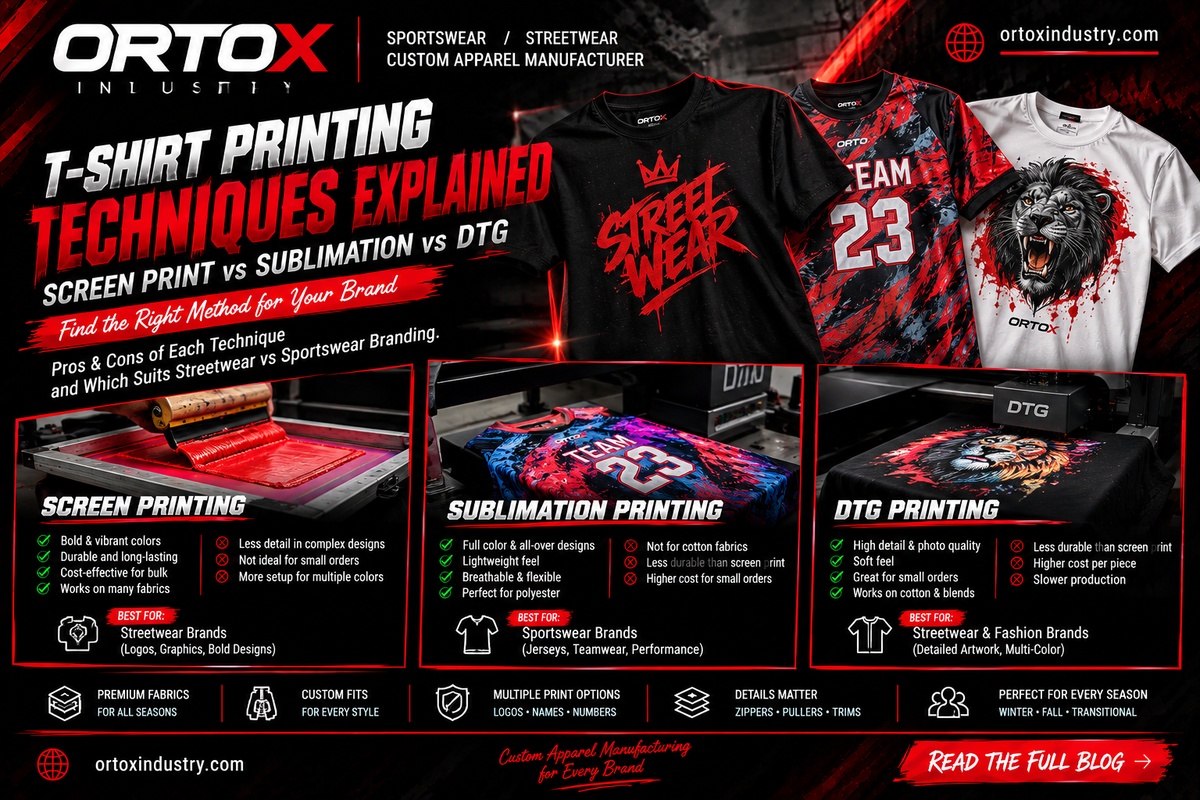
T-Shirt Printing Techniques Explained: Screen Print vs Sublimation vs DTG
Primary Keyword: custom t-shirt printing techniques
Secondary Keywords:
custom t-shirt printing
t-shirt printing techniques
screen printing t-shirts
sublimation printing
DTG printing
direct to garment printing
custom printed t-shirts
custom sportswear printing
custom streetwear printing
custom apparel printing
custom t-shirt manufacturer
sportswear manufacturer
custom sportswear manufacturer
streetwear manufacturer
custom streetwear manufacturer
private label clothing manufacturer
private label sportswear
OEM clothing manufacturer
custom clothing manufacturer
custom apparel manufacturer
custom performance shirts
custom graphic t-shirts
printed sportswear
printed streetwear
wholesale t-shirt printing
bulk t-shirt printing
branded t-shirts
custom teamwear
athletic apparel manufacturer
sportswear and streetwear
custom clothing manufacturer Pakistan
sportswear manufacturer Pakistan
Suggested SEO Title:
T-Shirt Printing Techniques Explained: Screen Print vs Sublimation vs DTG
Suggested Meta Description:
Learn the differences between screen printing, sublimation and DTG printing for custom T-shirts. Discover which t-shirt printing technique works best for streetwear, sportswear and private-label brands.
Suggested URL:
https://ortoxindustry.com/custom-t-shirt-printing-techniques/
Introduction: Why T-Shirt Printing Matters for Modern Clothing Brands
A T-shirt may look like a simple garment, but the printing technique used to decorate it can significantly influence its appearance, durability, texture, color quality and overall brand presentation.
For a clothing brand, choosing the right printing method is therefore an important part of product development.
A streetwear company may want bold graphics, oversized artwork and a premium visual effect.
A sportswear brand may need lightweight decoration that works with polyester performance fabrics.
A private-label clothing company may want detailed artwork without creating unnecessary production complexity.
A sports team may need player names, numbers, logos and full-color graphics.
These different requirements mean that there is no single printing technique that is perfect for every T-shirt.
Three of the most commonly discussed methods are:
Screen printing
Sublimation printing
DTG — Direct-to-Garment printing
Understanding the differences between these methods can help clothing brands, sports teams, retailers, distributors and private-label businesses select a printing process that matches their product.
For brands operating in sportswear and streetwear, this decision becomes even more important because these markets can involve very different fabrics, designs and use cases.
Ortox Industry currently positions itself around custom apparel, sportswear, streetwear, fitness apparel, athletic clothing and OEM/private-label manufacturing, including customizable T-shirts and performance shirts.
This guide explains the major custom t-shirt printing techniques, how each method works, their advantages and limitations, and how brands can think about printing when developing sportswear or streetwear collections.
- What Are Custom T-Shirt Printing Techniques?
Custom t-shirt printing techniques are different production methods used to apply artwork, graphics, logos, patterns, text or branding onto garments.
The printing method affects several aspects of the finished product.
These can include:
Appearance
Color reproduction
Print texture
Durability
Fabric compatibility
Production quantity
Artwork complexity
Cost
Production speed
Overall product feel
For example, a simple one-color streetwear logo may work extremely well with screen printing.
A full-color photographic design may be better suited to DTG.
A performance polyester sports shirt with an all-over pattern may be more appropriate for sublimation.
This is why brands should choose the printing process based on the garment + fabric + artwork + quantity + intended use, rather than choosing a method simply because it is popular.
- The Three Major T-Shirt Printing Methods
The three techniques discussed in this guide are:
Screen Printing
Screen printing uses separate screens to transfer ink onto the garment.
It is particularly well known for bold graphics and strong colors.
Sublimation Printing
Sublimation uses specialized inks and heat to transfer artwork into suitable synthetic fibers.
It is widely associated with polyester sportswear and all-over designs.
DTG Printing
DTG, or Direct-to-Garment printing, digitally prints artwork directly onto the garment.
It can be useful for highly detailed and multicolor graphics.
Each technique has a different production approach.
- Screen Printing Explained
Screen printing is one of the most established garment decoration methods.
The process uses a mesh screen and stencil to transfer ink onto fabric.
For designs with multiple colors, separate screens may be prepared for different colors.
The ink is then applied through the screen onto the garment.
After printing, the garment generally goes through a curing process so that the ink bonds properly with the fabric.
The result can be a bold and highly visible graphic.
This makes screen printing particularly popular for:
Streetwear
Graphic T-shirts
Brand merchandise
Events
Promotional clothing
Team apparel
Fashion collections
Bulk T-shirt orders
4. Advantages of Screen Printing
One major advantage of screen printing is its ability to produce strong, visually bold graphics.
Bold Colors
Screen printing can create highly visible colors, particularly when the artwork is designed specifically for the process.
Strong Graphic Appearance
Streetwear brands often use large front or back graphics because screen printing can create a strong visual presence.
Good for Bulk Production
Screen printing can become efficient when producing larger quantities of the same design.
This makes it relevant to wholesale T-shirt production and brand collections.
Wide Range of Applications
It can be used for:
Logos
Text
Illustrations
Brand graphics
Team designs
Promotional artwork
Fashion Applications
Screen printing has become closely associated with graphic apparel.
For streetwear brands, a well-designed screen-printed graphic can become one of the main visual elements of a collection.
- Limitations of Screen Printing
Screen printing is not ideal for every design.
The setup process can become more complicated when artwork contains many colors or highly detailed photographic imagery.
Each color may require additional preparation.
This can increase production complexity.
Screen printing may therefore be particularly attractive when:
The design uses limited colors
The quantity is relatively large
The graphic is bold
The brand wants a traditional printed appearance
For extremely detailed artwork, another method may be more appropriate.
- What Is Sublimation Printing?
Sublimation is a printing process that uses heat to transfer dye into suitable synthetic fibers.
Unlike traditional surface printing, sublimation can become part of the fabric structure rather than simply sitting as a layer on top.
This characteristic makes sublimation particularly relevant to performance apparel.
It is commonly associated with polyester-based garments.
The process is frequently used for:
Sports jerseys
Football uniforms
Basketball uniforms
Volleyball uniforms
Cycling apparel
Training shirts
Performance shirts
Teamwear
Custom athletic apparel
7. Why Sublimation Is Popular in Sportswear
Sportswear often requires lightweight, breathable and flexible garments.
Athletes may also require designs covering large portions of the garment.
Sublimation can be particularly useful for these applications because it can support detailed graphics and all-over designs on appropriate synthetic fabrics.
For example, a team jersey can incorporate:
Team colors
Logos
Player numbers
Player names
Patterns
Sponsor graphics
Gradient effects
This makes sublimation a useful option for custom sportswear.
Ortox’s current product range includes customizable performance shirts and sports jerseys, making performance-oriented printing relevant to its broader sportswear manufacturing positioning.
- Advantages of Sublimation Printing
Full-Color Designs
Sublimation can support complex artwork containing multiple colors.
All-Over Designs
It can be particularly useful when a brand wants artwork extending across large areas of a garment.
Lightweight Result
Because the dye is integrated into the appropriate fabric, the finished decoration can maintain a relatively lightweight feel.
Sportswear Applications
Sublimation is widely associated with polyester athletic garments.
Detailed Patterns
It can reproduce:
Geometric patterns
Gradients
Logos
Numbers
Names
Complex graphics
This makes it valuable for custom teamwear.
- Limitations of Sublimation
Sublimation is not equally suitable for every garment.
Fabric composition is critical.
The technique generally works best with suitable polyester or synthetic fabrics.
This means it may not be the natural first choice for every cotton streetwear T-shirt.
A heavyweight cotton graphic T-shirt designed for an urban fashion collection may require a different decoration approach.
Therefore, brands should first identify the fabric and intended garment before deciding on sublimation.
- What Is DTG Printing?
DTG stands for Direct-to-Garment printing.
Instead of transferring artwork through a screen, DTG uses digital printing technology to apply the design directly to the garment.
This allows highly detailed artwork to be reproduced without creating traditional screens for each individual color.
DTG can be useful for:
Detailed illustrations
Photographic designs
Multicolor graphics
Small-batch products
Artistic T-shirts
Custom merchandise
Personalized apparel
For brands with complex artwork, DTG can offer significant creative flexibility.
- Advantages of DTG Printing
Detailed Artwork
DTG can reproduce intricate graphics with many colors.
Photographic Designs
It can be useful when artwork contains photographic elements or complex gradients.
No Traditional Screen Setup
Because the artwork is digitally printed, the process can be more straightforward for certain designs.
Small-Batch Applications
Digital printing can be attractive when a brand does not want to produce a very large quantity of identical designs.
Creative Flexibility
Artists and designers can develop complex graphics without simplifying the artwork into a limited number of screen-print colors.
- Limitations of DTG
DTG is not automatically the best option for every T-shirt.
The final result can depend on:
Garment fabric
Garment color
Pretreatment
Artwork
Ink
Printer
Production settings
Curing
The economics can also differ from screen printing when producing large quantities.
Therefore, brands should evaluate the printing method based on their production requirements.
- Screen Printing vs Sublimation vs DTG
The simplest way to understand the difference is to consider the typical strengths of each method.
Feature Screen Printing Sublimation DTG
Bold graphics Excellent Good Excellent
Complex artwork Moderate Excellent Excellent
Full-color designs Good Excellent Excellent
All-over designs Limited/depends on process Excellent Limited
Polyester sportswear Possible Excellent Depends
Cotton streetwear Excellent Limited Excellent
Bulk production Strong Strong Depends
Small detailed designs Good Excellent Excellent
Traditional graphic T-shirts Excellent Less common Excellent
Sports jerseys Good Excellent Depends
This table is a general comparison. Actual results depend on the garment, artwork, equipment and production specifications.
- Which Printing Technique Is Best for Streetwear?
There is no universal answer because streetwear brands have different design identities.
However, screen printing is often a natural consideration for traditional graphic streetwear.
Why?
Because streetwear commonly uses:
Bold logos
Large graphics
Typography
Limited-color artwork
Front and back prints
Oversized designs
Artistic graphics
A heavyweight cotton T-shirt with a large graphic can be well suited to screen printing.
DTG can also be considered when the artwork contains:
Many colors
Detailed illustrations
Photographic elements
Complex gradients
The right choice depends on the actual design.
- Which Printing Technique Is Best for Sportswear?
Sportswear requires a different approach.
Performance garments may use polyester or other technical fabrics.
They may also require:
Lightweight decoration
Breathability
Flexibility
Detailed patterns
Team customization
Player numbers
Player names
Sponsor logos
For suitable synthetic performance garments, sublimation can be a particularly useful option.
This is one reason sublimation is frequently associated with custom jerseys and athletic uniforms.
- Screen Printing for Streetwear Brands
Streetwear brands often build their identity around graphics.
A single T-shirt can become a statement product through its:
Artwork
Typography
Placement
Color
Fit
Fabric weight
Screen printing can work particularly well when the brand wants a recognizable graphic language.
For example, a streetwear collection could include:
T-Shirt 1: Small chest logo
T-Shirt 2: Large back graphic
T-Shirt 3: Front typography
T-Shirt 4: Graphic sleeve print
The brand can maintain visual consistency across the collection.
- DTG for Artistic Streetwear
DTG can be useful when streetwear designs are more artistic or detailed.
Consider an artwork containing:
Multiple shades
Small details
Illustrations
Textures
Photographic elements
Simplifying such artwork for traditional screen printing may require additional preparation.
DTG can allow the original digital artwork to be reproduced more directly.
This can be particularly interesting for artist collaborations and limited collections.
- Sublimation for Performance Sportswear
Sportswear has different requirements from fashion T-shirts.
A football jersey, basketball uniform or training shirt may require full-color patterns across the garment.
Sublimation can make this type of design possible on appropriate polyester fabrics.
For example:
Base: Black polyester
Graphics: Red geometric pattern
Logo: Team crest
Back: Player name
Number: Large number
Sleeves: Sponsor graphics
This can create a highly customized team uniform.
- Fabric Should Come Before Printing Method
One of the most important lessons in apparel manufacturing is:
Do not select the printing method before considering the fabric.
A printing technique that works beautifully on one material may not be appropriate for another.
Consider:
Cotton
Often associated with:
Screen printing
DTG
Other suitable garment decoration methods
Polyester
Commonly associated with:
Sublimation
Performance printing
Heat-transfer applications
Stretch fabrics
Require careful consideration of:
Stretch
Recovery
Print flexibility
Garment construction
Heavyweight fabrics
May require evaluation of:
Ink coverage
Print texture
Curing
Surface characteristics
This is why experienced manufacturers discuss fabric and printing together.
- Printing and Fabric Weight
Fabric weight is another important consideration.
Streetwear often uses heavyweight T-shirts.
Sportswear generally focuses more heavily on lightweight performance fabrics, although this varies by product.
A heavyweight streetwear T-shirt may be designed around:
Structure
Oversized fit
Premium hand feel
Graphic impact
A performance T-shirt may prioritize:
Lightweight construction
Breathability
Moisture management
Flexibility
The printing method should support the intended product rather than compromise it.
- Printing Quality and Brand Perception
Printing quality directly affects how customers perceive a product.
A poorly executed print can make an otherwise high-quality garment look inexpensive.
Potential problems can include:
Misalignment
Incorrect colors
Uneven coverage
Cracking
Poor artwork resolution
Incorrect placement
Inconsistent prints
For this reason, brands should evaluate samples before bulk production.
- Why Sampling Is Important
A sample gives a brand an opportunity to inspect the final product.
Before approving bulk production, check:
Artwork
Is the graphic accurate?
Placement
Is the logo positioned correctly?
Colors
Do the colors match the intended design?
Fabric
Does the garment feel correct?
Fit
Does the garment have the intended silhouette?
Print Feel
Does the decoration feel appropriate for the product?
Durability
Does the print remain stable after appropriate testing and care?
A sample can reveal problems before they become large-scale production issues.
- Choosing Printing for Wholesale T-Shirt Production
Wholesale buyers often need to think differently from individual consumers.
A wholesaler may order:
Hundreds of T-shirts
Multiple sizes
Multiple colors
Multiple designs
At larger quantities, production efficiency becomes important.
Screen printing can be attractive for repeated bulk graphics.
Sublimation can be highly useful for customized sportswear.
DTG can be useful for selected detailed designs and smaller or varied production runs.
The correct choice depends on the order structure.
- Custom T-Shirt Printing for Private-Label Brands
Private-label brands need to think beyond printing.
Their product may include:
Custom T-shirt
Custom artwork
Neck label
Care label
Hang tag
Packaging
Brand identity
Printing is only one component of the final product.
A private-label clothing manufacturer can help coordinate these elements as part of the manufacturing process.
Ortox Industry describes its services around OEM and private-label apparel production, including custom apparel and sportswear categories.
- Screen Printing and Brand Identity
Screen printing can become part of a brand’s visual language.
For example, a streetwear brand may consistently use:
Large back graphics
Small chest logos
One or two signature colors
Bold typography
Heavyweight cotton garments
Over time, customers may recognize the visual style even before seeing the brand name.
That is why printing should be considered a branding decision, not simply a production decision.
- Sublimation and Team Identity
Sports teams have a similar opportunity.
A team jersey can communicate identity through:
Team colors
Logo
Number
Player name
Patterns
Sponsor placement
Sublimation can allow these elements to be incorporated into a single design system.
For teamwear, consistency is particularly important.
Every player should receive garments with consistent:
Colors
Logos
Numbers
Names
Placement
Sizing
27. DTG and Creative Collections
DTG can be useful for creative brands that produce highly detailed artwork.
For example, an artist could create a T-shirt featuring a digital illustration containing many colors and fine details.
Rather than simplifying the artwork, the brand can explore digital garment printing.
This opens opportunities for:
Artist collections
Limited drops
Graphic T-shirts
Illustrative designs
Custom merchandise
Experimental fashion
28. Custom T-Shirt Printing for Sportswear and Streetwear
One of the biggest opportunities for modern apparel brands is the intersection between sportswear and streetwear.
Sports-inspired clothing has become part of everyday fashion.
A performance-inspired T-shirt can be worn:
At the gym
While traveling
At casual events
With jeans
With joggers
With shorts
Similarly, streetwear designs can influence athletic-inspired collections.
Ortox Industry’s own website positions its offering across streetwear, sportswear, fitness apparel and athletic clothing, reflecting this broader product overlap.
- Custom Performance Shirts
Performance shirts have specific requirements.
They may use:
Lightweight polyester
Moisture-management fabrics
Quick-dry materials
Stretch construction
Breathable structures
Printing must be compatible with the fabric and intended use.
For sports brands, the goal is not only attractive artwork.
The finished garment should also remain practical for physical activity.
Ortox currently lists custom performance shirts designed around lightweight, breathable, moisture-wicking and quick-dry performance fabrics.
- Custom Graphic T-Shirts for Streetwear
Graphic T-shirts remain an important part of streetwear collections.
Brands can experiment with:
Logos
Typography
Illustrations
Photography
Abstract graphics
Vintage-inspired designs
Minimal graphics
Large back prints
The printing method should be selected according to the artwork and garment.
A simple logo and a complex illustration do not necessarily require the same printing process.
- How to Choose the Right Printing Method
A useful decision process is:
Question 1: What fabric are you using?
Cotton?
Polyester?
Blend?
Performance fabric?
Question 2: How complex is the artwork?
One color?
Several colors?
Photographic?
All-over pattern?
Question 3: What quantity are you producing?
Small batch?
Medium order?
Large wholesale order?
Question 4: What is the intended use?
Streetwear?
Sportswear?
Teamwear?
Promotional apparel?
Question 5: What kind of appearance do you want?
Bold graphic?
Soft digital appearance?
All-over design?
Minimal logo?
These questions can help narrow down the appropriate printing method.
- Screen Printing vs DTG for Cotton T-Shirts
For cotton T-shirts, both screen printing and DTG can be relevant.
Screen printing can be attractive for:
Bold designs
Limited-color graphics
Bulk orders
Traditional streetwear aesthetics
DTG can be attractive for:
Detailed artwork
Multiple colors
Illustrations
Photographic graphics
Smaller design variations
The choice should depend on the actual project.
- Sublimation vs Screen Printing for Sportswear
For sportswear, the fabric is particularly important.
If the garment is made from suitable polyester and requires a large, full-color pattern, sublimation may be considered.
If the product is a cotton lifestyle T-shirt with a simple team logo, screen printing may be more appropriate.
The garment determines the available options.
- Cost Considerations
Printing cost is influenced by several variables.
These can include:
Quantity
Number of colors
Artwork complexity
Print size
Garment type
Fabric
Number of print locations
Setup requirements
Packaging
Customization
Therefore, it is difficult to say that one technique is always cheaper.
A method that is economical for one order may not be the most efficient for another.
- Quantity and Production Efficiency
Production quantity can strongly influence the printing decision.
For example, a brand producing a large quantity of identical graphic T-shirts may evaluate screen printing because the setup can be spread across a larger order.
A brand producing several unique artistic designs may consider digital printing.
A sports team producing fully customized polyester uniforms may consider sublimation.
The order structure matters.
- Print Placement
Another important decision is where the design will appear.
Common placements include:
Left chest
Center chest
Full front
Upper back
Full back
Sleeve
Lower hem
Neck
Shorts
Large back graphics are common in streetwear.
Small chest logos are common for minimal branding.
Sportswear may require names and numbers on the back.
The printing technique should accommodate the required placement.
- Front and Back Printing
Streetwear brands frequently use both front and back decoration.
For example:
Front: Small logo
Back: Large artwork
This creates a balanced product design.
The manufacturer should receive clear artwork and placement instructions before production.
- Sleeve Printing
Sleeve graphics can add another layer of branding.
Possible designs include:
Brand name
Slogan
Small logo
Team name
Pattern
Sleeve printing can be particularly useful for fashion-focused products where the brand wants additional visual detail.
- Printing for Teamwear
Teamwear has different requirements from ordinary retail T-shirts.
A team may need:
Team logo
Player name
Player number
Sponsor
Team colors
Individual customization
This makes printing an important part of team identity.
Sportswear manufacturers should therefore understand both garment construction and decoration.
- Printing and Durability
Durability matters particularly for sportswear.
Athletic garments may be:
Washed frequently
Exposed to sweat
Stretched
Used outdoors
Subjected to repeated movement
The printing process should therefore be selected with the intended garment use in mind.
Streetwear also benefits from durable printing because customers expect their products to maintain their appearance.
- Printing Quality Control
Quality control should include inspection of the printed garment.
Check for:
Correct artwork
Correct placement
Consistent color
Clean edges
Proper coverage
No unwanted marks
Correct sizing
Consistent production
For bulk production, quality consistency becomes especially important.
- Artwork Preparation
Good printing starts with good artwork.
Depending on the printing process, manufacturers may request:
High-resolution artwork
Vector files
Transparent backgrounds
Color specifications
Print dimensions
Placement information
Common file formats can include:
AI
EPS
PDF
SVG
High-resolution PNG
The exact requirements vary by manufacturer and printing process.
- Why Vector Artwork Can Be Useful
Vector artwork can be scaled without losing the same type of resolution associated with raster images.
This can be particularly useful for:
Logos
Typography
Simple graphics
Brand marks
However, photographic artwork generally requires high-resolution raster files.
The manufacturer should confirm the appropriate file requirements before production.
- Choosing Colors for T-Shirt Printing
Color selection affects the appearance of the final garment.
Consider:
Garment color
Ink color
Contrast
Brand colors
Print method
Fabric
Lighting
A design that looks good on a computer screen may appear different on physical fabric.
This is another reason sampling is important.
- Streetwear Printing Trends
Streetwear brands continue to experiment with different visual styles.
Common approaches include:
Large back graphics
Minimal chest logos
Typography
Vintage-inspired artwork
Sports-inspired graphics
Oversized silhouettes
Matching printed sets
The printing method should support the visual identity rather than determine it.
- Sportswear Printing Trends
Sportswear branding often focuses on:
Team identity
Performance
Customization
Player information
Sponsor visibility
Bold graphics
Team colors
Sublimation can be particularly relevant to fully customized polyester sportswear.
- Private Label Printing Strategy
A private-label brand should consider printing as part of the entire product-development strategy.
Before production, define:
Garment type
Fabric
Fit
Artwork
Printing method
Print location
Labels
Packaging
Quantity
Quality requirements
This approach can reduce misunderstandings.
- Working With a Custom T-Shirt Manufacturer
When working with a custom t-shirt manufacturer, provide as much information as possible.
Useful information includes:
Product reference
Artwork
Fabric preference
Quantity
Size breakdown
Color
Print placement
Print method preference
Branding requirements
Delivery requirements
If you are unsure which printing method to use, discuss the artwork and fabric with the manufacturer.
- Why Manufacturer Experience Matters
A manufacturer experienced in both sportswear and streetwear can understand different production requirements.
Streetwear may prioritize:
Fabric weight
Oversized fits
Graphics
Fashion details
Sportswear may prioritize:
Performance fabrics
Movement
Breathability
Lightweight construction
Team customization
The manufacturing approach should adapt to the product.
- Ortox Industry and Custom Apparel Manufacturing
Ortox Industry presents itself as a manufacturer and exporter of streetwear, fashion wear, fitness apparel and athletic clothing for wholesalers, distributors, retailers and private-label brands. Its website also describes custom product development, material selection, stitching, printing and quality-control stages.
For brands looking for custom apparel production, this broader manufacturing approach is relevant because printing is only one part of creating a finished garment.
A custom T-shirt project may involve:
Design → Fabric → Pattern → Cutting → Stitching → Printing → Quality Control → Packaging → Shipping
Each stage contributes to the final product.
- Why Printing Should Be Planned Early
Printing should not always be treated as the final decision.
It can influence:
Artwork
Fabric selection
Garment color
Product cost
Construction
Sampling
For example, if a brand wants an all-over sublimated design, fabric selection must support that process.
If a brand wants a heavyweight screen-printed streetwear T-shirt, the garment should be developed around the desired look.
Planning early can prevent production problems.
- Custom T-Shirt Printing for USA Clothing Brands
USA-based brands working with an international manufacturer should provide clear production specifications.
This can include:
Artwork
Measurements
Product references
Fabric requirements
Quantity
Branding
Packaging
Shipping destination
Clear communication is especially important when manufacturing remotely.
A professional production workflow can help reduce misunderstandings.
- Custom T-Shirt Printing for Clothing Startups
New brands often begin with a small collection.
For example:
2 T-shirt designs
1 hoodie
1 sweatpant
1 jacket
Instead of developing a huge collection immediately, the brand can focus on product quality and consistent branding.
Printing becomes part of that initial identity.
A strong graphic T-shirt can help establish a visual direction for the rest of the collection.
- Building a Sportswear Collection
A sportswear brand can use printing consistently across its collection.
For example:
Performance Shirt
Team logo + chest graphic
Shorts
Small logo
Training Jacket
Large back branding
Jersey
Team logo + player name + number
T-Shirt
Lifestyle graphic
This creates a connected product family.
- Building a Streetwear Collection
A streetwear collection can use a similar approach.
Oversized T-Shirt
Large back graphic
Hoodie
Small embroidered logo
Sweatpants
Minimal leg branding
Jacket
Large back patch
Cap
Small front logo
The result is a coordinated collection rather than unrelated products.
- Printing Method Should Match Brand Positioning
A premium streetwear brand may want a specific print texture or visual appearance.
A performance sportswear brand may prioritize lightweight and flexible decoration.
A promotional company may prioritize cost and large quantities.
A sports team may prioritize personalization.
Therefore, printing should be selected according to the brand’s product strategy.
- Common T-Shirt Printing Mistakes
Mistake 1: Choosing the Printing Method First
Always consider the garment and artwork.
Mistake 2: Ignoring Fabric
Printing compatibility depends heavily on fabric.
Mistake 3: Using Low-Resolution Artwork
Poor artwork can lead to poor results.
Mistake 4: Skipping Samples
Always inspect samples where appropriate.
Mistake 5: Ignoring Print Placement
Small placement differences can change the entire appearance.
Mistake 6: Focusing Only on Price
The cheapest production method is not always the right solution for your product.
- How to Prepare Your T-Shirt Project
Before contacting a manufacturer, prepare:
Product: T-shirt
Fabric: Cotton/polyester/etc.
Fit: Regular/oversized/athletic
Color: Black/white/custom
Artwork: High-resolution
Print location: Front/back/sleeve
Quantity: Bulk quantity
Sizes: Complete size breakdown
Branding: Labels/tags/packaging
Target market: Streetwear/sportswear/etc.
This information makes the production discussion much easier.
- Frequently Asked Questions
What are the main custom t-shirt printing techniques?
Three widely used techniques are screen printing, sublimation and DTG. Each has different strengths depending on fabric, artwork, quantity and intended use.
Is screen printing good for streetwear?
Screen printing can be well suited to many streetwear applications, especially bold graphics, typography and bulk orders.
Is sublimation good for sportswear?
Sublimation can be particularly useful for suitable polyester sportswear, especially when detailed or all-over graphics are required.
Is DTG good for detailed designs?
DTG can be useful for highly detailed, multicolor and photographic artwork.
Which method is best for cotton T-shirts?
Screen printing and DTG can both be considered for cotton garments, depending on the artwork, quantity and desired finish.
Which method is best for polyester sportswear?
Sublimation is commonly considered for suitable polyester sportswear, particularly for all-over and full-color designs.
Can streetwear use sublimation?
It can, provided the garment and fabric are suitable. However, many cotton-focused streetwear products use other printing methods.
Can sportswear use screen printing?
Yes. Screen printing can be used for suitable sportswear products, depending on the fabric and intended application.
Can a manufacturer recommend a printing method?
Yes. A manufacturer can evaluate the garment, fabric, artwork and quantity and discuss appropriate production options.
- Final Thoughts: Choosing the Right Custom T-Shirt Printing Technique
There is no single printing method that is perfect for every clothing brand.
Screen printing can be highly suitable for bold graphics, traditional graphic T-shirts, streetwear and larger quantities.
Sublimation can be particularly useful for suitable polyester sportswear, teamwear, detailed patterns and all-over designs.
DTG can provide flexibility for detailed, multicolor and artistic graphics.
The best choice depends on:
Fabric
Artwork
Quantity
Product type
Intended use
Desired appearance
Brand positioning
Production requirements
For a modern sportswear and streetwear brand, understanding these differences can make product development much more effective.
The most important approach is to start with the garment and its purpose, then select the printing technique that supports the product.
For custom apparel brands, sports teams, retailers, distributors and private-label businesses, a capable manufacturing partner can help connect fabric selection, garment construction, printing, branding and final production into one complete workflow.
Ortox Industry’s current manufacturing positioning covers custom apparel, sportswear, streetwear, fitness apparel, athletic clothing and OEM/private-label production, making these printing considerations relevant to the broader custom apparel manufacturing process.
Explore Ortox Industry: ortoxindustry.com
SEO Keyword Placement Plan
6,000 words ke article mein keywords ko naturally distribute karne ke liye ye structure use karo:
Keyword Type Keywords
Primary custom t-shirt printing techniques
Core custom t-shirt printing, t-shirt printing techniques, custom printed t-shirts
Streetwear custom streetwear printing, streetwear manufacturer, custom streetwear manufacturer, printed streetwear
Sportswear custom sportswear printing, sportswear manufacturer, custom sportswear manufacturer, printed sportswear
Printing screen printing t-shirts, sublimation printing, DTG printing, direct to garment printing
Manufacturing custom t-shirt manufacturer, custom apparel manufacturer, custom clothing manufacturer
Private Label private label clothing manufacturer, private label sportswear, OEM clothing manufacturer
Product custom performance shirts, custom graphic t-shirts, branded t-shirts, teamwear
Location/Industry sportswear manufacturer Pakistan, custom clothing manufacturer Pakistan
Broad SEO sportswear and streetwear, athletic apparel manufacturer, wholesale t-shirt printing, bulk t-shirt printing
SEO tip: Primary keyword ko title, H1, introduction, kam az kam ek H2, conclusion, meta title aur URL mein naturally use karo. Baqi keywords ko headings aur paragraphs mein context ke mutabiq distribute karo—har paragraph mein keyword bharna avoid karo.
Website/blog link: Article ke CTA, relevant product section aur conclusion mein Ortox ki website ko naturally link karo, rather than har section mein same URL repeat karna.