

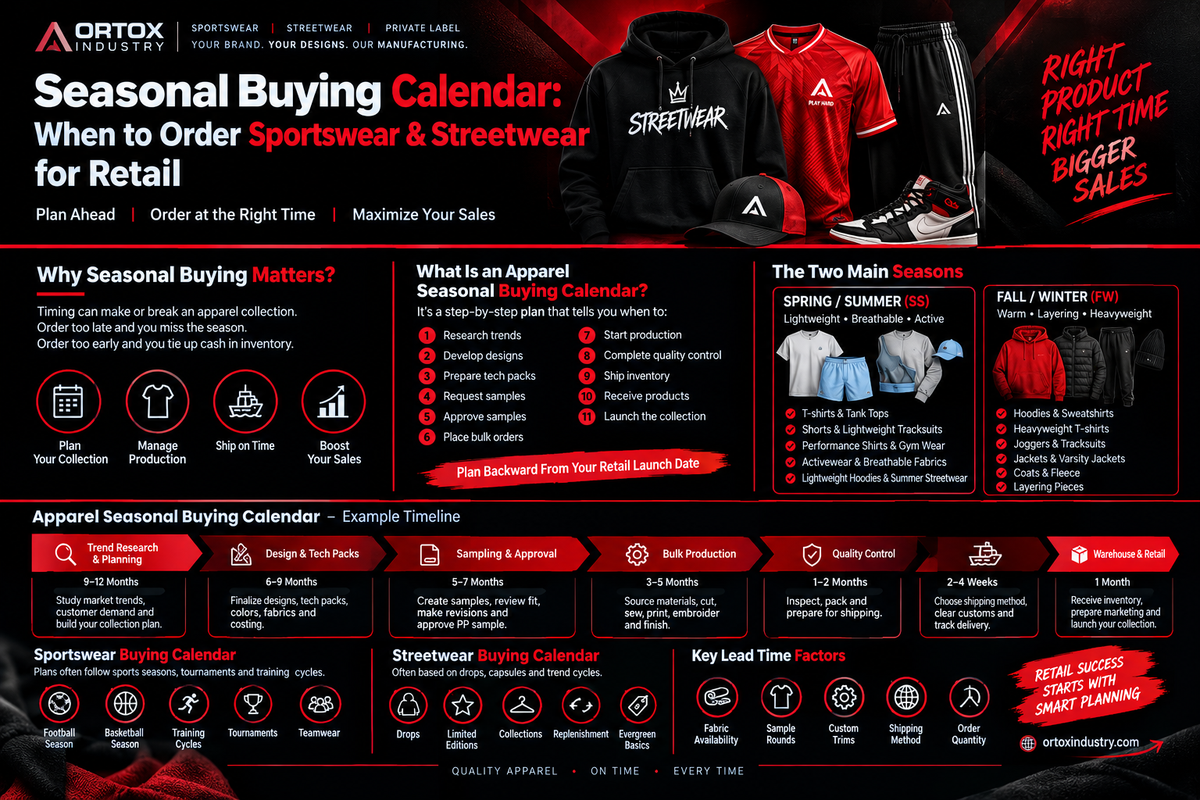
Seasonal Buying Calendar: When to Order Sportswear & Streetwear for Retail
A Complete Apparel Seasonal Buying Calendar for Sportswear, Streetwear & Private Label Clothing Brands
Timing can make or break an apparel collection.
A great product can miss its opportunity if it arrives after the selling season has already started. On the other hand, ordering too early can tie up cash in inventory long before customers are ready to buy.
This is why successful clothing brands, retailers, wholesalers and private label businesses do not simply ask:
“When should I place my clothing order?”
They ask:
“When does my collection need to be ready for customers, and when should I work backward to order, sample, manufacture and ship it?”
That difference is the foundation of an effective apparel seasonal buying calendar.
Whether you operate a sportswear brand, streetwear brand, activewear business, private label clothing company, online fashion store, retail boutique or wholesale apparel business, seasonal planning helps you coordinate product development, sampling, production, quality control, shipping and inventory arrival.
Traditional fashion calendars can run months ahead of the consumer selling season, although modern brands increasingly use smaller drops, replenishment programs and more flexible calendars.
For a brand working with an international clothing manufacturer, this becomes even more important.
Your production calendar may include:
- Design development
- Tech pack preparation
- Fabric sourcing
- Sample development
- Fit revisions
- Pre-production approval
- Fabric and trim purchasing
- Bulk cutting
- Sewing
- Printing
- Embroidery
- Finishing
- Quality control
- Packing
- International shipping
- Customs clearance
- Warehouse receiving
- Retail launch
If these stages are not planned together, a collection can easily become late.
This guide explains how to build a practical apparel seasonal buying calendar for sportswear and streetwear, how far in advance to order, how Spring/Summer differs from Fall/Winter, how lead times affect your buying decisions, and how brands can plan their collections backward from the retail launch date.
What Is an Apparel Seasonal Buying Calendar?
An apparel seasonal buying calendar is a planning system that tells a clothing brand when to:
- Research trends
- Develop designs
- Prepare tech packs
- Request samples
- Approve samples
- Place bulk orders
- Start production
- Complete quality control
- Ship inventory
- Receive products
- Launch the collection
The key idea is that the date customers see the product is usually not the date the manufacturer starts making it.
A retail launch in October may require production to begin months earlier.
A Spring/Summer collection planned for March may need sampling and manufacturing well before winter.
This is why experienced buyers work backward from the target retail date.
A recent apparel production guide describes the calendar as a chain of approvals and production stages rather than a single factory lead time.
Why Seasonal Buying Matters for Sportswear & Streetwear
Sportswear and streetwear are highly visual and often trend-sensitive categories.
Customers expect brands to release new:
- Hoodies
- T-shirts
- Joggers
- Tracksuits
- Jerseys
- Performance shirts
- Shorts
- Jackets
- Sweatshirts
- Activewear
- Matching sets
- Teamwear
- Oversized apparel
at the right time.
For example, launching heavyweight fleece hoodies at the end of winter may reduce the amount of time available to sell them at full price.
Similarly, launching lightweight sportswear after the peak summer training period may mean missing part of the demand window.
Seasonal planning helps brands align the product with customer purchasing behavior.
The Basic Fashion Buying Calendar
Although every business has its own calendar, two major seasonal cycles remain useful for planning:
Spring/Summer — SS
Spring/Summer collections generally focus on:
- Lightweight T-shirts
- Tank tops
- Shorts
- Lightweight tracksuits
- Performance shirts
- Gym wear
- Activewear
- Breathable fabrics
- Lightweight hoodies
- Summer streetwear
Fall/Winter — FW or AW
Fall/Winter collections generally focus on:
- Hoodies
- Sweatshirts
- Heavyweight T-shirts
- Joggers
- Tracksuits
- Jackets
- Varsity jackets
- Coats
- Fleece
- Heavyweight streetwear
- Layering pieces
Traditional wholesale calendars can run several months ahead of retail. One 2026 industry calendar, for example, describes SS and FW as roughly six months ahead of consumer selling periods, while also noting the growing use of resort, pre-fall and other mini-seasons.
However, today’s independent brands do not necessarily need to follow the traditional fashion-week calendar exactly.
Many use:
- Monthly drops
- Quarterly collections
- Capsule collections
- Limited editions
- Seasonal drops
- Pre-orders
- Restocks
- Evergreen basics
The best apparel seasonal buying calendar is therefore the one that matches your actual business model.
The Golden Rule: Plan Backward From Your Launch Date
One of the most useful principles in apparel sourcing is:
Start with the date you need inventory in your warehouse.
Then work backward.
For example, imagine a streetwear brand wants its Fall/Winter collection available to customers on September 15.
The planning process might look like:
September 15 — Retail launch
← Inventory received
← Shipping and customs
← Final QC and packing
← Bulk production
← Fabric and trim preparation
← PP sample approval
← Fit and sample revisions
← Initial sample
← Tech pack and costing
← Design development
This is much safer than waiting until September and asking a factory to produce the collection immediately.
Understanding Apparel Manufacturing Lead Time
The phrase apparel manufacturing lead time can be misleading because there is rarely one single number.
A factory might say:
“Bulk production takes 30 days.”
But that may not include:
- Sampling
- Fabric sourcing
- Custom dyeing
- Trim sourcing
- Artwork approval
- Payment processing
- Production queue
- Quality control
- Packing
- Shipping
- Customs clearance
Current manufacturer-published examples show substantial variation: some report sample development around 7–14 days and bulk around 3–6 weeks, while other programs publish longer overall timelines depending on customization and delivery terms.
Therefore, a buyer should calculate the complete product-to-market timeline, not only the sewing time.
A Practical Apparel Lead-Time Formula
For planning purposes, think of your timeline as:
Design + Sampling + Approval + Materials + Bulk Production + QC + Shipping + Customs + Buffer = Total Calendar Time
For example:
2–4 weeks design and sampling
1–3 weeks material preparation
3–6 weeks bulk production
1–2 weeks QC/packing/logistics
1–4 weeks international shipping depending on method and destination
=
A multi-week product-development cycle
These figures are planning examples rather than universal industry guarantees. Actual lead times vary by garment, factory, order quantity, material availability and destination. Published 2026 manufacturer guides show ranges from roughly several weeks for sampling and bulk through significantly longer programs when custom materials or additional approvals are involved.
Spring/Summer Apparel Buying Calendar
Let’s build a practical Spring/Summer apparel buying calendar.
Suppose your SS collection needs to arrive between February and April.
Your planning should begin months before the retail season.
9–12 Months Before Launch
Begin:
- Trend research
- Customer research
- Product planning
- Color planning
- Fabric research
- Competitor analysis
- Collection structure
- Budget planning
This is especially useful for brands developing completely new products.
6–9 Months Before Spring/Summer Launch
Now move into product development.
Work on:
- Design sketches
- Tech packs
- Measurements
- Fabric selection
- Colorways
- Print artwork
- Embroidery
- Labels
- Packaging
- Costing
This is the right stage to start communicating with your sportswear manufacturer or streetwear manufacturer.
If the manufacturer needs to source a special fabric or custom material, additional time may be necessary.
Custom materials can significantly extend the timeline compared with stock fabrics.
5–7 Months Before Launch
Start sampling.
Typical activities include:
- Prototype sample
- Fit sample
- Sample revisions
- Size-set review
- Artwork approval
- Fabric approval
- Trim approval
Do not rush this stage.
A problem discovered during sampling is generally easier to fix than the same problem discovered after hundreds of garments have been produced.
4–6 Months Before Launch
Move toward bulk-order decisions.
At this stage, brands should ideally have:
- Approved designs
- Approved measurements
- Approved materials
- Approved branding
- Confirmed quantities
- Confirmed size breakdown
- Confirmed colors
- Confirmed packaging
- Confirmed production schedule
The pre-production sample should be approved before bulk manufacturing begins.
2–4 Months Before Launch
Bulk production and logistics become the priority.
The factory may complete:
- Fabric cutting
- Sewing
- Printing
- Embroidery
- Finishing
- Quality control
- Packing
Then the goods move into shipping.
International shipping time varies by route, service and customs requirements, so it should be built into the calendar rather than treated as an afterthought.
1 Month Before Launch
Your inventory should ideally already be moving toward your warehouse or should have arrived.
Focus on:
- Receiving inventory
- Counting units
- Inspecting cartons
- Checking SKU quantities
- Photographing products
- Preparing product pages
- Preparing campaigns
- Preparing social media
- Preparing email marketing
- Preparing retail displays
The manufacturing process should not still be waiting for basic approvals at this point.
Fall/Winter Apparel Buying Calendar
Fall/Winter collections require a different product strategy.
Typical FW products include:
- Hoodies
- Sweatshirts
- Joggers
- Fleece sets
- Tracksuits
- Jackets
- Varsity jackets
- Heavyweight T-shirts
- Coats
- Layering pieces
The heavier the product and the more complicated the construction, the more carefully the calendar should be planned.
9–12 Months Before FW Launch
Begin:
- Trend research
- Collection planning
- Fabric research
- Color direction
- Product selection
- Competitive research
This is especially important for heavyweight streetwear.
A premium hoodie can involve multiple decisions:
- GSM
- Cotton composition
- Fleece construction
- Brushing
- Rib specification
- Hood construction
- Drawcord
- Embroidery
- Wash
- Label
- Packaging
A jacket or varsity jacket may require even more development.
6–8 Months Before FW Launch
Move into:
- Tech packs
- Pattern development
- Fabric sourcing
- Sample development
- Branding
- Color approval
For a new private label clothing brand, this is also a good point to finalize:
- Woven labels
- Neck labels
- Hang tags
- Packaging
- Custom polybags
- Brand cards
4–6 Months Before FW Launch
This is a key bulk-order period for many brands.
You should aim to have:
- Samples approved
- Quantities finalized
- Size breakdown finalized
- Fabric confirmed
- Branding approved
- Production slot confirmed
Do not wait until the beginning of the selling season to begin manufacturing.
2–4 Months Before FW Launch
Bulk production should be underway or nearing completion.
The process may include:
Cutting → Sewing → Printing/Embroidery → Finishing → QC → Packing
For international production, allow additional time for shipping and customs.
Apparel Seasonal Buying Calendar: Quick Reference
| Collection | Product Focus | Development | Bulk Planning | Target Arrival |
|---|---|---|---|---|
| Spring | T-shirts, light layers, activewear | Start months earlier | 3–6+ months ahead | Jan–Mar |
| Summer | Shorts, jerseys, lightweight apparel | Start months earlier | 3–6+ months ahead | Mar–May |
| Fall | Hoodies, sweatshirts, joggers | Start months earlier | 4–6+ months ahead | Jun–Aug |
| Winter | Heavy hoodies, jackets, coats | Start months earlier | 4–7+ months ahead | Aug–Oct |
| Holiday | Giftable apparel, fleece, sets | Start months earlier | 2–5+ months ahead | Oct–Nov |
These are planning frameworks, not fixed universal dates. The actual schedule should be calculated from your target launch, supplier lead time, sampling rounds and shipping route.
Sportswear Seasonal Buying Calendar
Sportswear requires additional planning because demand can be connected to:
- Sports seasons
- School calendars
- Club seasons
- Tournaments
- Training cycles
- Fitness trends
- Major sporting events
- Regional weather
For sports clubs, the buying calendar can be different from a fashion retailer.
For example, a football club may need:
- Home kits
- Away kits
- Training wear
- Tracksuits
- Warm-up jackets
- Staff uniforms
- Fan merchandise
The key date is often the first match or training period, not simply Spring or Fall.
Sports Club Teamwear Planning
Suppose a football academy needs custom uniforms for a new season beginning in August.
The academy should not wait until August.
A better approach is:
August — New season starts
← Kits delivered
← Shipping
← QC & packing
← Bulk production
← PP approval
← Sample
← Player size requirements
← Design approval
← Initial inquiry
This backward planning approach helps prevent last-minute teamwear problems.
For customized jerseys with player names, numbers and logos, the order should also account for artwork and roster changes.
Sportswear Manufacturer Lead Times
When choosing a sportswear manufacturer, ask for a complete timeline rather than only asking:
“How many days for production?”
Ask:
- How long does sampling take?
- How many sample rounds are included?
- How long does fabric sourcing take?
- When does bulk production start?
- How long is production?
- When does QC happen?
- How long does packing take?
- What shipping options are available?
- How long does delivery typically take?
A 2026 sportswear manufacturing reference describes an example total journey of roughly 6–10 weeks from inquiry through delivery, with sampling, bulk production and shipping each contributing to the timeline.
Another manufacturer lists sample and bulk windows separately and emphasizes that the actual schedule depends on specifications and material availability.
This illustrates an important point:
Never build your retail calendar around one factory number without understanding what that number includes.
Streetwear Seasonal Buying Calendar
Streetwear operates somewhat differently from traditional seasonal fashion.
Many streetwear brands use:
- Drops
- Capsules
- Limited releases
- Collaborations
- Seasonal collections
- Restocks
- Small-batch launches
This means a streetwear brand may need multiple buying calendars throughout the year.
Instead of only planning:
SS Collection
and
FW Collection
you may plan:
- January drop
- March capsule
- May summer collection
- July transitional drop
- September FW collection
- November holiday drop
This approach can create more frequent customer engagement but requires stronger production planning.
Best Time to Order Hoodies
Hoodies are a major product for streetwear brands and private label clothing brands.
For a Fall/Winter launch, do not wait for cold weather to begin production.
A safer planning approach is:
Winter demand → order and produce months earlier.
If you want your heavyweight hoodies available in September or October, sampling and bulk production should already be planned well before the weather turns cold.
This is especially important for:
- Heavyweight fleece
- Custom dye colors
- Garment washes
- Embroidery
- Large screen prints
- Custom labels
- Special packaging
Best Time to Order T-Shirts
T-shirts generally have a broader selling window than heavy winter products.
They can be used for:
- Spring collections
- Summer collections
- Gym wear
- Streetwear
- Everyday basics
- Merchandise
- Teamwear
Because T-shirts can function as both seasonal and evergreen products, brands can use a mixed strategy.
For seasonal graphics, plan around the launch.
For evergreen blank or branded basics, consider smaller repeat orders and replenishment.
Best Time to Order Tracksuits
Tracksuits can cross multiple seasons.
They are useful for:
- Sports teams
- Streetwear brands
- Training
- Travel
- Lifestyle collections
- Athleisure
For sportswear, the key date may be the beginning of the sporting season.
For streetwear, the product can be positioned as a transitional or Fall/Winter item.
This means the apparel seasonal buying calendar should be built around customer use rather than simply a generic season label.
Best Time to Order Joggers
Joggers can also be year-round products.
Heavy fleece joggers are especially suitable for:
- Fall
- Winter
- Cold-weather streetwear
Lightweight joggers can work for:
- Spring
- Summer evenings
- Training
- Travel
- Athleisure
Brands should select the fabric and weight based on the intended retail season.
Seasonal Fabric Planning
Fabric sourcing is one of the most important parts of seasonal apparel planning.
A brand should decide early whether it wants:
Stock Fabric
Usually easier to source and potentially faster.
Custom Color
May require additional dyeing or lab-dip approval.
Custom Fabric
May require additional development and production time.
Special Finish
Washing, brushing, coating, distressing or other treatments can add complexity.
If your collection depends on a particular fabric, confirm availability before locking the launch date.
Why Custom Colors Can Affect Your Calendar
Suppose your streetwear collection requires a unique red shade.
You may need:
- Color reference
- Lab dip
- Review
- Correction
- Approval
- Bulk dyeing
If the color is not approved quickly, the entire production schedule can move.
This is why color approvals should happen early.
The same principle applies to:
- Custom black
- Washed grey
- Cream
- Olive
- Burgundy
- Navy
- Pastel shades
- Neon performance colors
How MOQ Affects Seasonal Buying
MOQ means Minimum Order Quantity.
For emerging brands, MOQ can affect seasonal planning because ordering too much inventory creates financial risk.
Suppose a new brand expects to sell 300 hoodies.
If its manufacturer requires a very high MOQ, the brand may need to over-order.
A manufacturer offering more flexible quantities may allow the brand to test demand before scaling.
However, lower quantities can sometimes affect:
- Unit price
- Fabric sourcing
- Custom dyeing
- Trim pricing
- Production efficiency
Therefore, MOQ should be considered together with the seasonal sales forecast.
Seasonal Buying for New Clothing Brands
New brands should avoid copying the buying calendar of huge fashion corporations.
A startup might use:
Small initial quantity → customer feedback → reorder → scale
instead of:
Huge seasonal order → hope everything sells
This can be particularly useful for:
- New streetwear brands
- Small sportswear brands
- Instagram brands
- Shopify clothing stores
- Private label startups
- Boutique retailers
The goal is to balance:
Product availability + cash flow + demand risk.
Reorders vs Seasonal Orders
Not every product needs to follow a traditional seasonal cycle.
Some products are evergreen.
Examples:
- Black T-shirts
- Basic hoodies
- Classic joggers
- Plain sweatshirts
- Core sports jerseys
- Essential activewear
These products can be managed through replenishment.
A strong apparel business can therefore use two systems:
Seasonal Calendar
For new collections and trend products.
Replenishment Calendar
For products that consistently sell.
This combination can make inventory planning more flexible.
The Importance of Buffer Time
One of the biggest mistakes in seasonal apparel buying is planning with zero buffer.
Suppose you calculate:
- 10 days sampling
- 30 days production
- 7 days shipping
You might think:
47 days total.
But real projects can involve:
- Sample revisions
- Fabric delays
- Artwork changes
- Production queue
- QC issues
- Public holidays
- Customs
- Carrier delays
Therefore, add a reasonable buffer.
The exact buffer depends on the project.
A simple repeat order with approved materials may need less buffer than a completely new collection using custom fabric and complex decoration.
Common Seasonal Buying Mistakes
Mistake 1: Ordering When Customers Start Shopping
By then, manufacturing may already be too late.
Mistake 2: Ignoring Sampling
Sampling is part of product development, not an optional extra.
Mistake 3: Forgetting Shipping
Production completion does not mean the inventory is in your warehouse.
Mistake 4: Ignoring Customs
International shipments may require additional clearance time.
Mistake 5: No Buffer
One small delay can become a launch delay.
Mistake 6: Ordering Too Much
Over-ordering can create cash-flow and inventory problems.
Mistake 7: Ordering Too Little
Under-ordering can lead to stockouts during peak demand.
Mistake 8: Using the Same Calendar for Every Product
A T-shirt, hoodie, jacket and technical sportswear product may have very different development timelines.
How to Build Your Own Apparel Seasonal Buying Calendar
Start with a spreadsheet.
Create these columns:
| Planning Stage | Target Date |
|---|---|
| Retail Launch | |
| Warehouse Arrival | |
| Shipping Start | |
| QC & Packing | |
| Bulk Production Complete | |
| Bulk Production Start | |
| Fabric Ready | |
| PP Approval | |
| Fit Approval | |
| Sample Review | |
| Tech Pack Complete | |
| Design Finalized | |
| Collection Concept |
Then fill the calendar from bottom to top.
This is essentially reverse planning.
Example: Fall/Winter Streetwear Collection
Imagine a brand wants a collection to launch on October 1.
A planning framework could look like:
October 1
Retail launch.
September
Inventory received and launch preparation.
August
Shipping, customs and receiving.
July
Bulk production and final QC.
June
Bulk production begins.
May
Fabric and trims finalized.
April
PP sample approved.
March
Fit revisions and final sample.
February
Initial samples.
January
Tech packs and costing.
Previous Q4
Trend research and collection planning.
The exact dates should be adjusted based on your manufacturer’s quoted timeline and shipping method.
Example: Spring/Summer Sportswear Collection
Suppose a sportswear brand wants its collection available on March 1.
A possible framework:
March
Collection launch.
February
Inventory receiving and marketing.
January
Shipping and customs.
December
Bulk production/QC.
November
Production begins.
October
Fabric and trims.
September
PP approval.
August
Fit and revisions.
July
Sampling.
June
Tech packs and product development.
Again, this is a planning example, not a universal factory schedule.
Seasonal Buying Calendar for International Retailers
International buyers should consider the location of both:
Manufacturing
and
Retail market.
A manufacturer in Pakistan, for example, may need to ship products to:
- USA
- UK
- Canada
- Europe
- Australia
- New Zealand
The retail season may be similar, but the shipping distance and logistics process can differ.
For international apparel sourcing, the buyer should therefore request:
- Production lead time
- Shipping estimate
- Shipping method
- Incoterm
- Customs responsibility
- Documentation requirements
- Expected delivery window
This allows the retail calendar to reflect the entire supply chain.
Air Freight vs Sea Freight in Seasonal Planning
Shipping method can influence the buying calendar.
Air Freight
Advantages:
- Faster
- Useful for urgent replenishment
- Useful for smaller shipments
- Helpful when a launch date is close
Potential disadvantages:
- Higher cost
- Less attractive for very large shipments
Sea Freight
Advantages:
- Often more economical for larger shipments
- Useful for planned seasonal inventory
Potential disadvantages:
- Longer transit
- More planning required
- Greater need for schedule buffer
The right option depends on:
- Order size
- Destination
- Budget
- Urgency
- Product value
- Required delivery date
Seasonal Buying and Cash Flow
Timing is not only about manufacturing.
It is also about cash flow.
If you order your entire seasonal collection too early, you may have capital sitting in inventory for months.
If you order too late, you may pay premium shipping or miss sales.
The ideal calendar balances:
Production timing + inventory investment + expected sales + cash flow.
This is particularly important for small clothing brands.
Seasonal Buying and Inventory Risk
A seasonal product has a limited commercial window.
For example:
A winter heavyweight hoodie may sell strongly during cold weather but become less attractive as temperatures rise.
A summer tank top may have a smaller window in colder markets.
Therefore, seasonal buyers should consider:
- Expected demand
- Historical sales
- Weather
- Market
- Product category
- Price
- Inventory levels
- Reorder possibility
A smaller first order with a reliable reorder option can sometimes reduce risk.
The Role of Data in Seasonal Apparel Buying
Your previous sales data can make your buying calendar smarter.
Track:
- Units sold
- Sell-through rate
- Best colors
- Best sizes
- Best styles
- Return rates
- Stockout dates
- Reorder timing
- Customer feedback
If black hoodies consistently sell out first, that information should influence the next seasonal order.
If a particular sports jersey size sells slowly, adjust the next size breakdown.
Seasonal buying should become increasingly data-driven as the business grows.
Apparel Buying Calendar for Streetwear Drops
A streetwear drop may use a shorter cycle.
For example:
Launch date
↓
2–4 weeks logistics
↓
3–6 weeks production
↓
1–3 weeks sampling/approval
↓
Design and tech pack
The exact timeline depends on the manufacturer and product.
Current published apparel manufacturing schedules demonstrate that sampling and bulk production can vary widely by supplier and product complexity.
For this reason, streetwear brands should confirm the manufacturer’s actual schedule before announcing a launch publicly.
Apparel Seasonal Buying Calendar for Private Label Brands
Private label businesses need additional time for branding.
A private label order may require:
- Custom labels
- Hang tags
- Packaging
- Logo embroidery
- Custom prints
- Branded tape
- Custom bags
- Size labels
- Care labels
These details should be included in the production calendar.
A common mistake is to calculate the garment production time and forget that branded components also need to be manufactured and approved.
How to Work With Your Clothing Manufacturer
A good manufacturer relationship should include clear communication about:
Product
What are you making?
Quantity
How many pieces?
Size breakdown
How many XS, S, M, L, XL, etc.?
Colorways
Which colors and quantities?
Materials
Which fabrics and GSM?
Branding
Which labels, prints and embroidery?
Timeline
When does the inventory need to arrive?
Shipping
Which destination and shipping method?
Approval
Who signs off on samples?
When these details are clear, seasonal production becomes much easier to manage.
Why Early Communication With Your Manufacturer Matters
Do not contact a factory only when you are ready to place the bulk order.
A better approach is to involve your manufacturer early.
You can ask:
“We are planning our Fall/Winter collection for an October launch. What production timeline should we reserve?”
This gives the manufacturer an opportunity to assess:
- Product complexity
- Materials
- Sampling requirements
- Production capacity
- Order quantity
- Shipping timeline
Early communication can reveal potential bottlenecks before they become urgent.
Seasonal Planning for Sportswear Manufacturers
For custom sportswear manufacturing, seasonality can also be driven by events.
Examples include:
- Football seasons
- Basketball seasons
- Rugby seasons
- School sports
- University sports
- Fitness competitions
- Local tournaments
- Club calendars
A teamwear buyer should begin with the date the team needs the uniforms.
Then work backward through:
Roster → Design → Sample → Approval → Bulk → QC → Shipping → Delivery
This is more accurate than using a generic fashion calendar.
Seasonal Planning for Streetwear Manufacturers
For streetwear manufacturing, the calendar can be built around product drops.
Example:
Q1
Heavyweight basics and transitional pieces.
Q2
T-shirts, lightweight sweatshirts and summer streetwear.
Q3
Fall transition, hoodies, joggers and tracksuits.
Q4
Heavyweight fleece, jackets, winter streetwear and holiday products.
But brands should also consider their specific audience and geography.
A streetwear brand selling primarily in Australia may have a very different seasonal calendar from a brand selling primarily in the United States, United Kingdom or Europe.
Geography Changes Your Apparel Calendar
Seasonality is not identical worldwide.
When it is winter in the Northern Hemisphere, it is summer in much of the Southern Hemisphere.
This matters for brands selling internationally.
If your customers are located across:
- USA
- Canada
- UK
- Europe
- Australia
- New Zealand
you may need a more flexible collection strategy.
Instead of creating one global seasonal inventory plan, consider regional demand.
Building a Multi-Market Buying Calendar
For international brands, create separate columns:
| Market | Main Season | Launch | Product Focus |
|---|---|---|---|
| USA | SS | Planned date | Lightweight apparel |
| UK | SS | Planned date | T-shirts/layers |
| Europe | SS | Planned date | Active/streetwear |
| Canada | FW | Planned date | Fleece/layers |
| Australia | SS/FW opposite cycle | Planned date | Regional assortment |
| New Zealand | SS/FW opposite cycle | Planned date | Regional assortment |
This approach prevents you from assuming every market has identical seasonal demand.
The 90-Day Rule vs Longer Seasonal Planning
Some apparel businesses can work on relatively short cycles.
Others need much longer.
A basic repeat product made from stocked materials may move quickly.
A completely new collection may require:
- Design
- Sampling
- Fabric development
- Multiple revisions
- Custom trims
- Bulk production
- International shipping
Therefore, do not build your calendar around an arbitrary “90-day rule.”
Build it around the actual product.
A Better Way to Think About Lead Time
Instead of saying:
“The factory needs 30 days.”
Think:
“My product needs to pass through every stage between design and retail.”
For example:
Design
→ Tech Pack
→ Sampling
→ Approval
→ Material Preparation
→ Bulk Production
→ QC
→ Packing
→ Shipping
→ Customs
→ Warehouse
→ Retail
That is your real lead time.
Seasonal Buying Checklist
Before placing a seasonal apparel order, ask:
Product
☐ Which products are seasonal?
☐ Which products are evergreen?
☐ Which products are new?
☐ Which products are being restocked?
Design
☐ Are all designs finalized?
☐ Are tech packs complete?
☐ Are measurements approved?
Sampling
☐ Has the sample been reviewed?
☐ Is the fit approved?
☐ Is the PP sample approved?
Materials
☐ Is fabric available?
☐ Are colors approved?
☐ Are trims available?
Branding
☐ Labels approved?
☐ Artwork approved?
☐ Packaging approved?
Production
☐ Quantity confirmed?
☐ Size breakdown confirmed?
☐ Production slot reserved?
Logistics
☐ Shipping method confirmed?
☐ Destination confirmed?
☐ Customs requirements checked?
☐ Delivery buffer included?
Retail
☐ Product pages ready?
☐ Photography planned?
☐ Marketing campaign scheduled?
☐ Launch date confirmed?
How Far Ahead Should You Contact a Clothing Manufacturer?
For a completely new collection, contacting manufacturers several months before your intended retail launch is a safer planning approach than waiting until the last minute.
The more complicated the product, the earlier you should begin.
Especially plan early if you need:
- Custom fabric
- Custom colors
- Complex embroidery
- Garment washing
- Heavyweight fleece
- Technical performance fabric
- Special trims
- Custom packaging
- Multiple sample rounds
- Large quantities
A recent 2026 apparel lead-time guide notes that custom materials can add several weeks before factory production, while another manufacturer guide separates sampling, production and shipping into distinct stages.
Seasonal Buying Calendar for a Growing Clothing Brand
If you are a growing brand, your annual calendar can be simplified into four major planning periods.
Q1 — Spring & Summer
Focus on:
- T-shirts
- Shorts
- Lightweight sportswear
- Activewear
- Summer streetwear
- Early Fall/Winter design research
Q2 — Summer & Fall Development
Focus on:
- Hoodies
- Sweatshirts
- Joggers
- Tracksuits
- Jackets
- FW sampling
Q3 — Fall & Winter Production
Focus on:
- Heavyweight hoodies
- Fleece
- Jackets
- Winter streetwear
- Holiday collections
- Next Spring/Summer research
Q4 — Holiday & Next-Year Planning
Focus on:
- Holiday drops
- Best-seller replenishment
- Next SS collection
- Annual supplier review
- Production capacity planning
This creates a continuous product-development cycle instead of treating each collection as a separate emergency project.
Seasonal Apparel Buying Calendar for 2027 Planning
If you are planning future collections, the safest approach is to begin with the launch date and work backward.
For example:
Spring/Summer 2027
Research → Design → Sampling → Approval → Production → Shipping → Retail
Fall/Winter 2027
Research → Design → Sampling → Approval → Production → Shipping → Retail
The exact buying months should be adjusted according to:
- Target market
- Retail launch
- Factory location
- Product category
- Shipping method
- Supplier lead time
- Holiday closures
- Fabric availability
This is especially important when working internationally.
How Holiday Closures Can Affect Production
International apparel manufacturing calendars can be affected by factory holidays and regional holiday periods.
Before confirming your launch date, ask your manufacturer:
“Are there any factory holidays or capacity restrictions during our production window?”
This question can prevent unexpected delays.
Your calendar should include a buffer around major holiday periods when relevant to your manufacturing region.
Seasonal Buying and Quality Control
Never remove QC from your calendar just to meet a launch date.
If production finishes on Monday and your retail launch is Tuesday, you may not have enough time to identify and correct a serious issue.
A better calendar includes time for:
Production → QC → Corrections if needed → Packing → Shipping
Quality control is part of the delivery timeline.
Seasonal Buying for Low-MOQ Brands
Low MOQ can be useful for testing seasonal products.
For example:
Instead of producing 1,000 units of a new hoodie immediately, a brand may start with a smaller quantity.
Then:
Launch → Sell → Analyze → Reorder
This approach can reduce inventory risk.
However, the reorder timeline should be discussed with the manufacturer before launch.
If your best-selling product sells out in one week but the factory needs several weeks to reproduce it, you may experience a stockout.
Therefore, low-MOQ brands should think about reorder lead time, not just initial order quantity.
Seasonal Buying vs Fast Fashion
Not every brand needs a traditional six-month calendar.
Fast-moving brands may use:
- Smaller batches
- Faster development
- Frequent drops
- Rapid replenishment
Traditional wholesale brands may use:
- Seasonal collections
- Buyer appointments
- Larger advance orders
- Longer planning cycles
Streetwear brands often sit somewhere between these models.
The right strategy depends on your customer and business model.
What Retail Buyers Should Ask Their Apparel Manufacturer
Before finalizing a seasonal order, ask:
1. What is your sample lead time?
2. What is your bulk production lead time after approval?
3. Does the lead time include fabric sourcing?
4. Does it include printing and embroidery?
5. When does the production clock officially start?
6. How many revision rounds should we expect?
7. What happens if fabric is unavailable?
8. What is your busiest production period?
9. How long does shipping normally take to our destination?
10. What buffer do you recommend?
These questions help convert a vague timeline into a realistic production plan.
Why Ortox Industry Can Be Part of Your Seasonal Manufacturing Plan
For brands searching for a reliable sportswear manufacturer, streetwear manufacturer, custom clothing manufacturer or private label clothing manufacturer, Ortox Industry provides a manufacturing-focused route for developing custom apparel collections.
Ortox Industry — ortoxindustry.com
Brands can plan products such as:
- Custom sportswear
- Custom jerseys
- Teamwear
- Performance apparel
- Gym wear
- T-shirts
- Oversized T-shirts
- Hoodies
- Zip-up hoodies
- Sweatshirts
- Joggers
- Tracksuits
- Streetwear
- Private label apparel
- Custom jackets
- Varsity jackets
For seasonal collections, the important objective is to start early enough to allow:
Design → Sampling → Approval → Production → Quality Control → Shipping → Retail Launch
The earlier these stages are coordinated, the easier it becomes to manage your seasonal inventory.
The Best Apparel Seasonal Buying Strategy
There is no single perfect date for every clothing brand.
The better strategy is to create a calendar based on your own:
- Retail launch date
- Product category
- Target market
- Manufacturing location
- Sample timeline
- Production timeline
- Shipping method
- Sales forecast
- Inventory budget
The key is reverse planning.
Start with:
“When does the customer need the product?”
Then calculate backward.
A Simple Seasonal Buying Formula
Use this formula:
Retail Launch Date
minus
Warehouse & Receiving Time
minus
Shipping & Customs
minus
QC & Packing
minus
Bulk Production
minus
Fabric & Trim Preparation
minus
PP Approval
minus
Sampling & Revisions
minus
Design & Tech Pack
=
Your Ideal Development Start Date
Then add a reasonable buffer.
This is the foundation of a professional apparel seasonal buying calendar.
Final Apparel Seasonal Buying Calendar
For most growing sportswear and streetwear brands, a practical planning structure is:
9–12 Months Before Launch
Research + Concept
- Trends
- Customer demand
- Product range
- Colors
- Fabrics
6–9 Months Before Launch
Design + Development
- Tech packs
- Costing
- Fabric
- Branding
4–6 Months Before Launch
Sampling + Approval
- Prototype
- Fit sample
- Revisions
- PP sample
2–4 Months Before Launch
Bulk Production
- Cutting
- Sewing
- Printing
- Embroidery
- Finishing
1–2 Months Before Launch
Logistics
- QC
- Packing
- Shipping
- Customs
- Warehouse
Launch Month
Retail
- Product photography
- Website
- Social media
- Email marketing
- Retail merchandising
- Customer launch
The actual schedule can be shorter or longer depending on the manufacturer and product complexity.
Conclusion: Order Early, Launch With Confidence
The biggest lesson of an apparel seasonal buying calendar is simple:
Don’t plan production from the day you want to order.
Plan production backward from the day you want to sell.
For sportswear brands, this means considering sports seasons, tournaments, training calendars and team requirements.
For streetwear brands, it means coordinating drops, capsules, hoodies, T-shirts, joggers, tracksuits and seasonal collections with customer demand.
For private label clothing brands, it means allowing enough time for samples, labels, branding, packaging and approvals.
And for international apparel buyers, it means including manufacturing, quality control, shipping and customs in the same calendar.
A successful collection is not only about designing great clothing.
It is about getting the right product to the right customer at the right time.
The brands that plan early have more room to:
- Improve samples
- Negotiate production
- Confirm materials
- Reserve factory capacity
- Control quality
- Manage cash flow
- Choose economical shipping
- Prepare marketing
- Avoid last-minute production pressure
If you are preparing your next sportswear or streetwear collection, start by deciding your retail launch date and work backward from there.
For custom manufacturing and private label apparel development, you can explore:
ortoxindustry.com — Sportswear & Streetwear Manufacturing
Ortox Industry
Your Brand. Your Designs. Our Manufacturing.
Frequently Asked Questions
What is an apparel seasonal buying calendar?
An apparel seasonal buying calendar is a schedule that maps design, sampling, production, shipping and inventory arrival against the retail season.
When should I order Spring/Summer clothing?
For custom manufacturing, begin planning several months before the intended retail launch. More complex collections should start earlier because sampling, custom materials and revisions can add time.
When should I order Fall/Winter clothing?
For Fall/Winter, begin development well before the weather turns cold. Hoodies, fleece, jackets and heavyweight streetwear often require more planning than simple basics.
How far in advance should I contact a clothing manufacturer?
For a new collection, contacting the manufacturer several months before launch is a safer approach. Complex products requiring custom materials or multiple samples should be started earlier.
How long does apparel manufacturing take?
There is no universal timeline. Sampling, material sourcing, bulk production, QC and shipping can each contribute to the final delivery date. Current published manufacturer timelines show significant variation depending on product and specifications.
Is the traditional fashion calendar still important?
Yes, especially for wholesale and larger retail operations, but modern brands increasingly use drops, capsules, replenishment and shorter product cycles.
Should streetwear brands follow Spring/Summer and Fall/Winter?
They can, but they do not have to. Many streetwear brands combine seasonal collections with smaller drops and evergreen products.
Should sportswear brands use the same calendar as fashion brands?
Not necessarily. Sportswear often needs to be planned around team seasons, tournaments, school calendars, training schedules and sporting events.
Does shipping count as apparel lead time?
Yes. Your inventory is not ready for retail until it reaches the required destination. Shipping and customs should therefore be included in the seasonal buying calendar.
What is the biggest seasonal buying mistake?
Waiting until the retail season starts before contacting the manufacturer. The safest approach is to start from the target launch date and work backward through every development and production stage.
Final SEO Takeaway
The apparel seasonal buying calendar is more than a list of months. It is a complete planning framework connecting sportswear manufacturing, streetwear manufacturing, private label apparel, sampling, bulk production, quality control, international shipping and retail launch timing.
Plan early.
Approve carefully.
Build in buffer.
And always work backward from the date your customer needs the product.