

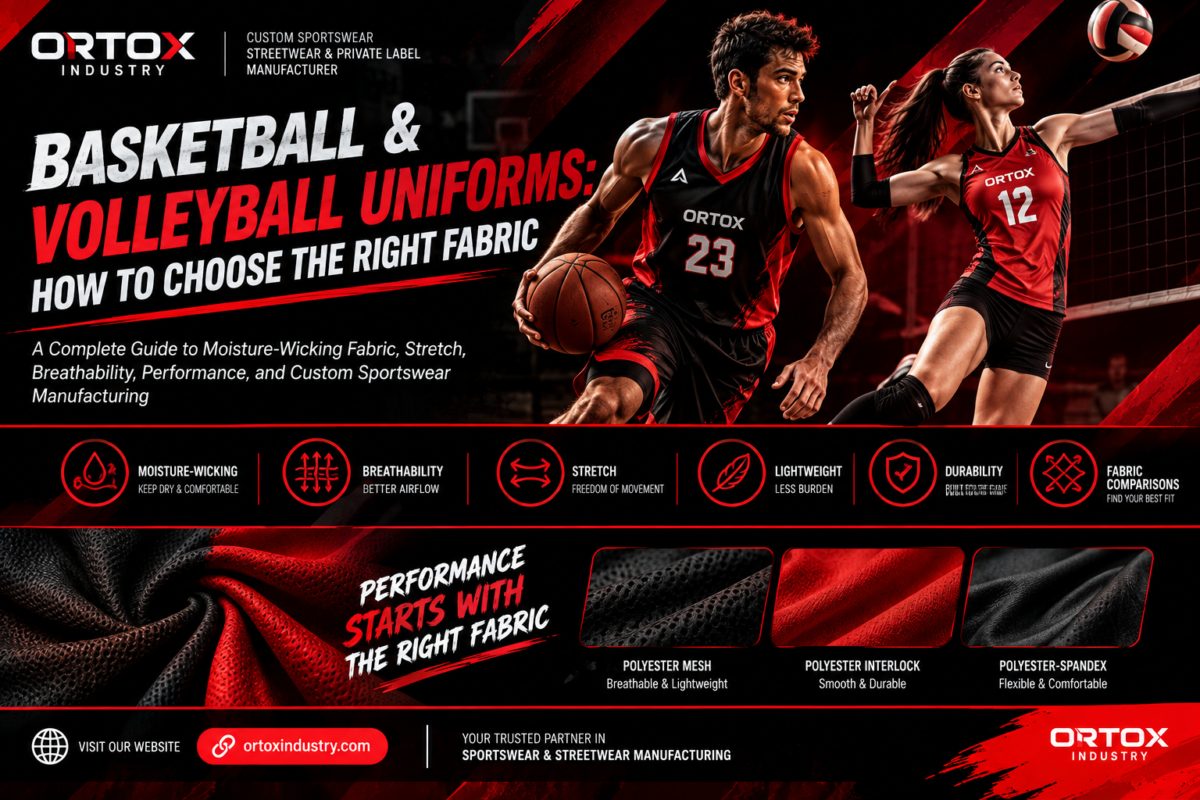
# Basketball & Volleyball Uniforms: How to Choose the Right Fabric ## A Complete Guide to Moisture-Wicking Fabric, Stretch, Breathability, Performance, and Custom Sportswear Manufacturing Choosing the right fabric is one of the most important decisions when developing **basketball and volleyball uniforms**. A uniform is not simply a visual representation of a team. It is a performance garment that needs to support movement, manage moisture, provide airflow, maintain its shape, withstand repeated washing, and remain comfortable throughout practices and competitive games. For teams, academies, schools, clubs, distributors, retailers, and private-label sportswear brands, fabric selection can directly affect the quality and performance of the final uniform. A basketball player may sprint, jump, pivot, and change direction repeatedly during a game. A volleyball player may jump, dive, reach, block, and move laterally across the court. These activities create different performance requirements, which means the fabric should be selected according to the sport, garment construction, climate, fit, and intended use. If you are searching for a reliable **basketball uniform manufacturer**, understanding fabric technology can help you communicate better with your manufacturing partner and make more informed product decisions. This guide explains the most important fabric characteristics for basketball and volleyball uniforms, including **moisture-wicking performance, breathability, stretch, lightweight construction, durability, fabric weight, comfort, printing compatibility, and customization**. For brands developing complete sportswear collections, these same principles can also help when selecting fabrics for performance shirts, shorts, training wear, tracksuits, and other athletic apparel. — ## Table of Contents 1. Why Fabric Matters in Basketball and Volleyball Uniforms 2. Understanding Moisture-Wicking Fabric 3. What Makes a Sportswear Fabric Breathable? 4. Stretch and Freedom of Movement 5. Basketball vs Volleyball Fabric Requirements 6. Polyester for Basketball Uniforms 7. Polyester Mesh and Breathable Construction 8. Micro Polyester and Interlock Fabrics 9. Polyester-Spandex Performance Blends 10. Fabric Weight and GSM 11. Quick-Dry Performance 12. Moisture Management vs Breathability 13. Durability for Team Uniforms 14. Comfort and Hand Feel 15. Sublimation Printing and Fabric Selection 16. Choosing Fabric for Basketball Jerseys 17. Choosing Fabric for Basketball Shorts 18. Choosing Fabric for Volleyball Jerseys 19. Choosing Fabric for Volleyball Shorts 20. Men’s, Women’s, and Youth Uniform Considerations 21. Fit and Fabric Relationship 22. Fabric Selection for Different Climates 23. Practice Uniforms vs Game-Day Uniforms 24. Customization and Branding 25. Sportswear Manufacturing Quality Control 26. How to Choose a Basketball Uniform Manufacturer 27. Questions to Ask Your Manufacturer 28. Why Custom Manufacturing Matters for Sportswear Brands 29. Basketball Uniforms and Streetwear 30. Building a Complete Sportswear Collection 31. Private Label Sportswear Manufacturing 32. Common Fabric Selection Mistakes 33. How Ortox Industry Approaches Custom Sportswear 34. Basketball and Volleyball Uniform Manufacturing Checklist 35. FAQs 36. Final Thoughts — # 1. Why Fabric Matters in Basketball and Volleyball Uniforms A professional-looking uniform begins with good design, but design alone cannot determine performance. The fabric is responsible for many of the physical characteristics players experience while wearing the uniform. A suitable sportswear fabric can help provide: * Lightweight comfort * Moisture management * Breathability * Flexibility * Freedom of movement * Quick drying * Shape retention * Durability * Comfortable skin feel * Consistent appearance * Compatibility with printing and branding Modern sportswear manufacturers commonly develop fabrics around these performance requirements. Basketball applications often prioritize lightweight construction, airflow, and comfort, while volleyball garments may place additional emphasis on stretch and unrestricted movement. Industry fabric guides similarly identify breathability, moisture management, stretch, and comfort as major performance considerations. The right fabric therefore depends on the actual application. A recreational basketball team playing indoors may require a different fabric specification from a private-label sportswear brand selling premium performance uniforms in warm climates. Likewise, a volleyball team requiring a fitted women’s jersey may need different stretch characteristics from a loose-fit basketball jersey. — # 2. Understanding Moisture-Wicking Fabric One of the most important terms in modern sportswear is **moisture-wicking**. Moisture-wicking fabric is designed to move perspiration away from the skin toward the outer surface of the garment, where it can evaporate more efficiently. This can make the uniform feel more comfortable during intense physical activity. Basketball and volleyball involve repeated bursts of movement, jumping, running, and rapid changes of direction. Players can therefore generate significant heat and perspiration. A moisture-management fabric can help reduce the uncomfortable feeling of wet fabric against the skin. Common performance materials include polyester and polyester-based constructions. Polyester is widely used in sportswear because it can be lightweight, durable, quick-drying, and suitable for sublimation printing. Polyester mesh can provide additional airflow through its open structure, while polyester-spandex blends can add stretch for garments requiring greater flexibility. — # 3. What Makes a Sportswear Fabric Breathable? Breathability refers to how effectively air can move through or around a garment. For basketball and volleyball uniforms, breathability can be particularly important because players spend extended periods performing high-intensity movements. A breathable uniform can help improve wearing comfort by allowing heat and moisture to move away from the body. Several factors affect breathability: ### Fabric construction An open mesh structure generally allows more airflow than a dense fabric construction. ### Fabric weight A lighter fabric can feel less bulky and may improve comfort during active movement. ### Knit structure Different knitting structures can produce different levels of airflow, flexibility, and surface texture. ### Garment design Even a breathable fabric can perform differently depending on the garment’s panels, fit, seams, neckline, and ventilation areas. For basketball uniforms, lightweight mesh is frequently selected where airflow is a priority. Volleyball garments can also benefit from lightweight breathable performance materials. — # 4. Stretch and Freedom of Movement Stretch is another critical consideration. Basketball players need freedom of movement for: * Jump shots * Layups * Rebounding * Sprinting * Pivoting * Defensive movement * Rapid changes of direction Volleyball players similarly need mobility for: * Serving * Jumping * Blocking * Spiking * Digging * Diving * Setting * Lateral movement A fabric with suitable mechanical or elastane-based stretch can help the garment move with the athlete. However, maximum stretch is not always necessary. A loose basketball jersey may require less stretch than a fitted volleyball uniform. This is why fabric should be selected together with the garment pattern and intended fit. — # 5. Basketball vs Volleyball Fabric Requirements Basketball and volleyball are both indoor court sports, but their uniforms can have different construction requirements. ## Basketball Basketball uniforms commonly prioritize: * Lightweight performance * Breathability * Moisture management * Comfortable loose or athletic fit * Durability * Easy movement * Vibrant team graphics Basketball jerseys are frequently paired with loose or athletic shorts. ## Volleyball Volleyball uniforms can prioritize: * Lightweight construction * Breathability * Stretch * Flexibility * Comfortable fitted construction * Moisture management * Freedom of movement Volleyball garments may also include fitted tops, performance shorts, spandex-based bottoms, or specialized cuts. Industry guidance for volleyball teamwear similarly highlights lightweight fabric, stretch, breathability, moisture management, and comfortable construction as useful characteristics. The important lesson is that **there is no single universal sportswear fabric that is perfect for every team**. — # 6. Polyester for Basketball Uniforms Polyester is one of the most common materials used in performance sportswear. For basketball uniforms, polyester can offer several advantages: * Lightweight construction * Durability * Quick drying * Shape retention * Color stability * Sublimation compatibility * Easy-care characteristics For brands ordering custom uniforms, polyester can also be attractive because it works well with full-color digital sublimation. A suitable polyester construction can provide a good balance between performance and manufacturing practicality. However, “polyester” alone does not describe the complete performance of a fabric. Two polyester fabrics can have different: * GSM * Knit structures * Surface finishes * Stretch * Breathability * Hand feel * Opacity * Durability Therefore, when working with a **basketball uniform manufacturer**, ask about the actual fabric construction rather than only asking whether the garment is polyester. — # 7. Polyester Mesh and Breathable Construction Mesh is particularly popular for performance uniforms because the construction can improve airflow. Basketball players can benefit from lightweight mesh because the sport involves continuous movement and frequent changes in intensity. A mesh construction can help create a more ventilated garment. However, mesh should still be selected carefully. Consider: * Hole size * Fabric weight * Strength * Transparency * Surface texture * Color appearance * Printing compatibility * Skin comfort A very open mesh may provide excellent airflow but may not provide the desired appearance or coverage. A more compact mesh may offer better coverage while still providing useful breathability. The right choice depends on the final garment specification. — # 8. Micro Polyester and Interlock Fabrics Micro polyester and interlock constructions can also be used in performance uniforms. Micro polyester generally provides a smooth and lightweight feel. Interlock fabrics have a more compact knit structure and can offer a smooth surface and comfortable hand feel. Some sportswear applications use micro polyester interlock because it can provide a balance between: * Durability * Comfort * Lightweight construction * Smooth appearance * Performance functionality For example, volleyball uniforms may benefit from a smooth performance fabric when a team wants a clean fitted appearance. The final choice should depend on the required fit, stretch, moisture management, weight, and decoration method. — # 9. Polyester-Spandex Performance Blends When greater stretch is required, polyester can be blended with spandex or elastane. These blends can provide: * Greater flexibility * Four-way stretch * Improved movement * Fitted silhouettes * Comfortable recovery * Athletic fit They can be especially useful for fitted volleyball uniforms, compression-style garments, performance shorts, and certain women’s teamwear applications. However, adding stretch changes the characteristics of the garment. A manufacturer should consider: * Stretch percentage * Recovery * Fabric weight * Opacity * Seam construction * Printing method * Garment fit A good **custom sportswear manufacturer** should evaluate the fabric together with the pattern rather than treating fabric selection as an isolated decision. — # 10. Fabric Weight and GSM GSM means **grams per square meter**. It is commonly used to describe fabric weight. A lower GSM fabric is generally lighter, while a higher GSM fabric is generally heavier. However, GSM alone does not determine whether a fabric is comfortable or suitable for sportswear. For example, two fabrics with similar GSM values can feel completely different because of differences in: * Knit construction * Fiber characteristics * Finishing * Stretch * Density * Surface texture When selecting basketball or volleyball uniform fabric, do not ask only: “How many GSM?” Instead, consider the entire performance profile. Ask your manufacturer: * What is the GSM? * What is the fabric composition? * Is it moisture-wicking? * Is it breathable? * Does it stretch? * Is it suitable for sublimation? * How does it perform after washing? * Is it appropriate for the intended climate? This approach produces a more reliable product specification. — # 11. Quick-Dry Performance Quick-dry performance is closely related to moisture management. During a game, sweat needs to move away from the skin and evaporate efficiently. A quick-drying garment can help maintain a more comfortable wearing experience. For basketball and volleyball, quick-dry performance is especially useful because athletes can remain active for long periods. A fabric that retains moisture heavily may become: * Heavier * Less comfortable * Less breathable * More difficult to wear during intense activity Performance polyester constructions are frequently selected because they can dry relatively quickly. For brands, quick-dry performance can also become an important selling point when describing technical sportswear. — # 12. Moisture Management vs Breathability These two terms are related but should not be treated as identical. ### Moisture management Concerns how the fabric handles sweat and moisture. ### Breathability Concerns airflow and how easily heat and air can move through the garment. A fabric can have good moisture management but still feel less breathable than an open mesh fabric. Similarly, a highly breathable fabric may not automatically provide the best moisture management. The ideal basketball or volleyball uniform balances both characteristics. A practical performance specification may therefore look like: **Lightweight + moisture-wicking + breathable + quick-drying + suitable stretch.** — # 13. Durability for Team Uniforms Team uniforms are used repeatedly. They may be: * Washed frequently * Worn during intense activity * Exposed to sweat * Packed and transported * Used across multiple seasons * Subjected to repeated stretching Therefore, durability matters. A good uniform should maintain: * Shape * Color * Print quality * Seam strength * Fabric integrity The fabric is only one part of durability. Stitching, thread selection, seam construction, pattern design, printing, and quality control all contribute to the final product. A professional manufacturer should therefore inspect the complete garment rather than focusing only on fabric.