

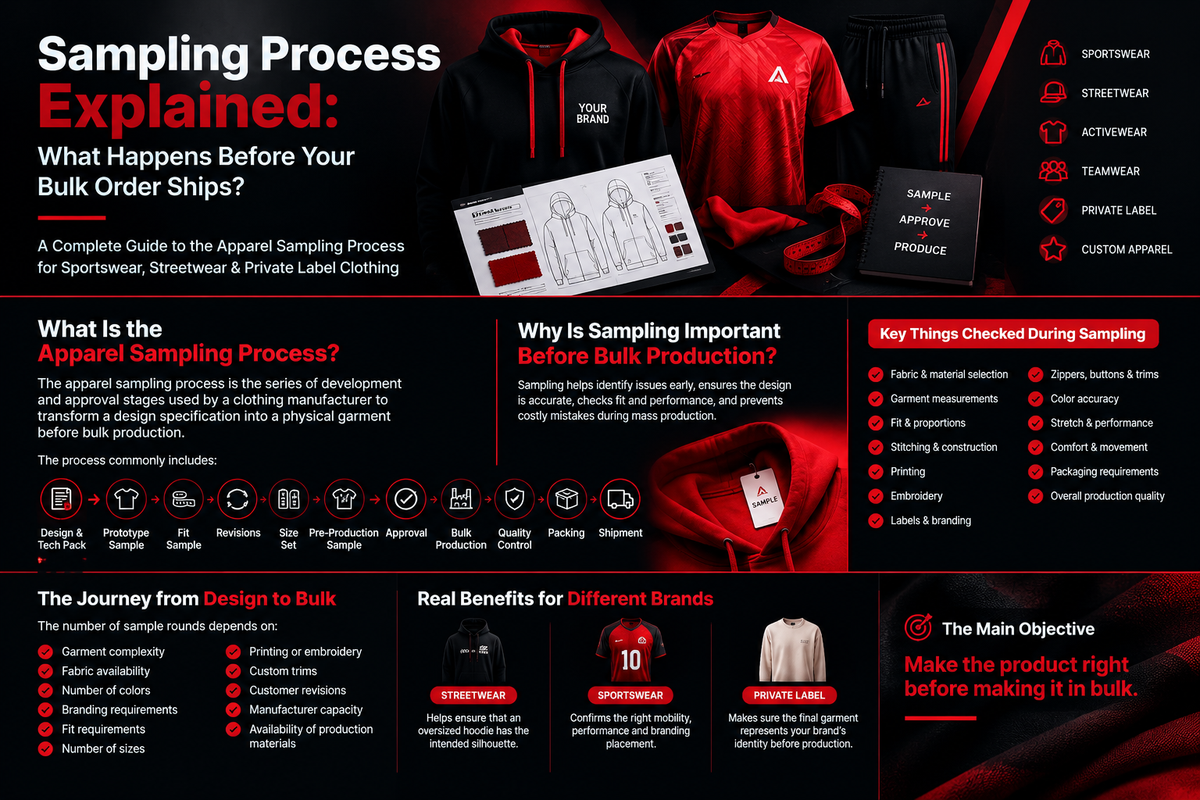
Sampling Process Explained: What Happens Before Your Bulk Order Ships?
A Complete Guide to the Apparel Sampling Process for Sportswear, Streetwear & Private Label Clothing
When a clothing brand decides to manufacture a new collection, the journey from an idea to a finished product involves much more than simply sending a design to a factory.
Before hundreds or thousands of garments are cut, stitched, printed, embroidered, packed and shipped, professional manufacturers use a structured apparel sampling process to turn the design concept into a production-ready garment.
For brands producing sportswear, streetwear, activewear, teamwear, private label clothing and custom apparel, sampling is one of the most important stages of the entire manufacturing process.
A hoodie may look perfect in a digital design. A sports jersey may appear exactly right in a tech pack. A tracksuit may have the correct measurements on paper. But the actual garment can reveal issues that cannot always be identified from drawings or specifications alone.
The sample allows the brand and manufacturer to physically evaluate the product before committing to bulk production.
During sampling, manufacturers can check:
- Fabric and material selection
- Garment measurements
- Fit and proportions
- Stitching and construction
- Printing
- Embroidery
- Labels and branding
- Zippers, buttons and trims
- Color accuracy
- Stretch and performance
- Comfort and movement
- Packaging requirements
- Overall production quality
This makes the apparel sampling process a critical quality-control and product-development stage before a bulk clothing order begins.
For a growing streetwear brand, sampling can help ensure that an oversized hoodie actually has the intended silhouette.
For a sportswear brand, it can help confirm that a jersey provides the correct mobility, fabric performance and branding placement.
For a private label clothing brand, sampling provides an opportunity to make sure the final garment represents the brand’s identity before production starts.
What Is the Apparel Sampling Process?
The apparel sampling process is the series of development and approval stages used by a clothing manufacturer to transform a design specification into a physical garment before bulk production.
Instead of immediately manufacturing the complete order, the factory develops samples first.
The brand reviews each sample and provides feedback. The manufacturer then makes necessary adjustments until the garment reaches the required standard.
The process commonly includes:
Design & Tech Pack → Prototype Sample → Fit Sample → Revisions → Size Set → Pre-Production Sample → Approval → Bulk Production → Quality Control → Packing → Shipment
Not every order requires exactly the same number of stages.
For example, a simple T-shirt may require fewer development rounds than a highly technical performance jacket. Similarly, an existing repeat style may move faster than a completely new garment.
The number of sample rounds depends on:
- Garment complexity
- Fabric availability
- Number of colors
- Branding requirements
- Fit requirements
- Number of sizes
- Printing or embroidery
- Custom trims
- Customer revisions
- Manufacturer capacity
- Availability of production materials
The main objective remains the same:
Make the product right before making it in bulk.
Why Is Sampling Important Before Bulk Production?
One of the biggest mistakes a new clothing brand can make is moving directly from a digital design to bulk production without properly reviewing a physical sample.
Once bulk fabric has been cut and hundreds of garments are being manufactured, making major changes becomes significantly more difficult and expensive.
Sampling provides a controlled opportunity to identify problems before they become production-scale problems.
1. Sampling Verifies the Design
A digital design communicates the concept, but a physical garment demonstrates how that concept actually works.
For example, a hoodie design may specify:
- Oversized body
- Dropped shoulders
- Heavy fleece
- Kangaroo pocket
- Ribbed cuffs
- Screen-printed artwork
- Woven neck label
The sample allows the manufacturer and brand to see whether these elements work together correctly.
2. Sampling Checks Fit
Fit is especially important for streetwear and sportswear manufacturing.
Streetwear often depends on specific silhouettes such as:
- Oversized
- Relaxed
- Boxy
- Cropped
- Drop shoulder
- Loose fit
Sportswear may require:
- Athletic fit
- Mobility
- Stretch
- Appropriate sleeve length
- Comfortable armholes
- Functional proportions
A measurement chart alone cannot completely communicate how the garment will feel and move when worn.
3. Sampling Protects Your Bulk Order
A properly approved sample gives both the manufacturer and customer a clear production reference.
The approved sample can be compared with bulk garments during quality control.
This helps reduce the risk of unexpected differences in:
- Measurements
- Construction
- Branding
- Fabric
- Colors
- Trims
- Finishing
The PP sample is particularly important because it represents the final production standard before bulk manufacturing. SeamFoundry
Step 1: Design Brief & Tech Pack Review
Before sampling begins, the manufacturer needs to understand exactly what the customer wants.
The process normally starts with a tech pack, design files, measurement chart, reference garment, sketches or a combination of these.
A detailed tech pack may contain:
- Technical drawings
- Front and back views
- Measurements
- Fabric specifications
- Fabric composition
- GSM
- Color references
- Stitching details
- Seam construction
- Print artwork
- Embroidery artwork
- Label placement
- Trim specifications
- Packaging requirements
- Size grading
- Tolerances
- Bill of materials
The tech pack acts as an important communication document between the clothing brand and manufacturer.
If the specification is unclear, the manufacturer should clarify it before sampling.
This is especially important for custom clothing manufacturing, where every brand may have different expectations.
For example, “heavyweight hoodie” can mean different things to different buyers.
One brand might want 400 GSM fleece while another may prefer 500 GSM.
Likewise, “oversized T-shirt” needs a measurable definition through the actual size chart and pattern.
Clear specifications reduce misunderstandings.
Step 2: Fabric & Material Selection
The next important part of the apparel sampling process is material selection.
The correct fabric can dramatically affect the appearance, comfort, durability and performance of a garment.
For streetwear manufacturing, popular fabric considerations include:
- Cotton
- Cotton jersey
- French terry
- Fleece
- Heavyweight cotton
- Polyester blends
- Nylon
- Twill
- Denim
- Canvas
For sportswear manufacturing, common material considerations include:
- Polyester
- Recycled polyester
- Nylon
- Spandex blends
- Elastane
- Performance mesh
- Moisture-management fabrics
- Stretch fabrics
The manufacturer needs to consider the intended use of the garment.
A basketball jersey has different material requirements from a heavyweight streetwear hoodie.
A gym T-shirt has different performance expectations from a premium cotton oversized T-shirt.
Step 3: Prototype Sample
The prototype sample, often called the proto sample, is generally the first physical version of the garment.
Its main purpose is to determine whether the design and construction can be translated successfully into a real product.
The prototype may not always use the final bulk-production fabric or every final trim.
Instead, the focus is often on:
- Shape
- Construction
- Pattern
- Proportions
- Panel placement
- Pockets
- Sleeves
- Collar
- Hood
- Seams
- Overall design execution
The prototype is an opportunity to identify problems early.
For example, the manufacturer may discover that:
- A pocket is positioned incorrectly.
- A hood shape does not work as expected.
- A sleeve is too wide.
- A shoulder seam needs adjustment.
- A panel creates an awkward shape.
- A particular construction method is inefficient.
- A trim does not work with the selected fabric.
These issues can then be corrected before the garment moves further into development.
Step 4: Fit Sample
Once the basic construction is established, the garment moves toward the fit sample stage.
The purpose of a fit sample is to evaluate the actual fit, measurements and proportions of the garment.
This is particularly important for brands building a consistent clothing identity.
For example, a streetwear brand may want its hoodies to have a recognizable oversized silhouette across every collection.
A sportswear brand may need shirts that allow athletes to move comfortably without excessive fabric.
During fit evaluation, brands can review:
Body Length
Is the garment too long or too short?
Chest Width
Does the garment provide the intended amount of room?
Shoulder Width
Does the shoulder sit correctly?
Sleeve Length
Are sleeves proportionate to the body?
Armhole
Does the armhole provide enough movement?
Neck Opening
Is the neckline comfortable and visually correct?
Hood
Does the hood maintain the intended shape?
Waist and Hem
Does the bottom of the garment sit correctly?
Overall Silhouette
Does the garment look like the original design concept?
A fit sample may lead to one or more revision rounds before approval. SML Intimate
Step 5: Fit Revision & Sample Corrections
The first fit sample does not always need to be perfect.
Sampling is a development process.
If the customer identifies issues, the manufacturer updates the pattern or construction and produces another sample.
For example:
First Fit Sample
Chest: Too narrow
Sleeve: Too long
Body: Too short
Hood: Too small
Revision
Chest increased
Sleeve shortened
Body length increased
Hood pattern adjusted
The revised sample is then evaluated again.
The important thing is to provide clear and measurable feedback.
Instead of saying:
“Make it a little bigger.”
It is better to specify:
“Increase half-chest measurement by 2 cm.”
Instead of:
“Sleeves are too long.”
Specify:
“Reduce sleeve length by 1.5 cm from shoulder point.”
Clear comments help manufacturers make precise corrections.
Step 6: Size Set Sample
For brands selling multiple sizes, size grading is another important part of the apparel development process.
A garment that fits correctly in one size does not automatically guarantee that every size will be correct.
A size set allows the manufacturer to evaluate graded measurements across the intended size range.
For example:
XS → S → M → L → XL → XXL
Depending on the product, the brand may review selected sizes or a complete size set.
Important areas include:
- Chest
- Body length
- Shoulder
- Sleeve
- Waist
- Hip
- Rise
- Inseam
- Armhole
- Neck opening
For sportswear, size grading is especially important because incorrect proportions can affect athlete comfort and movement.
For streetwear, grading is equally important because the silhouette needs to remain consistent from smaller to larger sizes.
Step 7: Printing, Embroidery & Branding Approval
A clothing product is not complete without its branding and decoration.
During sampling, manufacturers also need to verify the execution of:
- Screen printing
- Digital printing
- Sublimation
- Heat transfer
- Embroidery
- Chenille
- Appliqué
- Woven labels
- Printed labels
- Hang tags
- Patches
Branding should be checked for:
- Position
- Size
- Color
- Sharpness
- Stitch density
- Artwork accuracy
- Durability
- Alignment
For example, if a streetwear hoodie contains a large front graphic, the brand should verify its exact placement on the physical garment.
For sports jerseys, team logos, player names and numbers should be checked carefully before bulk production.
Step 8: Pre-Production Sample — The Most Important Approval
The pre-production sample, commonly called the PP sample, is one of the most important stages in the apparel sampling process.
This is the final reference garment before bulk manufacturing begins.
Ideally, the PP sample should use the actual production specifications, including:
- Final fabric
- Final color
- Final trims
- Final labels
- Final artwork
- Final measurements
- Final stitching
- Final construction
- Final finishing
- Applicable packaging details
The purpose is simple:
The bulk order should reproduce the approved PP standard.
The PP sample becomes a reference point for the production team and quality-control process. BOMME STUDIO
What Should You Check on a PP Sample?
Before approving your PP sample, do not simply look at it for a few seconds and say “approved.”
Perform a structured review.
1. Fabric
Check:
- Composition
- GSM
- Hand feel
- Stretch
- Thickness
- Surface appearance
- Color
2. Measurements
Compare the garment against your approved measurement chart.
Check every important point of measurement.
3. Fit
Wear the garment or test it on the intended fit model.
Evaluate:
- Comfort
- Mobility
- Silhouette
- Length
- Width
- Sleeve balance
4. Stitching
Inspect:
- Seam quality
- Stitch density
- Loose threads
- Seam alignment
- Reinforcement
- Hem finishing
5. Branding
Check:
- Logo position
- Logo size
- Print quality
- Embroidery
- Label placement
- Artwork accuracy
6. Trims
Review:
- Zippers
- Buttons
- Drawcords
- Elastic
- Patches
- Eyelets
- Labels
7. Finishing
Check:
- Washing
- Pressing
- Thread trimming
- Shape
- Cleanliness
- Final appearance
Approval Stages in the Apparel Sampling Process
A professional sampling workflow should have clear approval points.
A simplified approval structure looks like this:
Approval 1 — Design & Construction
Question: Can the design be manufactured correctly?
↓
Approval 2 — Fit
Question: Does the garment fit and look the way the brand expects?
↓
Approval 3 — Size Grading
Question: Does the fit remain correct across the size range?
↓
Approval 4 — Branding & Materials
Question: Are fabric, colors, labels, printing and trims correct?
↓
Approval 5 — PP Sample
Question: Is this the exact production standard?
↓
Approval 6 — Bulk Production
Question: Can manufacturing begin?
This stage-gate approach helps prevent unresolved issues from moving into bulk production. T&B Fashion Group
How Long Does Apparel Sampling Take?
One of the most common questions from clothing brands is:
“How long will my sample take?”
There is no universal timeline because different garments require different development work.
As a general planning guide, a prototype can take around 7–14 days, fit revisions may take roughly 7–10 days per round, and a PP sample can take approximately 7–14 days, depending on complexity and material availability. BOMME STUDIO
Some standard styles may move through sampling faster, while complicated garments can take longer.
Factors that affect the timeline include:
Garment Complexity
A basic T-shirt is generally easier to sample than a multi-panel technical jacket.
Fabric Availability
If the required fabric is readily available, development can move faster.
If custom fabric needs to be sourced or developed, additional time may be required.
Custom Trims
Special zippers, buttons, labels and hardware can add lead time.
Artwork
Complex embroidery, prints or special finishing may require additional testing.
Number of Revisions
Every revision can add another sampling cycle.
Customer Feedback Speed
Fast and organized approvals help keep the project moving.
Production Calendar
Factory sample-room workload can also affect scheduling.
Typical Apparel Sampling Timeline
A simplified timeline might look like this:
| Stage | Purpose | Typical Planning Range |
|---|---|---|
| Tech Pack Review | Confirm specifications | 1–3 days |
| Prototype | Test construction | 7–14 days |
| Fit Sample | Check fit and measurements | 7–10 days |
| Revision | Correct identified issues | 7–10 days |
| Size Set | Verify grading | 7–12 days |
| PP Sample | Final production approval | 7–14 days |
| Bulk Production | Manufacture approved order | Depends on order |
These are planning ranges rather than guarantees. A complex garment, unavailable material or additional revision rounds can extend the schedule. BOMME STUDIO
How Sampling Helps Sportswear Brands
The sportswear sampling process has unique considerations.
Sportswear is not only about appearance.
The garment may need to support:
- Movement
- Training
- Competition
- Breathability
- Stretch
- Durability
- Moisture management
- Team identity
A sportswear manufacturer needs to consider how the garment behaves when worn during physical activity.
For example, a football jersey may need:
- Lightweight performance fabric
- Comfortable construction
- Correct sleeve proportions
- Accurate team crest
- Player name
- Player number
- Sponsor logo
A basketball uniform may require different construction and fit considerations.
Likewise, gym wear may require stretch and recovery properties.
This is why sampling is particularly valuable for custom sportswear manufacturing.
Sampling for Streetwear Brands
Streetwear products often depend heavily on silhouette and visual details.
For an oversized hoodie, buyers may care about:
- Drop shoulder
- Body width
- Hood size
- Sleeve volume
- Rib construction
- Fabric weight
- Wash effect
- Graphic placement
For an oversized T-shirt, the difference of a few centimeters can significantly change the appearance.
For a varsity jacket, brands may need to approve:
- Body fabric
- Sleeve material
- Rib
- Snap buttons
- Embroidery
- Patches
- Lining
- Pocket construction
Therefore, the streetwear sampling process should focus not only on measurements but also on the visual identity of the product.
Sampling for Private Label Clothing
For private label clothing manufacturers, sampling is especially important because branding becomes part of the product.
A private label garment may include:
- Custom neck labels
- Woven labels
- Size labels
- Hang tags
- Custom packaging
- Branded polybags
- Embroidery
- Custom prints
Before bulk production, the brand should verify that every branding element is correct.
A small label placement mistake multiplied across hundreds of garments can become an expensive issue.
Sampling gives the brand an opportunity to correct these details before production.
Common Problems Found During Apparel Sampling
Sampling exists because problems happen.
Some of the most common issues include:
Incorrect Measurements
The garment does not match the approved measurement chart.
Poor Fit
The garment is too tight, too loose, too long or too short.
Fabric Mismatch
The actual material feels different from what the customer expected.
Color Difference
The physical fabric or print color does not match the approved reference.
Print Placement
The graphic sits too high, too low or off-center.
Embroidery Problems
The logo may be too dense, poorly aligned or cause puckering.
Stitching Problems
Loose threads, uneven seams or inconsistent stitching can appear.
Trim Issues
Zippers, buttons, cords or labels may not match the specification.
Pattern Problems
Panels may not align correctly.
Grading Problems
The base size may fit correctly while other sizes do not.
These problems are precisely why professional manufacturers use sample approvals before bulk production.
How Brands Can Make Sampling Faster
A common misconception is that rushing the sampling stage always saves time.
In reality, skipping important checks can create bigger delays later.
The best way to speed up the process is to make the development process organized.
Provide a Complete Tech Pack
Include measurements, fabric details, artwork and construction instructions.
Send Clear Artwork
Use high-resolution files and provide exact logo placement.
Define Your Fit
Explain whether you want:
- Slim
- Regular
- Relaxed
- Oversized
- Boxy
- Athletic
Provide Measurement Tolerances
Clearly define acceptable variations.
Give Consolidated Feedback
Instead of sending five separate messages over several days, collect all comments into one organized revision sheet.
Approve Quickly
Once the sample is received, review it promptly.
Keep Versions Organized
Use labels such as:
Sample V1 → Sample V2 → Fit Approved → PP Approved
This prevents confusion.
How to Give Better Sample Feedback
Good feedback is specific.
Instead of:
“The hoodie doesn’t look right.”
Write:
“Increase body width by 2 cm, reduce sleeve length by 1 cm and increase hood height by 1.5 cm.”
Instead of:
“Logo is too small.”
Write:
“Increase front logo width from 25 cm to 28 cm and keep the logo centered on the chest.”
Instead of:
“Fabric should be heavier.”
Specify the desired:
GSM, composition and fabric construction.
Professional communication reduces the number of unnecessary sample rounds.
What Is the Difference Between a Sample and a PP Sample?
This is an important distinction for clothing buyers.
A general sample can be used to test:
- Design
- Construction
- Fit
- Proportions
A pre-production sample is intended to represent the final production standard.
The PP sample should reflect the final approved:
- Fabric
- Color
- Construction
- Measurements
- Branding
- Trims
- Finishing
Therefore, the PP sample should be treated as a production reference rather than simply another prototype. SeamFoundry
What Happens After PP Sample Approval?
Once the PP sample has been approved, the project can move into bulk production preparation.
The factory may finalize:
- Production patterns
- Fabric quantities
- Trims
- Labels
- Artwork
- Cutting plans
- Production schedule
- Quality-control standards
- Packing specifications
Then bulk manufacturing begins.
A typical flow is:
PP Approval
↓
Fabric & Trim Preparation
↓
Bulk Cutting
↓
Printing / Embroidery
↓
Sewing
↓
Finishing
↓
Quality Control
↓
Folding & Packing
↓
Final Inspection
↓
Shipment
This is where the approved sample becomes extremely valuable.
The production team can use the approved standard as a reference while manufacturing the bulk order.
Top-of-Production Sample
Some manufacturers also use a TOP sample, meaning a Top of Production sample.
This is taken from the early bulk production output and checked against the approved PP sample.
The purpose is to verify that the actual production line is reproducing the approved standard.
This creates another quality checkpoint between sampling and the completion of the order. Surajmal Shobhachand Ltd.
For large or technically complicated orders, this additional verification can be useful.
Sampling & Quality Control
Sampling and quality control are connected but they are not exactly the same thing.
Sampling asks:
“Is the product correct before bulk production?”
Quality control asks:
“Is the bulk production consistently matching the approved standard?”
A strong apparel manufacturing workflow uses both.
During bulk QC, manufacturers may inspect:
- Measurements
- Stitching
- Fabric
- Color
- Printing
- Embroidery
- Labels
- Trims
- Finishing
- Packaging
The approved sample gives the QC team a physical reference for comparison.
Sampling Mistakes New Clothing Brands Should Avoid
Mistake 1: Approving Too Quickly
Never approve a sample simply because you are excited to start production.
Review it carefully.
Mistake 2: Giving Vague Feedback
Use measurements and specific comments.
Mistake 3: Ignoring the Fabric
A garment’s appearance can change significantly with different fabric weights and compositions.
Mistake 4: Checking Only One Measurement
Review the complete measurement chart.
Mistake 5: Ignoring Branding
Check every logo, label and print.
Mistake 6: Changing Details After PP Approval
Late changes can affect cost and production timing.
Mistake 7: Not Keeping an Approved Reference
Always maintain a clear record of what was approved.
How Much Does Apparel Sampling Cost?
Sampling cost varies depending on:
- Garment type
- Fabric
- Construction
- Artwork
- Number of components
- Number of revisions
- Embroidery
- Printing
- Special trims
A simple T-shirt sample may cost significantly less to develop than a heavily customized technical jacket.
Some manufacturers charge separately for samples, while others may apply sampling charges toward a later bulk order depending on their commercial terms.
Brands should always confirm:
- Sample price
- Shipping cost
- Revision charges
- Sampling timeline
- Whether sample cost is refundable or deductible
- What is included in the sample
before development begins.
Apparel Sampling Process for Low-MOQ Clothing Brands
Low-MOQ manufacturing has become particularly useful for emerging clothing brands.
A new brand may not want to order thousands of pieces immediately.
Instead, it may want to test:
- One hoodie
- One T-shirt
- One tracksuit
- One jersey
- One jogger
- Multiple colorways
A structured sampling process allows the brand to refine its product before committing to a larger quantity.
For startups, this can reduce product-development risk.
However, low MOQ does not mean that sampling should be skipped.
In fact, sampling can be even more important when a brand has limited production experience.
Why Sampling Matters for International Apparel Manufacturing
International brands often work with manufacturers located in different countries.
Clear sampling procedures become even more important when the buyer and factory are separated by thousands of miles.
A physical sample creates a shared reference.
Instead of relying only on:
- Photos
- Videos
- Drawings
- Messages
- Measurements
the buyer and manufacturer can evaluate the same physical product.
For international sportswear manufacturers and streetwear manufacturers, this can improve communication and reduce misunderstandings.
Choosing the Right Clothing Manufacturer for Sampling
When selecting a custom clothing manufacturer, do not look only at the bulk price.
Ask about the manufacturer’s development process.
Questions worth asking include:
- Do you provide prototype samples?
- Do you provide fit samples?
- Can you make revisions?
- Can you develop custom fabrics?
- Can you handle printing and embroidery?
- Can you produce custom labels?
- How is PP approval handled?
- What is the estimated sampling timeline?
- How is customer feedback documented?
- How does QC compare bulk production with the approved sample?
A manufacturer that communicates clearly during sampling can make the overall production experience much smoother.
Apparel Sampling Checklist for Buyers
Before approving your final sample, use this checklist.
Product Design
☐ Correct silhouette
☐ Correct construction
☐ Correct panels
☐ Correct pockets
☐ Correct functional details
Fabric
☐ Correct composition
☐ Correct GSM
☐ Correct hand feel
☐ Correct stretch
☐ Correct color
Measurements
☐ Body length
☐ Chest
☐ Shoulder
☐ Sleeve
☐ Waist
☐ Hip
☐ Inseam
☐ Rise
☐ Armhole
Branding
☐ Logo size
☐ Logo placement
☐ Print quality
☐ Embroidery quality
☐ Neck label
☐ Size label
☐ Hang tag
Construction
☐ Seam quality
☐ Stitching
☐ Hem
☐ Rib
☐ Zippers
☐ Buttons
☐ Drawcords
Final Appearance
☐ No loose threads
☐ No visible defects
☐ Correct shape
☐ Correct finishing
☐ Correct packaging requirements
Once everything has been reviewed, the approval should be clearly documented.
Apparel Sampling Process: A Simple Example
Imagine a new streetwear brand wants to manufacture 500 heavyweight oversized hoodies.
The brand sends the manufacturer:
- Hoodie artwork
- Logo
- Size chart
- Fabric requirement
- Color
- Label design
- Packaging requirements
Stage 1
The manufacturer reviews the specification.
Stage 2
A prototype hoodie is produced to check construction and proportions.
Stage 3
The brand reviews the hoodie and requests a slightly wider body.
Stage 4
A revised fit sample is produced.
Stage 5
The brand approves the fit.
Stage 6
The manufacturer prepares the final PP sample using the selected production fabric, final color, branding and trims.
Stage 7
The brand approves the PP sample.
Stage 8
Bulk production begins.
Stage 9
The production team checks the garments against the approved standard.
Stage 10
The finished 500 hoodies are packed and shipped.
This is the basic principle behind professional apparel product development.
How Ortox Industry Can Support Your Apparel Sampling Process
For brands looking for a sportswear manufacturer, streetwear manufacturer or private label clothing manufacturer, Ortox Industry focuses on turning custom apparel concepts into production-ready garments.
Ortox Industry — Custom Sportswear & Streetwear Manufacturing
From initial requirements to sampling and bulk production, the objective is to maintain clear communication between the brand and manufacturing team.
Ortox Industry can be positioned as a manufacturing partner for products such as:
- Custom T-shirts
- Oversized T-shirts
- Hoodies
- Zip-up hoodies
- Sweatshirts
- Joggers
- Tracksuits
- Sports jerseys
- Team uniforms
- Performance wear
- Gym wear
- Streetwear
- Private label apparel
- Custom jackets
- Varsity jackets
- Athletic clothing
For brands developing a new collection, the sampling stage provides an opportunity to evaluate the product before moving into larger-scale manufacturing.
The principle is straightforward:
Your Brand. Your Designs. Our Manufacturing.
Why Professional Sampling Can Save Money
It may seem that sampling adds another cost to the manufacturing process.
But the bigger question is:
What would it cost if the mistake happened in 500 or 5,000 garments?
Suppose a brand discovers after bulk production that:
- The hoodie is too short.
- The logo is incorrectly positioned.
- The fabric is not heavy enough.
- The sleeves are too long.
- The labels are wrong.
Correcting these issues after bulk production can be much more difficult than identifying them during sampling.
Sampling therefore works as a form of production risk management.
It gives the brand a controlled environment for making changes.
Sampling Is More Than Making a Sample
The most important thing to understand about the apparel sampling process is that sampling is not simply about producing one garment.
It is about building a reliable production standard.
The sample answers questions such as:
Can the design be manufactured?
Does the garment fit correctly?
Are the materials right?
Are the branding details correct?
Can the garment be reproduced consistently?
Is the product ready for bulk production?
Each sample stage should have a specific purpose.
This prevents the development process from becoming a cycle of random changes.
Final Approval Before Bulk Production
Before giving final approval, the brand should make sure there are no unresolved issues.
The final PP approval should ideally confirm:
Design: Approved
Pattern: Approved
Measurements: Approved
Fit: Approved
Fabric: Approved
Color: Approved
Trims: Approved
Printing: Approved
Embroidery: Approved
Labels: Approved
Finishing: Approved
Packaging: Approved
Once the manufacturer receives clear approval, bulk production can move forward according to the agreed specifications.
Frequently Asked Questions About the Apparel Sampling Process
What is an apparel sampling process?
The apparel sampling process is the development and approval workflow used to create physical garment samples before bulk production. It typically covers prototype development, fit evaluation, revisions, size grading and pre-production approval.
What is a pre-production sample?
A pre-production sample, or PP sample, is the final sample used to represent the approved bulk-production standard. It should reflect the final materials, measurements, branding, trims and construction wherever possible. SeamFoundry
What is a fit sample?
A fit sample is produced to evaluate garment measurements, proportions, silhouette and comfort before final production approval.
How many samples are needed before bulk production?
There is no universal number. A straightforward garment may need a prototype, fit sample and PP sample, while a complex garment may require additional revisions or a size set.
How long does apparel sampling take?
Sampling timelines vary according to garment complexity, material availability, factory workload and the number of revisions. A common planning range for a complete sampling process is several weeks. BOMME STUDIO
Can I change the design after the sample?
Yes. Changes are normally easier before bulk production. However, major changes after PP approval may affect cost and timeline.
Do sportswear products need sampling?
Yes. Sampling is especially useful for sportswear because fit, movement, fabric performance and decoration need to be evaluated before bulk production.
Do streetwear brands need a sample?
Absolutely. Streetwear often depends on precise silhouettes, fabric weight, oversized proportions and branding placement, making physical sampling highly valuable.
Can small brands order samples before bulk?
Yes. Sampling is particularly useful for startups and emerging brands that want to validate a product before placing a larger manufacturing order.
Conclusion: Never Skip the Apparel Sampling Process
The journey from a clothing idea to a finished bulk order should not be a single step.
A professional apparel sampling process creates multiple checkpoints where the brand and manufacturer can evaluate the product before committing fully to bulk production.
The process generally moves from:
Design → Tech Pack → Prototype → Fit Sample → Revision → Size Set → PP Sample → Approval → Bulk Production → QC → Packing → Shipment
For sportswear brands, sampling helps verify performance, fit and teamwear details.
For streetwear brands, it helps establish the right silhouette, fabric weight, construction and branding.
For private label clothing brands, it provides an opportunity to approve labels, trims, packaging and other brand-specific elements.
The most important rule is simple:
Do not approve bulk production until you are confident that the final sample represents exactly what you want your customers to receive.
A well-managed sampling process can reduce production risks, improve communication, protect product quality and help a clothing brand move from concept to commercial product with greater confidence.
If you’re developing your next sportswear, streetwear, activewear or private label clothing collection, the right manufacturing partner can help turn your specifications into production-ready garments.
Ready to develop your next collection?
Visit Ortox Industry — ortoxindustry.com
Ortox Industry — Your Brand. Your Designs. Our Manufacturing.