

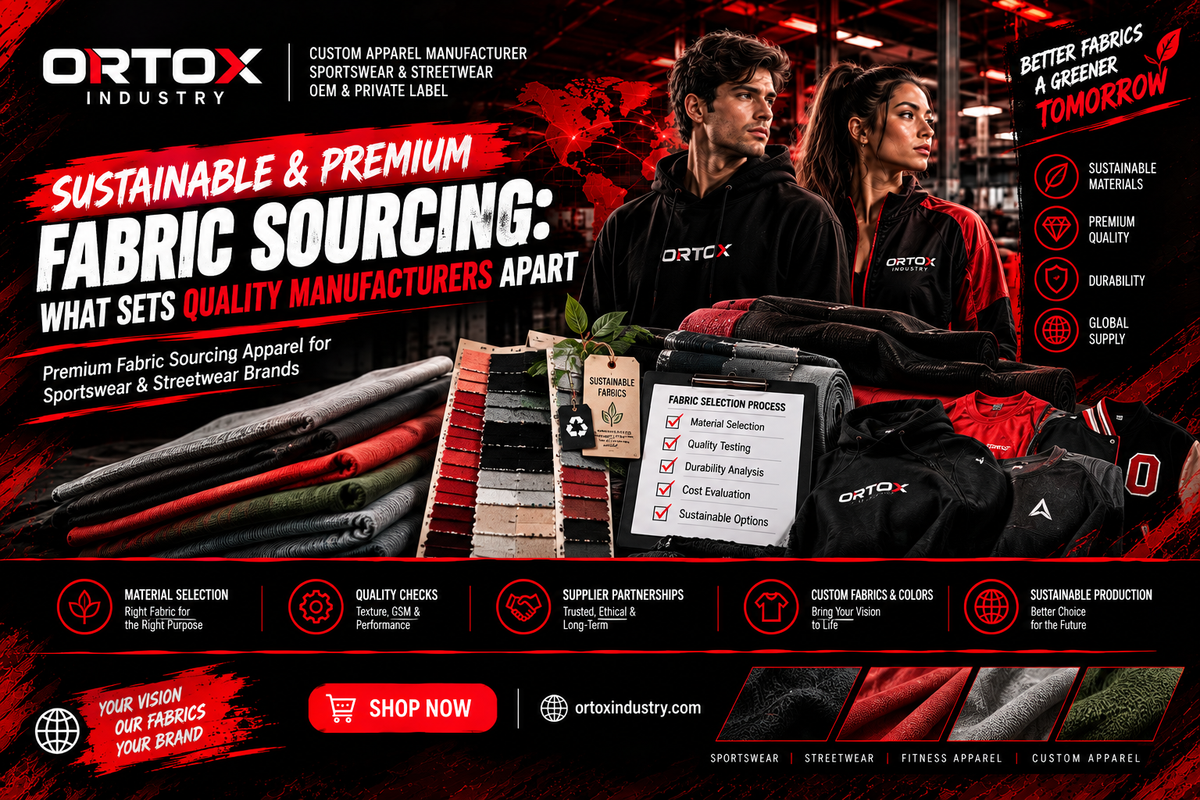
Sustainable & Premium Fabric Sourcing: What Sets Quality Manufacturers Apart
A Complete Guide to Premium Fabric Sourcing Apparel, Sustainable Materials, Durability, Cost, Sportswear & Streetwear Manufacturing
Fabric is one of the most important decisions in apparel manufacturing.
A clothing design can look impressive on paper, but the final product depends heavily on the material selected for production. Fabric affects comfort, appearance, durability, weight, fit, breathability, stretch, performance, printing, washing behavior, and even how customers perceive the value of a garment.
This is why premium fabric sourcing apparel has become an important consideration for modern clothing brands, sportswear companies, streetwear labels, private-label businesses, wholesalers, and distributors.
For a sportswear brand, the wrong fabric can affect movement, breathability, moisture management, and durability.
For a streetwear brand, the wrong material can change the silhouette, hand feel, drape, weight, and overall premium appearance of a garment.
At the same time, choosing the most expensive fabric is not automatically the right solution.
A professional manufacturer needs to balance:
- Material quality
- Product requirements
- Durability
- Comfort
- Performance
- Appearance
- Fabric weight
- Sustainability
- Production requirements
- Customer expectations
- Target retail price
- Order quantity
- Long-term consistency
This is where professional fabric sourcing becomes different from simply buying fabric.
A quality apparel manufacturer needs to understand which material is appropriate for which product.
A heavyweight cotton fabric may be excellent for an oversized streetwear hoodie but unsuitable for a lightweight running shirt.
A performance polyester may be ideal for a football jersey but inappropriate for a premium heavyweight fashion T-shirt.
A stretch blend may be useful for leggings and gym wear but unnecessary for a structured varsity jacket.
The goal of fabric sourcing is therefore not simply to find a premium-looking material.
The goal is to find the right material for the intended product.
This guide explains how professional manufacturers approach fabric sourcing, how brands can compare sustainability and durability, how to balance quality against cost, and what sportswear and streetwear brands should consider before starting bulk apparel production.
Table of Contents
- Why Fabric Sourcing Matters in Apparel Manufacturing
- What Is Premium Fabric Sourcing Apparel?
- What Makes a Fabric Premium?
- The Complete Material Selection Process
- Understanding Fabric Composition
- Understanding Fabric GSM
- Fabric Weight and Product Design
- Cotton for Apparel Manufacturing
- Organic Cotton and Responsible Material Choices
- Polyester for Sportswear
- Recycled Polyester
- Nylon and Performance Apparel
- Elastane and Stretch Fabrics
- Fleece and Sweatshirt Materials
- Jersey Fabrics
- Performance Fabrics for Sportswear
- Fabrics for Streetwear
- Sustainable Fabric Sourcing
- Durability vs Cost Trade-Offs
- Why the Cheapest Fabric Can Become Expensive
- Why the Most Expensive Fabric Is Not Always Best
- Fabric Testing Before Production
- Colorfastness and Fabric Quality
- Shrinkage and Washing Performance
- Fabric Hand Feel
- Breathability and Moisture Management
- Fabric Stretch and Recovery
- Fabric Selection for Sportswear
- Fabric Selection for Streetwear
- Fabric Sourcing for Private Label Brands
- OEM Fabric Sourcing
- Custom Fabric Development
- Supplier Reliability and Consistency
- Fabric Availability and Lead Times
- Sampling and Fabric Approval
- Quality Control During Fabric Sourcing
- Sustainable Manufacturing and Material Decisions
- How Manufacturers Balance Quality and Cost
- Questions to Ask a Fabric Supplier
- Questions to Ask an Apparel Manufacturer
- Common Fabric Sourcing Mistakes
- How to Build a Fabric Specification
- Premium Fabric Sourcing for USA Brands
- Premium Sportswear Fabric Sourcing
- Premium Streetwear Fabric Sourcing
- Ortox Industry and Material Sourcing
- SEO Keyword Strategy for Apparel Brands
- Final Fabric Sourcing Checklist
- Frequently Asked Questions
- Conclusion
1. Why Fabric Sourcing Matters in Apparel Manufacturing
Fabric is not simply the material from which a garment is made.
It is one of the foundations of the product.
The same clothing design can feel completely different depending on the fabric.
Consider two hoodies with exactly the same pattern.
One hoodie may use lightweight fleece.
Another may use heavyweight fleece.
The patterns might be similar, but the finished products can have very different:
- Weight
- Shape
- Warmth
- Drape
- Hand feel
- Durability
- Appearance
- Retail positioning
The same principle applies to sportswear.
Two performance shirts may have similar designs, but one may use a lightweight breathable fabric while another uses a heavier stretch material.
The difference can influence how the garment performs during physical activity.
For this reason, professional premium fabric sourcing apparel should begin with the product’s purpose.
Before selecting a fabric, manufacturers and brands should ask:
What is the garment?
Who will wear it?
Where will it be used?
What performance is required?
What type of fit is required?
What appearance should the product have?
What price category is the product targeting?
What level of durability is expected?
These questions help create a better material selection process.
2. What Is Premium Fabric Sourcing Apparel?
Premium fabric sourcing apparel refers to the process of identifying, evaluating, selecting, testing, and purchasing high-quality materials for clothing production.
The process can involve:
- Fabric research
- Supplier identification
- Material comparison
- Fabric sampling
- Composition verification
- GSM evaluation
- Color development
- Performance testing
- Shrinkage evaluation
- Durability assessment
- Cost analysis
- Bulk availability checks
- Production consistency
Premium fabric sourcing does not necessarily mean choosing the most expensive material.
Instead, it means selecting a material that provides the right combination of:
Quality + Performance + Durability + Appearance + Cost + Availability
For example, a sportswear brand may prioritize lightweight performance and breathability.
A streetwear brand may prioritize structure and heavyweight construction.
An activewear brand may prioritize stretch and recovery.
A private-label fashion brand may prioritize hand feel and appearance.
The definition of “premium” therefore depends partly on the product category and customer expectations.
3. What Makes a Fabric Premium?
There is no single characteristic that makes every fabric premium.
A premium fabric can be defined by multiple characteristics.
3.1 Fiber Quality
The underlying fiber can influence:
- Strength
- Softness
- Durability
- Appearance
- Comfort
- Performance
3.2 Consistent Construction
Fabric should have consistent construction across the roll.
Inconsistent fabric can create problems during production.
3.3 Appropriate GSM
Fabric weight should match the product requirements.
A premium fabric is not necessarily heavy.
For example, a premium performance shirt may intentionally use lightweight material.
3.4 Good Hand Feel
The fabric should provide the intended tactile experience.
This can be especially important for streetwear and fashion apparel.
3.5 Color Consistency
Colors should remain consistent across production batches whenever possible.
3.6 Durability
The fabric should withstand the expected level of use.
3.7 Performance
For sportswear, performance characteristics may be particularly important.
3.8 Production Compatibility
A fabric may look excellent but still create manufacturing challenges.
The material should be compatible with:
- Cutting
- Sewing
- Printing
- Embroidery
- Washing
- Finishing
- Packaging
This is why premium fabric sourcing should be evaluated from both a product and manufacturing perspective.
4. The Complete Material Selection Process
A professional fabric selection process can be divided into several stages.
Stage 1: Define the Product
First, determine what you are producing.
Examples include:
- T-shirt
- Hoodie
- Sweatshirt
- Joggers
- Sports jersey
- Performance shirt
- Leggings
- Gym shorts
- Tracksuit
- Varsity jacket
Stage 2: Define Product Requirements
Determine:
- Fit
- Weight
- Stretch
- Breathability
- Durability
- Intended use
- Season
- Target market
Stage 3: Select Potential Materials
The manufacturer identifies suitable fabric options.
Stage 4: Compare Samples
Physical samples can be evaluated for:
- Feel
- Appearance
- Weight
- Stretch
- Construction
- Color
Stage 5: Evaluate Cost
The material price should be compared against the product’s target cost.
Stage 6: Test the Material
Where appropriate, evaluate:
- Shrinkage
- Colorfastness
- Stretch recovery
- Durability
- Washing performance
Stage 7: Approve the Fabric
The selected material should be documented.
Stage 8: Confirm Bulk Availability
Before production, confirm that sufficient material can be sourced.
Stage 9: Monitor Production
The fabric used for bulk production should match the approved specification.
This structured approach reduces the risk of unexpected changes between sampling and bulk manufacturing.
5. Understanding Fabric Composition
Fabric composition tells you what the material is made from.
Common apparel fibers include:
- Cotton
- Polyester
- Nylon
- Elastane
- Viscose
- Rayon
- Wool
- Linen
- Modal
- Lyocell
- Blended fibers
Blends combine different fibers to achieve specific characteristics.
For example, a cotton-polyester blend may combine aspects of both fibers.
A polyester-elastane blend can provide performance characteristics with stretch.
The correct composition depends on the intended product.
6. Understanding Fabric GSM
GSM means grams per square meter.
It is commonly used to describe fabric weight.
GSM is particularly important for brands developing:
- Streetwear
- Hoodies
- T-shirts
- Sweatshirts
- Sportswear
- Tracksuits
- Activewear
However, GSM should not be treated as a simple quality score.
Higher GSM does not automatically mean better fabric.
A lightweight sports shirt can be premium because it is designed to be lightweight.
A heavyweight streetwear hoodie can be premium because it is designed to provide structure and substance.
The correct GSM depends on the product.
7. Fabric Weight and Product Design
Fabric weight can influence the entire appearance of a garment.
For streetwear, heavier fabrics can create:
- Structured silhouettes
- Oversized shapes
- Premium hand feel
- Stronger drape
- Substantial appearance
For sportswear, lighter materials can support:
- Mobility
- Breathability
- Reduced weight
- Faster drying
- Athletic movement
Manufacturers should therefore select GSM according to the product’s purpose rather than following a universal number.
8. Cotton for Apparel Manufacturing
Cotton remains one of the most widely used fibers in apparel.
It is popular because of its:
- Comfort
- Familiar hand feel
- Breathability
- Versatility
- Natural fiber characteristics
Cotton can be used for:
- T-shirts
- Sweatshirts
- Hoodies
- Streetwear
- Casualwear
- Fleece products
- Fashion garments
For premium streetwear, brands may pay particular attention to cotton quality, fabric weight, finishing, and construction.
The right cotton fabric can significantly influence how a T-shirt or hoodie feels.
9. Organic Cotton and Responsible Material Choices
Organic cotton can be considered by brands looking to incorporate different material sourcing approaches into their collections.
However, sustainability should not be reduced to simply adding the word “organic” to a product description.
Brands should understand:
- Material origin
- Certification where relevant
- Supplier documentation
- Processing
- Dyeing
- Manufacturing
- Transportation
- Product lifespan
Sustainability is a broader supply-chain consideration.
A durable garment that remains useful for a long period can also be an important part of responsible product development.
10. Polyester for Sportswear
Polyester is widely used in sportswear and performance apparel.
It can be suitable for:
- Sports jerseys
- Performance shirts
- Training tops
- Shorts
- Tracksuits
- Athletic apparel
Depending on the construction and finishing, polyester fabrics can offer useful characteristics for active products.
Sportswear manufacturers may evaluate:
- Weight
- Breathability
- Moisture management
- Stretch
- Drying behavior
- Color
- Surface texture
The specific fabric should be selected according to the intended sport and garment design.
11. Recycled Polyester
Recycled polyester is another material option for brands exploring sustainability-focused apparel collections.
It can be used in various sportswear and activewear applications.
For brands considering recycled materials, the sourcing process should still examine:
- Material specifications
- Supplier documentation
- Performance
- Consistency
- Cost
- Availability
- Relevant certification requirements
Sustainability claims should be supported by appropriate documentation.
Manufacturers and brands should avoid making environmental claims that cannot be verified.
12. Nylon and Performance Apparel
Nylon can be useful for performance-focused products because of characteristics such as strength and durability.
It can be used in:
- Activewear
- Sportswear
- Outerwear
- Training garments
- Performance products
Nylon blends can also be combined with stretch fibers to create materials suitable for fitted athletic garments.
Again, the correct material depends on the intended use.
13. Elastane and Stretch Fabrics
Elastane is commonly used when stretch is required.
It can be incorporated into:
- Leggings
- Gym wear
- Compression garments
- Athletic tops
- Stretch shorts
- Activewear
For stretch apparel, the manufacturer should consider both stretch and recovery.
A garment may stretch during movement but should also return toward its intended shape.
This is particularly important for products that experience repeated use.
14. Fleece and Sweatshirt Materials
Fleece is commonly associated with:
- Hoodies
- Sweatshirts
- Sweatpants
- Tracksuits
- Casualwear
- Streetwear
Different fleece constructions can produce different levels of:
- Warmth
- Weight
- Softness
- Structure
- Surface texture
For premium streetwear, fabric selection can significantly affect the final appearance of the hoodie.
A heavyweight hoodie, for example, requires material that supports the desired silhouette.
15. Jersey Fabrics
Jersey fabrics are commonly used for T-shirts and lightweight apparel.
They can be produced using different fibers and constructions.
For brands, important factors can include:
- GSM
- Composition
- Stretch
- Softness
- Recovery
- Surface appearance
- Shrinkage
The correct jersey fabric depends on whether the product is intended for fashion, casualwear, sportswear, or another category.
16. Performance Fabrics for Sportswear
Performance fabrics are selected according to functional requirements.
Depending on the garment, brands may look for:
- Moisture management
- Breathability
- Stretch
- Lightweight construction
- Durability
- Quick-drying characteristics
- Comfortable movement
For example, a football jersey, running shirt, gym top, and lifestyle T-shirt may all require different fabric solutions.
A professional sportswear manufacturer should discuss the intended activity before recommending the material.
17. Fabrics for Streetwear
Streetwear often places significant importance on:
- Fabric weight
- Structure
- Hand feel
- Fit
- Surface appearance
- Printing
- Embroidery
- Garment finishing
Popular streetwear products can include:
- Oversized T-shirts
- Heavyweight hoodies
- Sweatpants
- Tracksuits
- Varsity jackets
- Graphic shirts
- Streetwear jackets
The fabric should support the visual identity of the collection.
For example, an oversized hoodie may require enough structure to maintain its intended shape.
18. Sustainable Fabric Sourcing
Sustainable fabric sourcing involves more than selecting one environmentally marketed fiber.
A broader approach can consider:
- Fiber source
- Production process
- Durability
- Product lifespan
- Waste
- Dyeing
- Supplier practices
- Packaging
- Transportation
- Certifications
- Documentation
For brands, sustainability should ideally be integrated into the overall product strategy.
The question should not simply be:
“Is this fabric sustainable?”
Instead, ask:
“What is the material, where does it come from, how is it processed, how long will the garment last, and what evidence supports the sustainability claims?”
This creates a more responsible sourcing approach.
19. Durability vs Cost Trade-Offs
One of the biggest challenges in apparel manufacturing is balancing durability and cost.
A stronger or more complex material may cost more.
But that does not automatically mean the more expensive fabric creates a better product.
Manufacturers should consider the relationship between:
Cost → Performance → Durability → Customer Expectations
For example, a premium streetwear hoodie may justify a heavier fabric because customers expect substantial construction.
A basic promotional T-shirt may not require the same fabric investment.
A sports jersey intended for frequent team use may require different durability characteristics than a fashion-oriented shirt.
The correct balance depends on the product.
20. Why the Cheapest Fabric Can Become Expensive
Low material cost can appear attractive during the quotation stage.
However, poor material quality can create additional costs through:
- Returns
- Customer complaints
- Replacements
- Product failures
- Poor reviews
- Brand reputation problems
- Inconsistent repeat orders
If a brand sells premium products, customers generally expect the physical product to support the price positioning.
A low-quality fabric can undermine that positioning.
This is why material cost should be evaluated as part of the complete product cost rather than in isolation.
21. Why the Most Expensive Fabric Is Not Always Best
The opposite mistake is also possible.
A manufacturer might select an expensive fabric that provides characteristics the product does not actually need.
For example, a simple casual T-shirt may not require an advanced performance material.
Using an unnecessarily expensive fabric can increase the product cost without creating proportional value for the customer.
The better approach is:
Select the fabric that meets the product requirements at the appropriate cost.
That is the core principle of professional fabric sourcing.
22. Fabric Testing Before Production
Before bulk manufacturing, appropriate fabric testing can help identify potential problems.
Depending on the product, testing can evaluate:
- Shrinkage
- Colorfastness
- Pilling
- Stretch
- Recovery
- Abrasion resistance
- Washing performance
- Fabric weight
- Construction
Not every garment requires every test.
The testing program should reflect the product and target market.
23. Colorfastness and Fabric Quality
Color consistency is particularly important for branded apparel.
A product may include:
- Brand colors
- Team colors
- Seasonal colors
- Custom dyed fabric
- Printed artwork
If colors change significantly between batches, the brand experience can become inconsistent.
Manufacturers should therefore document color references and production requirements.
For sportswear, accurate team colors can be especially important.
For streetwear, color consistency can be important for maintaining a collection’s visual identity.
24. Shrinkage and Washing Performance
A garment can change after washing.
Potential changes include:
- Length
- Width
- Fit
- Shape
- Surface appearance
This is why shrinkage should be considered during product development.
A manufacturer and brand should understand how the selected fabric behaves under expected care conditions.
Care instructions should also be appropriate for the finished product.
25. Fabric Hand Feel
Hand feel describes how a material feels when touched.
It can influence customer perception immediately.
For premium apparel, hand feel can be a major part of the product experience.
A streetwear hoodie may be expected to feel:
- Soft
- Heavy
- Structured
- Comfortable
A sportswear shirt may be expected to feel:
- Lightweight
- Smooth
- Breathable
- Flexible
Hand feel should therefore be evaluated physically rather than through photographs alone.
26. Breathability and Moisture Management
For sportswear, breathability can be an important consideration.
Athletes generate heat and moisture during activity.
A suitable fabric can help create a more comfortable garment.
Manufacturers may evaluate:
- Fabric construction
- Weight
- Fiber composition
- Surface structure
- Moisture management
The intended activity should always be considered.
27. Fabric Stretch and Recovery
Stretch is important in many activewear products.
But stretch alone is not enough.
Recovery also matters.
A garment that stretches during movement but loses its shape quickly may not perform well over time.
This is why activewear manufacturers should consider:
- Stretch percentage
- Recovery
- Fabric construction
- Fiber composition
- Garment pattern
These characteristics should be evaluated during sampling.
28. Fabric Selection for Sportswear
Sportswear requires product-specific material selection.
Football Jerseys
May prioritize:
- Lightweight construction
- Breathability
- Moisture management
- Sublimation compatibility
- Durability
Basketball Uniforms
May require:
- Lightweight fabric
- Movement
- Breathability
- Durable construction
Gym Wear
May prioritize:
- Stretch
- Comfort
- Breathability
- Moisture management
Running Apparel
May prioritize:
- Lightweight materials
- Breathability
- Moisture management
- Comfortable movement
Tracksuits
May require:
- Durability
- Comfort
- Appropriate structure
- Seasonal suitability
The fabric should always match the intended activity.
29. Fabric Selection for Streetwear
Streetwear brands often approach fabric selection from a combination of fashion and comfort.
Important factors can include:
- GSM
- Hand feel
- Structure
- Drape
- Fit
- Surface appearance
- Durability
- Printing compatibility
For oversized T-shirts, the fabric should support the desired silhouette.
For heavyweight hoodies, fabric weight and construction can influence the overall appearance.
For sweatpants, the fabric should provide the desired balance between comfort and structure.
For varsity jackets, the manufacturer may need to work with multiple materials.
30. Fabric Sourcing for Private Label Brands
Private-label brands need consistency.
A brand may launch a product today and reorder the same product several months later.
If the fabric changes significantly, customers may notice differences in:
- Weight
- Color
- Hand feel
- Fit
- Durability
This is why fabric specifications should be documented.
A private-label manufacturer should maintain clear product references wherever possible.
31. OEM Fabric Sourcing
OEM apparel manufacturing often begins with detailed product requirements.
The buyer may specify:
- Fabric composition
- GSM
- Color
- Stretch
- Finish
- Construction
- Performance requirements
The manufacturer then sources or develops the appropriate material.
The more detailed the product specification, the easier it becomes to identify suitable fabric options.
32. Custom Fabric Development
Some brands want something beyond standard stock fabric.
Custom fabric development may involve:
- Custom color
- Custom GSM
- Custom composition
- Custom finishing
- Custom texture
- Custom performance requirements
This process can require additional development time and minimum quantities.
Brands should therefore discuss custom fabric requirements early.
33. Supplier Reliability and Consistency
A fabric supplier is an important part of the manufacturing supply chain.
Manufacturers should evaluate suppliers based on:
- Material quality
- Consistency
- Availability
- Communication
- Lead times
- Documentation
- Production capability
A supplier that can provide consistent material can help reduce production problems.
34. Fabric Availability and Lead Times
A fabric may be excellent but difficult to source consistently.
This can become a problem when a brand receives a large order.
Before approving a fabric, manufacturers should consider:
- Is it readily available?
- Is it seasonal?
- Is custom production required?
- What is the minimum quantity?
- How long does production take?
- Can repeat orders use the same specification?
These questions are particularly important for growing brands.
35. Sampling and Fabric Approval
Sampling should include fabric approval.
A brand should not approve only the design.
The material should also be reviewed.
Check:
- Composition
- GSM
- Color
- Hand feel
- Stretch
- Fit
- Construction
- Finishing
Once the fabric is approved, the specification should be documented for production.
36. Quality Control During Fabric Sourcing
Quality control begins before stitching.
It starts with material selection.
A professional apparel manufacturing workflow can include:
Material Selection → Fabric Inspection → Cutting → Stitching → Printing/Embroidery → Final Inspection → Packing
Fabric inspection can identify issues such as:
- Holes
- Stains
- Color variation
- Construction problems
- Incorrect weight
- Surface defects
Early detection is generally easier than discovering material problems after garments have been completed.
37. Sustainable Manufacturing and Material Decisions
Sustainable manufacturing is becoming an increasingly important consideration for many apparel brands.
However, responsible manufacturing should be approached realistically.
Brands can consider:
- Longer-lasting products
- Appropriate material selection
- Reduced waste
- Responsible sourcing
- Better production planning
- Recycled materials where suitable
- Appropriate packaging
- Transparent claims
Sustainability and quality do not have to be treated as completely separate concepts.
A well-designed, durable product can potentially remain useful longer, reducing the need for frequent replacement.
38. How Manufacturers Balance Quality and Cost
A manufacturer must understand the target product before recommending materials.
Consider a simple example.
A brand wants a premium hoodie.
The manufacturer can evaluate:
Option A
Lower fabric cost
Basic construction
Standard finishing
Option B
Higher fabric cost
Heavier material
Enhanced finishing
Premium branding
The manufacturer should explain the differences so the brand can make an informed decision.
This is more useful than simply saying:
“Premium fabric costs more.”
The buyer should understand what additional value the material provides.
39. Questions to Ask a Fabric Supplier
Before selecting a material, brands can ask:
- What is the fabric composition?
- What is the GSM?
- Is the material available in custom colors?
- Is the fabric suitable for the intended product?
- What are the available widths?
- Is the fabric stock available?
- What is the minimum quantity?
- What is the expected lead time?
- Is the fabric suitable for printing?
- Is it suitable for embroidery?
- How does it behave after washing?
- Is shrinkage information available?
- Is color consistency monitored?
- Are relevant certificates available?
- Can a physical sample be provided?
These questions help turn a vague material discussion into a technical sourcing process.
40. Questions to Ask an Apparel Manufacturer
Brands should also ask the manufacturer:
- Do you source fabrics directly?
- What fabric categories do you work with?
- Can you provide fabric samples?
- Can you recommend materials for sportswear?
- Can you recommend materials for streetwear?
- Can you source sustainable materials?
- Can you produce custom colors?
- Can you match an existing fabric?
- How do you inspect incoming fabric?
- How do you maintain fabric consistency?
- Can you produce samples before bulk orders?
- How do you document approved fabric specifications?
- What happens if a selected fabric becomes unavailable?
- Can you support repeat orders?
- What information do you need to recommend the correct fabric?
A manufacturer that can discuss these questions clearly is easier to evaluate.
41. Common Fabric Sourcing Mistakes
Mistake 1: Choosing Only by Price
Lowest price does not automatically equal best value.
Mistake 2: Choosing Fabric From a Photograph
Photographs cannot communicate complete hand feel, weight, stretch, or construction.
Mistake 3: Ignoring GSM
Fabric weight can significantly affect the final garment.
Mistake 4: Skipping Samples
Bulk production should not be started before important material decisions are confirmed.
Mistake 5: Ignoring Washing Behavior
A garment can change after washing.
Mistake 6: Making Unsupported Sustainability Claims
Environmental claims should be supported by appropriate documentation.
Mistake 7: Ignoring Repeat Availability
A fabric should ideally be available for future production if the product is expected to become a permanent collection item.
Mistake 8: Using One Fabric for Every Product
Different garments have different requirements.
42. How to Build a Fabric Specification
A fabric specification can include:
Fabric Name:
Specific material description
Composition:
Fiber percentages
GSM:
Target fabric weight
Color:
Approved color reference
Width:
Required usable width
Stretch:
Where applicable
Finish:
Specified surface treatment
Application:
Product for which the fabric is intended
Washing:
Expected care requirements
Performance:
Relevant performance requirements
Approval:
Approved sample/reference
A clear specification helps the brand and manufacturer work from the same information.
43. Premium Fabric Sourcing for USA Brands
USA clothing brands working with overseas manufacturers should pay particular attention to communication and documentation.
Before production, the buyer should clearly communicate:
- Product type
- Quantity
- Fabric requirements
- GSM
- Color
- Size breakdown
- Branding
- Packaging
- Delivery destination
- Target timeline
International manufacturing can work efficiently when product specifications are clear.
The manufacturer and buyer should also discuss shipping and export requirements before production begins.
44. Premium Sportswear Fabric Sourcing
Sportswear brands should begin with the intended activity.
Ask:
Is the garment for football?
Basketball?
Running?
Gym training?
Fitness?
Training?
Lifestyle wear?
Different activities can create different requirements.
A sportswear manufacturer can then evaluate appropriate fabric options based on:
- Weight
- Breathability
- Stretch
- Durability
- Moisture management
- Construction
- Decoration method
The objective is to create a garment that works for its intended purpose.
45. Premium Streetwear Fabric Sourcing
Streetwear brands should define their desired visual identity before choosing fabric.
For example:
Premium Oversized T-Shirt
Consider:
- GSM
- Structure
- Softness
- Drape
- Fit
- Color
Heavyweight Hoodie
Consider:
- Fleece construction
- GSM
- Hood structure
- Ribbing
- Fit
- Hand feel
Sweatpants
Consider:
- Comfort
- Structure
- Weight
- Stretch
- Durability
Varsity Jacket
Consider:
- Body fabric
- Sleeve material
- Ribbing
- Lining
- Closures
- Embroidery
Fabric sourcing should support the overall product concept.
46. Ortox Industry and Material Sourcing
Ortox Industry positions itself as a manufacturer and exporter serving streetwear, fashion wear, fitness apparel, athletic clothing, OEM, private-label and custom apparel buyers. Its published manufacturing process includes material selection, where it describes selecting fabrics and accessories with attention to durability, comfort and performance, followed by stitching, printing, quality inspection and packing.
For brands considering a manufacturing partnership, the fabric discussion should begin with the actual product requirements.
A buyer can prepare:
- Product images
- Product sketches
- Tech packs
- Fabric references
- GSM requirements
- Color references
- Logo files
- Quantity
- Size breakdown
- Packaging requirements
- Target market
- Delivery destination
For sportswear, discuss:
- Performance requirements
- Breathability
- Stretch
- Moisture management
- Athletic fit
- Durability
For streetwear, discuss:
- GSM
- Oversized fit
- Fabric hand feel
- Printing
- Embroidery
- Labels
- Finishing
- Packaging
For private-label products, discuss the complete branding package.
The more information a buyer provides, the easier it becomes to develop an accurate product specification.
47. SEO Keyword Strategy for Apparel Brands
For brands creating SEO content around apparel manufacturing, fabric sourcing can support several related search themes.
Primary Keyword
premium fabric sourcing apparel
Secondary Keywords
- premium fabric sourcing
- apparel fabric sourcing
- sustainable fabric sourcing
- clothing fabric manufacturer
- premium apparel manufacturer
- quality fabric sourcing
- fabric sourcing for clothing brands
- sustainable apparel manufacturing
- sportswear fabric sourcing
- streetwear fabric sourcing
- custom clothing manufacturer
- sportswear manufacturer
- streetwear manufacturer
- private label clothing manufacturer
- OEM clothing manufacturer
- custom apparel manufacturer
- premium sportswear manufacturer
- sustainable clothing manufacturer
- fabric selection for apparel
- clothing material sourcing
- apparel manufacturing
- custom sportswear
- private label sportswear
- private label streetwear
These keywords should be used naturally.
Keyword stuffing can make an article difficult to read.
A stronger SEO strategy combines the primary keyword with useful information, clear headings, related terminology, internal links, product pages, FAQs, images, and strong user intent.
48. Final Fabric Sourcing Checklist
Before approving fabric for bulk production, review:
Product
☐ Product type defined
☐ Intended use defined
☐ Target customer defined
☐ Target price defined
Fabric
☐ Composition confirmed
☐ GSM confirmed
☐ Color confirmed
☐ Hand feel approved
☐ Stretch checked where required
☐ Fabric construction reviewed
Performance
☐ Durability considered
☐ Breathability considered
☐ Moisture management considered
☐ Shrinkage considered
☐ Washing behavior considered
Sustainability
☐ Material claims reviewed
☐ Relevant documentation checked
☐ Sustainability claims verified where required
Production
☐ Fabric sample approved
☐ Supplier availability confirmed
☐ Bulk quantity confirmed
☐ Production lead time discussed
☐ Repeat availability considered
Quality
☐ Fabric inspection planned
☐ Color consistency monitored
☐ GSM checked
☐ Final garment inspected
Branding
☐ Printing compatibility checked
☐ Embroidery compatibility checked
☐ Labels confirmed
☐ Packaging confirmed
This checklist can help brands make more informed sourcing decisions.
49. Frequently Asked Questions
What is premium fabric sourcing apparel?
Premium fabric sourcing apparel is the process of researching, evaluating, selecting and sourcing high-quality fabrics for clothing production based on product requirements, performance, durability, appearance, cost and availability.
Is expensive fabric always better?
No. The most expensive fabric is not automatically the best choice. The correct material is the one that meets the requirements of the product and target customer.
What is the best fabric for sportswear?
There is no single best fabric for every sportswear product. The correct material depends on the activity, garment design, desired performance, stretch, breathability, durability and other requirements.
What is the best fabric for streetwear?
Streetwear can use many different fabrics. The appropriate choice depends on the product. Heavyweight materials may be suitable for some hoodies and oversized garments, while lighter materials may work better for T-shirts and seasonal collections.
Why is GSM important?
GSM describes fabric weight and helps manufacturers communicate material requirements. It can influence the feel, structure and appearance of the final garment.
What is sustainable fabric sourcing?
Sustainable fabric sourcing involves considering the material’s origin, production, durability, supplier documentation and environmental characteristics as part of a broader responsible sourcing strategy.
Should I choose organic cotton?
Organic cotton may be appropriate for some products and brand strategies, but the decision should consider the complete product requirements, sourcing documentation, cost and intended use.
Can sportswear use recycled polyester?
Recycled polyester can be considered for various sportswear products. The manufacturer should still evaluate performance, consistency, availability and appropriate documentation.
How do I compare fabric suppliers?
Compare composition, GSM, quality, consistency, availability, lead times, documentation, pricing and suitability for your product.
Should I approve a fabric before bulk production?
Yes. Fabric and product samples should generally be evaluated before bulk production so that important specifications can be confirmed.
Can a clothing manufacturer source custom fabric?
Some manufacturers can source or develop custom materials depending on their supplier network, order quantity, fabric type and development requirements.
Why is fabric important for private-label clothing?
Fabric strongly affects the final product’s appearance, comfort, quality perception and durability. Consistent fabric sourcing is especially important for repeat private-label production.
What should a new clothing brand prioritize?
A new brand should clearly define its product requirements, choose an appropriate manufacturer, review fabric samples, understand MOQ and pricing, approve samples before bulk production, and establish clear quality expectations.
50. Conclusion
Fabric is one of the foundations of a successful apparel product.
Whether you are developing sportswear, streetwear, activewear, private-label clothing or custom fashion apparel, the material you choose can influence almost every part of the finished garment.
That is why premium fabric sourcing apparel should be treated as a strategic manufacturing process rather than a simple purchasing decision.
The right material can help support:
- Better comfort
- Better durability
- Better appearance
- Better performance
- Better fit
- Better brand perception
- More consistent production
But premium sourcing does not mean choosing the most expensive material.
It means understanding what your product actually needs.
A sportswear brand may need lightweight, breathable and performance-oriented materials.
A streetwear brand may need heavyweight, structured and visually distinctive fabrics.
A private-label brand may need consistent materials that can be reproduced across future orders.
An activewear brand may prioritize stretch, recovery and comfort.
Every product has different requirements.
The most effective approach is therefore:
Define the product → Understand the requirements → Research materials → Compare samples → Evaluate durability → Consider sustainability → Compare cost → Test the fabric → Approve the specification → Begin production.
For international brands, working with an experienced custom apparel manufacturer can make this process more organized.
Ortox Industry’s published manufacturing positioning includes custom apparel, sportswear, streetwear, fitness apparel, OEM and private-label production, along with material selection, manufacturing and quality-control processes.
For brands developing a new collection, the conversation should begin with the product—not simply the price.
Tell the manufacturer what you want to make, how the product will be used, who will wear it, what quality level you expect, and what market you are targeting.
From there, fabric selection becomes a technical and commercial decision rather than a guess.
Better material decisions create better products.
And better products give sportswear and streetwear brands a stronger foundation for long-term growth.
Suggested SEO Metadata
SEO Title:
Sustainable & Premium Fabric Sourcing Apparel | Sportswear & Streetwear Guide
Meta Description:
Learn how premium fabric sourcing apparel works, from material selection and sustainability to durability, GSM, cost, sportswear, streetwear and private-label manufacturing.
Focus Keyword:
premium fabric sourcing apparel
Secondary Keywords:
premium fabric sourcing, sustainable fabric sourcing, apparel fabric sourcing, sportswear fabric sourcing, streetwear fabric sourcing, custom clothing manufacturer, sportswear manufacturer, streetwear manufacturer, private label clothing manufacturer, OEM clothing manufacturer.
Suggested URL Slug:sustainable-premium-fabric-sourcing-apparel
Suggested Image Filename:sustainable-premium-fabric-sourcing-apparel-sportswear-streetwear.jpg
Suggested Image ALT Text:
Sustainable and premium fabric sourcing for sportswear and streetwear apparel
Suggested Image Title:
Sustainable & Premium Fabric Sourcing Apparel
Internal Link Suggestions:
Use natural anchor text such as custom clothing manufacturer, sportswear manufacturer, streetwear manufacturer, private label clothing manufacturer, OEM apparel manufacturing, and relevant Ortox product/category pages.
Ortox Website CTA
For the final section of the published blog, use a strong CTA such as:
Ready to Develop Your Next Apparel Collection?
From premium fabric selection to custom sportswear, streetwear, OEM and private-label apparel, Ortox Industry can work with brands on their product requirements, material specifications, branding and bulk manufacturing needs.
Shop / Explore Ortox Industry →
ortoxindustry.com