

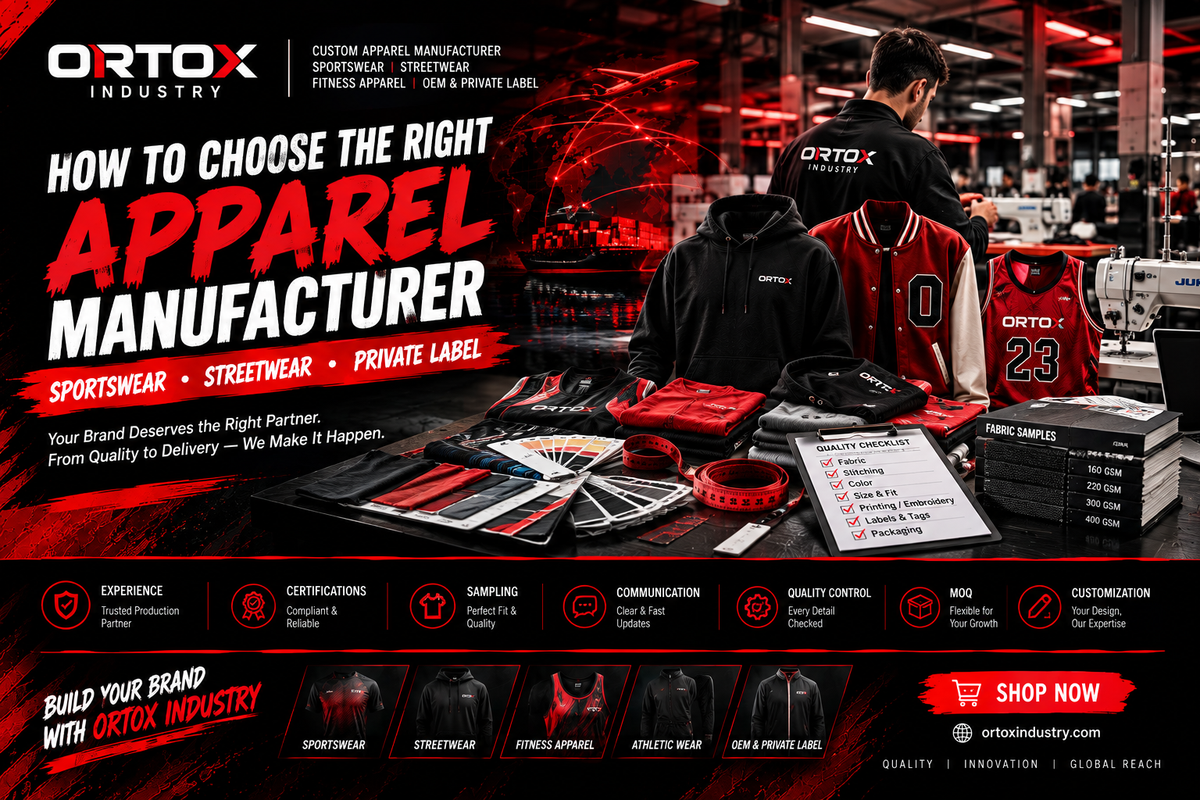
# How to Choose the Right Apparel Manufacturer for Your Brand ## A Complete Guide to Experience, Certifications, Sampling, Communication, Quality Control, MOQ & Custom Sportswear and Streetwear Manufacturing Choosing the right apparel manufacturer can be one of the most important decisions a clothing brand makes. A strong brand concept, attractive logo, professional website, and effective marketing campaign are valuable, but none of them can compensate for consistently poor product quality. If your manufacturer produces garments with incorrect measurements, inconsistent fabric, weak stitching, poor printing, late production, or unreliable communication, your customers ultimately experience those problems as part of your brand. That is why learning **how to choose a clothing manufacturer** is essential for anyone starting or growing an apparel business. This is especially important for brands operating in the **sportswear and streetwear** markets. Sportswear brands may need performance fabrics, stretch, breathability, durability, athletic fits, custom team designs, sublimation, embroidery, and functional construction. Streetwear brands may focus on heavyweight fabrics, oversized silhouettes, custom graphics, embroidery, garment finishing, premium labels, unique details, and strong brand identity. The right manufacturing partner should understand the requirements of your specific product category rather than treating every garment in exactly the same way. This guide explains how to evaluate an apparel manufacturer before placing a production order. You will learn how to evaluate: * Manufacturing experience * Sportswear experience * Streetwear experience * Certifications and compliance * Product quality * Fabric sourcing * Sampling * Communication * Minimum order quantity * Customization * Private labeling * OEM production * Quality control * Production capacity * Pricing * Packaging * Shipping * Export support * Customer service * Long-term manufacturing relationships The goal is not simply to find the cheapest factory. The goal is to find a manufacturer that can consistently produce the products your brand needs at an appropriate quality level, quantity, cost, and timeline. — # Table of Contents 1. Why Choosing the Right Apparel Manufacturer Matters 2. What Is an Apparel Manufacturer? 3. How to Choose a Clothing Manufacturer 4. Start With Your Product Requirements 5. Check Manufacturing Experience 6. Look for Sportswear Manufacturing Experience 7. Look for Streetwear Manufacturing Experience 8. Check Certifications and Compliance 9. Evaluate Product Quality 10. Ask About Fabric Selection 11. Understand Fabric GSM 12. Review Manufacturing Capabilities 13. Evaluate the Sampling Process 14. Why Sample Approval Matters 15. Check Communication 16. Evaluate Response Quality 17. Ask About MOQ 18. Understand Pricing 19. Compare Quotes Correctly 20. Evaluate Customization 21. Private Label Manufacturing 22. OEM Apparel Manufacturing 23. Quality Control 24. Production Capacity 25. Lead Times 26. Packaging 27. Shipping and Export Support 28. Questions to Ask an Apparel Manufacturer 29. Red Flags to Watch For 30. Common Mistakes When Choosing a Manufacturer 31. How to Compare Multiple Manufacturers 32. Manufacturer Evaluation Checklist 33. Choosing a Sportswear Manufacturer 34. Choosing a Streetwear Manufacturer 35. Choosing a Private Label Clothing Manufacturer 36. Choosing a Custom Clothing Manufacturer 37. Why Communication Matters 38. Building a Long-Term Manufacturing Relationship 39. Ortox Industry 40. SEO Keyword Strategy 41. Frequently Asked Questions 42. Final Checklist 43. Conclusion — # 1. Why Choosing the Right Apparel Manufacturer Matters Your manufacturer is more than a supplier. For a clothing brand, the manufacturer can influence: * Product quality * Fit * Fabric * Durability * Branding * Production consistency * Customer satisfaction * Delivery schedules * Inventory availability * Product development * Business growth Imagine launching a premium streetwear hoodie. You spend weeks developing the design. You create professional product photography. You run advertising campaigns. Customers place orders. Then they receive a hoodie with the wrong measurements, inconsistent color, loose stitching, or poor-quality printing. The customer does not blame the factory. They blame your brand. This is why manufacturing should be treated as part of your brand strategy. A similar situation can happen with sportswear. Suppose a team orders custom jerseys. The design looks excellent. However, the final garments have inconsistent sizing, incorrect player numbers, poor logo placement, or uncomfortable fabric. The problem is not simply manufacturing. It becomes a customer experience problem. Therefore, the process of **how to choose a clothing manufacturer** should begin before you request a final quotation. — # 2. What Is an Apparel Manufacturer? An apparel manufacturer is a company or production facility that produces garments for brands, retailers, distributors, teams, organizations, or other businesses. Depending on the manufacturer, services can include: * Product development * Pattern development * Fabric sourcing * Cutting * Sewing * Printing * Embroidery * Sublimation * Label manufacturing * Branding * Quality control * Packaging * Bulk production * Export * Shipping support Some manufacturers specialize in specific categories. For example: * Sportswear * Streetwear * Activewear * Fitness apparel * Workwear * Fashion wear * Team uniforms * Private-label clothing * Casualwear * Outerwear This is why the word “manufacturer” alone does not tell you whether a company is suitable for your project. You need to determine whether the manufacturer has experience with the products your brand actually wants to sell. — # 3. How to Choose a Clothing Manufacturer If you are researching **how to choose a clothing manufacturer**, start with a structured evaluation rather than choosing the first supplier you find. A practical evaluation can include these areas: ### 1. Experience How long has the manufacturer been producing apparel? ### 2. Product specialization Does the manufacturer understand your product category? ### 3. Quality Can the manufacturer consistently reproduce the required quality? ### 4. Sampling Can you receive and approve a sample before bulk production? ### 5. Communication Can the production team understand your requirements? ### 6. Customization Can they produce your desired fabric, fit, branding, artwork, and construction? ### 7. MOQ Does their minimum order quantity fit your business model? ### 8. Pricing Is the quotation appropriate for the specification? ### 9. Production capacity Can the factory handle your current and future order volume? ### 10. Quality control What checks happen before products are shipped? ### 11. Shipping Can the manufacturer support international apparel export? ### 12. Reliability Can the relationship work over multiple orders? This checklist gives you a much better basis for comparison than price alone. — # 4. Start With Your Product Requirements Before searching for an apparel manufacturer, define what you actually want to manufacture. You do not need to have every detail finalized. However, you should have a basic product direction. For example: ## Streetwear Brand You may want: * Oversized T-shirts * Heavyweight hoodies * Sweatpants * Tracksuits * Varsity jackets * Cargo-style bottoms * Graphic shirts * Embroidered hoodies ## Sportswear Brand You may want: * Performance T-shirts * Sports jerseys * Training shorts * Tracksuits * Gym wear * Activewear * Team uniforms * Performance jackets Then identify the expected requirements. For example: **Product:** Oversized hoodie **Fabric:** Heavyweight fleece **Fit:** Oversized **Branding:** Embroidery **Label:** Custom woven label **Packaging:** Individual branded packaging **Quantity:** Bulk production This gives the manufacturer something concrete to evaluate. — # 5. Check Manufacturing Experience Experience is one of the first things you should investigate when selecting a manufacturer. However, experience should be relevant. A factory may have years of experience producing basic garments but limited experience with complex performance sportswear. Another manufacturer may specialize in sports uniforms but have limited experience with premium heavyweight streetwear. Ask: * What products do you manufacture? * What markets do you serve? * Do you produce custom garments? * Do you manufacture private-label apparel? * Do you handle OEM production? * Do you produce sportswear? * Do you produce streetwear? * Can you show examples of similar products? Look for evidence that the manufacturer understands your category. The closer their experience is to your product requirements, the easier technical communication may become. — # 6. Look for Sportswear Manufacturing Experience Sportswear manufacturing can involve requirements that differ from standard fashion apparel. Sportswear can be designed for: * Running * Training * Football * Basketball * Volleyball * Rugby * Gym training * Fitness * Team sports * General athletic activity Depending on the product, manufacturers may need to understand: * Stretch * Fabric weight * Breathability * Moisture management * Seam construction * Movement * Durability * Sublimation * Performance printing * Athletic fit For a sportswear brand, ask the manufacturer whether they have experience producing similar products. For example: > Can you manufacture performance shirts with moisture-management requirements? Or: > Can you produce custom sports jerseys with sublimation and player personalization? Specific questions produce more useful answers than simply asking: > Do you make sportswear? A manufacturer that understands the technical requirements of your product can potentially make the development process more efficient. — # 7. Look for Streetwear Manufacturing Experience Streetwear has its own manufacturing requirements. A streetwear brand may care strongly about: * Oversized fit * Boxy silhouettes * Heavyweight fabric * Graphic printing * Embroidery * Custom labels * Garment finishing * Wash effects * Premium packaging * Drop-specific designs For example, a heavyweight hoodie may require a very different construction approach from a lightweight training top. When evaluating a streetwear manufacturer, ask about: * Fabric GSM * Oversized patterns * Drop-shoulder construction * Ribbing * Hood construction * Embroidery * Printing * Custom labels * Packaging * Sampling A manufacturer should be able to discuss these details rather than only provide a unit price. — # 8. Check Certifications and Compliance Certifications can be important depending on your target market, customer requirements, product category, and intended claims. However, do not assume that a manufacturer has a certification simply because it appears in a sales presentation. Ask for: * Certification name * Certificate number * Issuing organization * Validity dates * Scope of certification * Products or facilities covered Also determine whether the certification actually applies to your project. Depending on the product and market, buyers may ask about standards related to: * Factory management * Social compliance * Environmental practices * Material standards * Chemical restrictions * Product safety * Quality management The exact requirements depend on your destination market and product. A responsible buyer should verify documentation rather than relying only on logos displayed on a website. For Ortox Industry specifically, do not add certification claims to your website unless the relevant certification can be documented and verified. That is important for maintaining trust with international buyers. — # 9. Evaluate Product Quality Quality should be evaluated using measurable requirements. Instead of saying: > “I want premium quality.” Define what premium quality means for your product. For example: ### Fabric * Composition * GSM * Color * Hand feel * Stretch * Surface appearance ### Construction * Stitching * Seams * Hems * Collars * Cuffs * Pockets ### Branding * Logo * Label * Hang tag * Artwork ### Measurements * Chest * Length * Shoulder * Sleeve * Waist * Inseam ### Finishing * Loose threads * Stains * Wrinkles * Packaging The clearer the quality standard, the easier it becomes for both sides to understand what is expected. — # 10. Ask About Fabric Selection Fabric can completely change the final appearance and performance of a garment. Two T-shirts can have the same basic design but feel completely different because of their: * Composition * GSM * Knitting * Finishing * Stretch * Hand feel * Color * Construction For streetwear, a brand may prefer heavyweight cotton or a structured fabric. For sportswear, the brand may require lightweight performance material. For activewear, stretch and recovery may be important. Ask the manufacturer: * What fabrics are available? * What GSM options are available? * Can you source custom colors? * Can you provide fabric samples? * What compositions are available? * What fabric is suitable for this product? * How does the fabric behave after washing? A good manufacturing conversation should include the product’s intended use. — # 11. Understand Fabric GSM GSM means grams per square meter. It is commonly used to describe fabric weight. GSM does not automatically determine whether a fabric is good or bad. Instead, it helps communicate the desired weight and structure of a material. For example: A lightweight sports T-shirt may use a lighter fabric. A heavyweight streetwear hoodie may use a much heavier fabric. A buyer should therefore specify the expected GSM where appropriate. If a sample uses one fabric weight and bulk production uses a substantially different weight, the final garment may feel different. This is why fabric specifications should be documented before production. — # 12. Review Manufacturing Capabilities Before choosing a manufacturer, understand what they can actually produce. Ask about: * Cutting * Sewing * Printing * Embroidery * Sublimation * Heat transfer * Labels * Trims * Packaging * Quality inspection * Product development Also ask whether these services are handled internally or through external production partners. This does not automatically make one model better than another. The important issue is whether responsibilities are clear and quality remains consistent. — # 13. Evaluate the Sampling Process Sampling is one of the most important parts of apparel manufacturing. A sample gives you the opportunity to evaluate the product before committing to bulk production. During sampling, review: ### Fabric Is the material correct? ### GSM Does the fabric weight match the specification? ### Color Does it match the approved reference? ### Fit Does the garment create the intended silhouette? ### Measurements Are the key measurements correct? ### Stitching Are seams clean and secure? ### Printing Is the artwork accurate? ### Embroidery Is the logo correctly positioned? ### Labels Are branding elements correct? ### Finishing Does the garment look production-ready? Sampling is especially important for new brands because the product concept may change once you physically see and wear the garment. — # 14. Why Sample Approval Matters Never assume that a digital design automatically represents the final garment. A design file cannot fully communicate: * Fabric hand feel * Actual weight * Fit * Stitching * Construction * Comfort * Print texture * Embroidery texture A physical sample gives you a much better basis for evaluation. If changes are required, make them before bulk production. For example: > Increase body length by 2 cm. is much more useful than: > Make it fit better. Likewise: > Move the chest logo 2 cm toward the center. is more precise than: > The logo looks too far to the side. Specific feedback reduces misunderstandings. — # 15. Check Communication Communication is one of the most important parts of international manufacturing. A clothing order can contain dozens of specifications. For example, one hoodie may include requirements for: * Fabric * GSM * Color * Measurements * Hood * Ribbing * Drawcord * Logo * Embroidery * Labels * Packaging If communication is unclear, production errors become more likely. When evaluating a manufacturer, pay attention to how they respond to your questions. Do they: * Answer directly? * Ask useful questions? * Understand measurements? * Confirm specifications? * Explain limitations? * Provide realistic timelines? * Keep information organized? A manufacturer who communicates clearly during the quotation stage may be easier to work with during production. — # 16. Evaluate Response Quality Do not judge communication only by response speed. A fast answer is not necessarily a useful answer. For example: > Yes, we can make everything. does not tell you much. A stronger response may explain: * Fabric options * MOQ * Sampling * Production timeline * Decoration methods * Packaging * Shipping * Required artwork You want a manufacturing partner who can discuss the practical details of your project. — # 17. Ask About MOQ MOQ means Minimum Order Quantity. Different manufacturers may calculate MOQ differently. MOQ can depend on: * Product * Fabric * Color * Number of sizes * Printing * Embroidery * Custom trims * Packaging * Production complexity Before comparing quotations, ask: > Is your MOQ per style, per color, per size, or total order? This distinction can make a significant difference. For a startup, MOQ is particularly important. A brand may not want to purchase thousands of units before testing a product. A practical MOQ can allow a business to test products and gradually increase production. — # 18. Understand Pricing Price matters. However, price should be evaluated alongside the product specification. A quote may depend on: * Fabric * GSM * Construction * Printing * Embroidery * Labels * Packaging * Quantity * Customization * Shipping * Production complexity For example, two hoodie quotations may look different because one includes: * Heavyweight fabric * Embroidery * Custom labels * Premium packaging while the other includes: * Lightweight fabric * Basic printing * Standard labels * Simple packaging Comparing only the unit price can therefore produce misleading conclusions. — # 19. Compare Quotes Correctly When comparing apparel manufacturers, create a simple comparison sheet. | Category | Manufacturer A | Manufacturer B | Manufacturer C | | ——————— | ————– | ————– | ————– | | Product experience | | | | | Sportswear experience | | | | | Streetwear experience | | | | | MOQ | | | | | Sample process | | | | | Fabric options | | | | | Customization | | | | | Branding | | | | | Quality control | | | | | Production timeline | | | | | Packaging | | | | | Shipping support | | | | | Communication | | | | | Price | | | | This approach makes the comparison more objective. — # 20. Evaluate Customization A custom clothing manufacturer should be able to discuss how your product can be customized. Customization can involve: * Fabric * Color * GSM * Measurements * Fit * Patterns * Printing * Embroidery * Labels * Tags * Trims * Packaging The level of customization depends on your product and manufacturing requirements. For a basic product, you might only need a logo and custom label. For a premium collection, you may need a completely custom pattern and construction. — # 21. Private Label Manufacturing A private label clothing manufacturer produces apparel for a brand that sells the finished products under its own identity. Private-label services may include: * Custom neck labels * Woven labels * Care labels * Size labels * Hang tags * Custom packaging * Custom colors * Custom artwork * Custom garments For a new clothing brand, private labeling can provide greater control than simply purchasing generic garments. Instead of selling a basic blank hoodie, a brand can develop a hoodie around its own identity. That identity can include: * Fit * Fabric * Color * Logo * Labels * Packaging * Product details — # 22. OEM Apparel Manufacturing OEM stands for Original Equipment Manufacturer. In apparel, OEM production generally means the manufacturer produces a garment according to the buyer’s specifications. These specifications can include: * Technical drawings * Measurements * Fabric * GSM * Colors * Artwork * Stitching * Trims * Labels * Packaging OEM manufacturing can be useful for brands that already have detailed product concepts. For example, a sportswear brand may provide a complete technical specification for a performance shirt. The manufacturer then develops and produces the garment according to the agreed requirements. OEM and private-label services can also be used together. — # 23. Quality Control Quality control should not be treated as something that happens only after production. A strong process can include checks at different stages. ## Before Production Check: * Fabric * Colors * Measurements * Artwork * Labels * Sample * Construction ## During Production Check: * Cutting * Stitching * Measurements * Printing * Embroidery * Color * Construction ## Final Inspection Check: * Fabric * Measurements * Stitching * Printing * Embroidery * Labels * Finishing * Packaging A structured quality-control process helps reduce avoidable production problems. — # 24. Production Capacity Do not choose a manufacturer based only on whether they can produce your first order. Think about your future. Suppose your first order is 100 pieces. Six months later, your brand needs 2,000 pieces. Can the manufacturer support that growth? Ask: * What production quantities do you normally handle? * Can you scale repeat orders? * How are production schedules managed? * What happens during busy seasons? * How are repeat products reproduced consistently? Your manufacturer should ideally fit your current needs while allowing room for growth. — # 25. Lead Times Production time can vary depending on: * Product complexity * Quantity * Fabric availability * Sampling * Customization * Printing * Embroidery * Packaging * Order season Do not rely on a vague statement such as: > Production is fast. Ask for a realistic production schedule. Separate: 1. Sampling time 2. Approval time 3. Production time 4. Packaging time 5. Shipping time This gives you a clearer picture of the complete order timeline. Never promise customers a delivery date until you understand the entire manufacturing and shipping process. — # 26. Packaging Packaging is often overlooked. However, for private-label brands, packaging can be part of the product experience. Packaging may include: * Poly bags * Size stickers * Hang tags * Woven labels * Care labels * Branded bags * Cartons Ask the manufacturer: * Can packaging be customized? * Can individual garments be packed? * Can size labels be applied? * Can branded tags be included? * How are cartons prepared for export? Good packaging also helps protect garments during transportation. — # 27. Shipping and Export Support International apparel manufacturing requires more than production. After garments are completed, they need to reach the buyer. Depending on the order, shipping may involve: * Export documentation * Commercial invoices * Packing lists * Customs information * Courier arrangements * Freight * Tracking * Import requirements When evaluating a clothing manufacturer, ask whether they support international shipping. This can be particularly important for brands ordering from overseas manufacturers. A manufacturer that understands export logistics can make the overall process easier to manage. — # 28. Questions to Ask an Apparel Manufacturer Before placing an order, ask the following questions. ### Experience 1. How long have you been manufacturing apparel? 2. What products do you specialize in? 3. Do you manufacture sportswear? 4. Do you manufacture streetwear? 5. Do you offer private-label production? 6. Do you offer OEM manufacturing? ### Sampling 7. Can I order a sample? 8. How are sample changes handled? 9. Is the approved sample used as a bulk-production reference? ### Fabric 10. What fabric compositions do you offer? 11. What GSM options are available? 12. Can you provide fabric samples? 13. Can you develop custom colors? ### Customization 14. Can you create custom patterns? 15. Can you provide custom printing? 16. Can you provide embroidery? 17. Can you provide sublimation? 18. Can you manufacture custom labels? 19. Can you provide custom packaging? ### Quality 20. How do you inspect garments? 21. Do you perform final inspection? 22. How are production defects handled? 23. How do you maintain consistency between repeat orders? ### MOQ 24. What is your MOQ? 25. Is MOQ calculated per style or color? 26. Can smaller quantities be produced for testing? ### Production 27. What is the expected production timeline? 28. How do you handle repeat orders? 29. What happens if production is delayed? ### Export 30. Do you ship internationally? 31. What shipping options are available? 32. Can you provide tracking information? 33. What export documentation is provided? The answers to these questions can tell you much more than a simple price quote. — # 29. Red Flags to Watch For When researching **how to choose a clothing manufacturer**, you should also know what warning signs to look for. ## Red Flag 1: No Clear Sampling Process If a manufacturer wants bulk production without giving you an opportunity to review the product, ask why. ## Red Flag 2: Unclear Pricing If the quotation does not explain what is included, request clarification. ## Red Flag 3: No Product Details If the manufacturer does not ask about: * Fabric * Measurements * Quantity * Artwork * Branding you may need to clarify whether they understand your requirements. ## Red Flag 4: Unrealistic Promises Be careful with promises that sound too good to be true. For example: * Extremely low price * Extremely short production time * Unlimited customization * Guaranteed perfection Ask for practical details. ## Red Flag 5: Poor Communication If basic questions remain unanswered, production communication may become difficult later. ## Red Flag 6: No Quality Process Ask how products are checked. ## Red Flag 7: Unverified Certifications Never assume a certification is valid simply because its logo appears on a website. Request verifiable documentation. — # 30. Common Mistakes When Choosing a Manufacturer ## Mistake 1: Choosing Only by Price Cheap manufacturing can become expensive if the final products cannot be sold. ## Mistake 2: Skipping Samples A sample gives you an opportunity to identify problems early. ## Mistake 3: Providing Incomplete Information A manufacturer cannot accurately produce a product if important specifications are missing. ## Mistake 4: Ignoring MOQ Make sure MOQ matches your inventory strategy. ## Mistake 5: Not Asking About Quality Control Understand how the manufacturer checks production. ## Mistake 6: Ignoring Communication Good communication is essential for custom manufacturing. ## Mistake 7: Not Planning Shipping Production completion does not automatically mean the goods have reached your warehouse. ## Mistake 8: Ordering Too Much Too Soon A new brand may benefit from testing products before committing to very large quantities. — # 31. How to Compare Multiple Manufacturers Do not evaluate manufacturers based on one conversation. Create a shortlist. For example: ### Manufacturer A Strong sportswear experience. ### Manufacturer B Strong streetwear experience. ### Manufacturer C Strong private-label experience. Then compare them using the same questions. Evaluate: * Experience * Quality * Sampling * MOQ * Communication * Customization * Pricing * Production * Packaging * Export support This helps prevent emotional decisions based on a single attractive quotation. — # 32. Manufacturer Evaluation Checklist Use this checklist before choosing a production partner. ### Experience ☐ Relevant apparel experience ☐ Experience with your product category ☐ Sportswear experience if required ☐ Streetwear experience if required ☐ Private-label experience ☐ OEM experience ### Sampling ☐ Sample available ☐ Clear sample process ☐ Sample approval before bulk production ☐ Changes can be communicated clearly ### Quality ☐ Fabric specifications confirmed ☐ GSM confirmed ☐ Measurements confirmed ☐ Stitching inspected ☐ Printing inspected ☐ Embroidery inspected ☐ Final inspection completed ### Communication ☐ Questions answered clearly ☐ Specifications confirmed ☐ Timeline communicated ☐ Changes documented ### Business ☐ MOQ understood ☐ Pricing understood ☐ Payment terms understood ☐ Production timeline understood ☐ Packaging understood ☐ Shipping understood ### Compliance ☐ Relevant certifications identified ☐ Certificates verified where required ☐ Destination-market requirements understood — # 33. Choosing a Sportswear Manufacturer If your business is focused on sportswear, your manufacturer should understand athletic apparel. Look for experience with: * Jerseys * Performance shirts * Sports shorts * Tracksuits * Training wear * Gym apparel * Activewear * Team uniforms Ask about: * Breathability * Stretch * Durability * Moisture management * Seam construction * Performance fabrics * Sublimation * Player personalization Sportswear is not simply casual clothing with a sports logo. The garment needs to be developed around its intended activity. — # 34. Choosing a Streetwear Manufacturer Streetwear brands often require strong attention to appearance and brand identity. Look for manufacturing experience with: * Oversized T-shirts * Heavyweight hoodies * Sweatpants * Tracksuits * Varsity jackets * Graphic apparel * Embroidery * Custom labels Ask about: * GSM * Oversized patterns * Fabric hand feel * Printing * Embroidery * Wash effects * Labels * Packaging For streetwear, small details can strongly influence how the final product feels to the customer. — # 35. Choosing a Private Label Clothing Manufacturer If you want to sell garments under your own brand, private labeling should be part of your evaluation. Ask whether the manufacturer can provide: * Custom neck labels * Woven labels * Care labels * Size labels * Hang tags * Custom packaging Also ask whether the manufacturer can maintain branding consistency across repeat orders. A private-label brand needs more than a good-looking garment. It needs a consistent brand experience. — # 36. Choosing a Custom Clothing Manufacturer A custom clothing manufacturer should be able to work from your product requirements. Your input may be: * Sketch * Photo * Reference garment * Tech pack * Measurement chart * Artwork * Logo * Fabric specification The more technical the product, the more important clear specifications become. For simple customization, you may only need a logo and color. For full custom manufacturing, you may need detailed development. — # 37. Why Communication Matters Manufacturing is a collaborative process. Your manufacturer may need clarification about: * Measurements * Fabric * Colors * Logos * Labels * Printing * Embroidery * Packaging * Quantity You should also feel comfortable asking questions. A good manufacturing relationship should make it possible to discuss problems before they become production problems. For example: If the factory notices that a particular design detail may not work well with the selected fabric, that information should be discussed before production. This is much better than discovering the issue after the garments are finished. — # 38. Building a Long-Term Manufacturing Relationship Finding a manufacturer is only the beginning. A strong relationship can develop through repeat orders. Over time, both sides can understand: * Product standards * Preferred fabrics * Measurements * Branding * Packaging * Quality expectations * Production schedules This can make future orders easier to manage. For brands, consistency is particularly important. If customers reorder the same product, they expect it to remain consistent in: * Fit * Fabric * Color * Construction * Branding That is why choosing a manufacturer should be viewed as a long-term decision. — # 39. Ortox Industry Ortox Industry is positioned as a manufacturer and exporter serving apparel brands, wholesalers, distributors, retailers, and private-label businesses. Its manufacturing positioning includes: * Custom apparel * Sportswear * Streetwear * Fitness apparel * Athletic clothing * OEM manufacturing * Private-label production The company also presents a manufacturing approach built around custom product development, material sourcing, manufacturing, quality control, and global export support. For a brand researching **how to choose a clothing manufacturer**, these are useful areas to discuss directly with the manufacturing team. Before requesting a quotation, prepare: * Product images * Design files * Quantity * Size breakdown * Fabric requirements * Color references * Logo * Label requirements * Packaging requirements * Target market * Delivery destination This allows the manufacturer to understand the project more accurately. For sportswear brands, discuss the performance requirements of the product. For streetwear brands, discuss fabric weight, fit, graphics, embroidery, labels, and finishing. For private-label brands, discuss the complete branding package. The goal is to move from a general idea to a clear production specification. **Internal-link placement recommendation:** link the anchor text **“custom clothing manufacturer”**, **“sportswear manufacturer”**, or **“private label